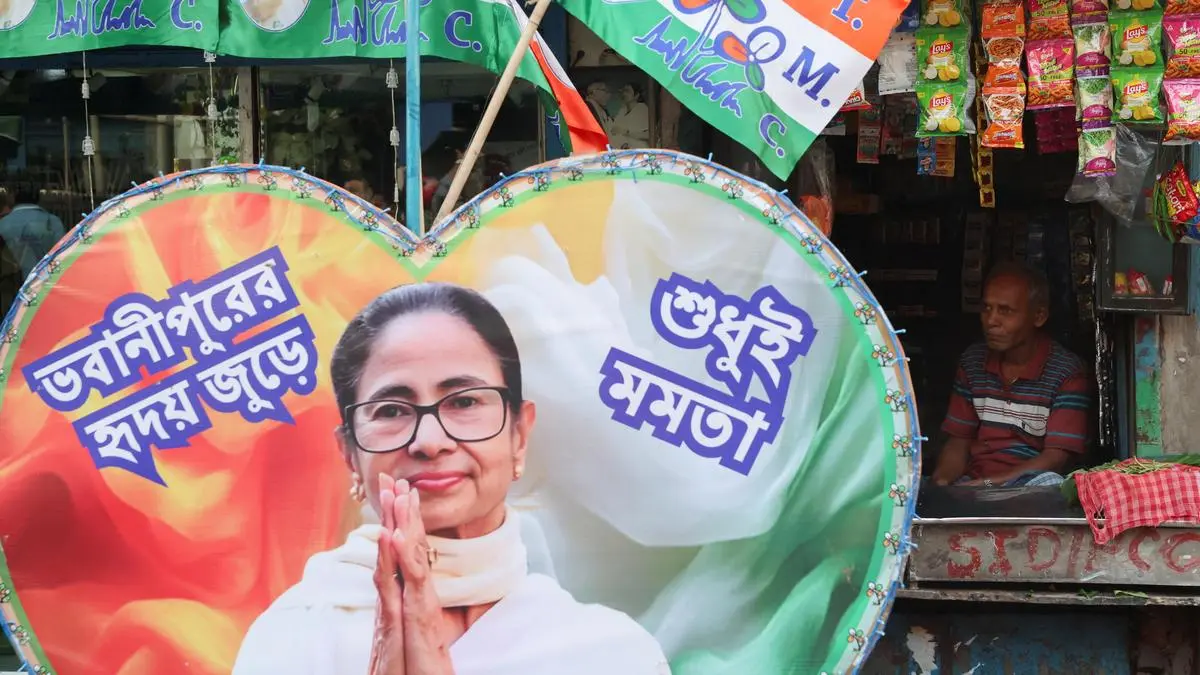






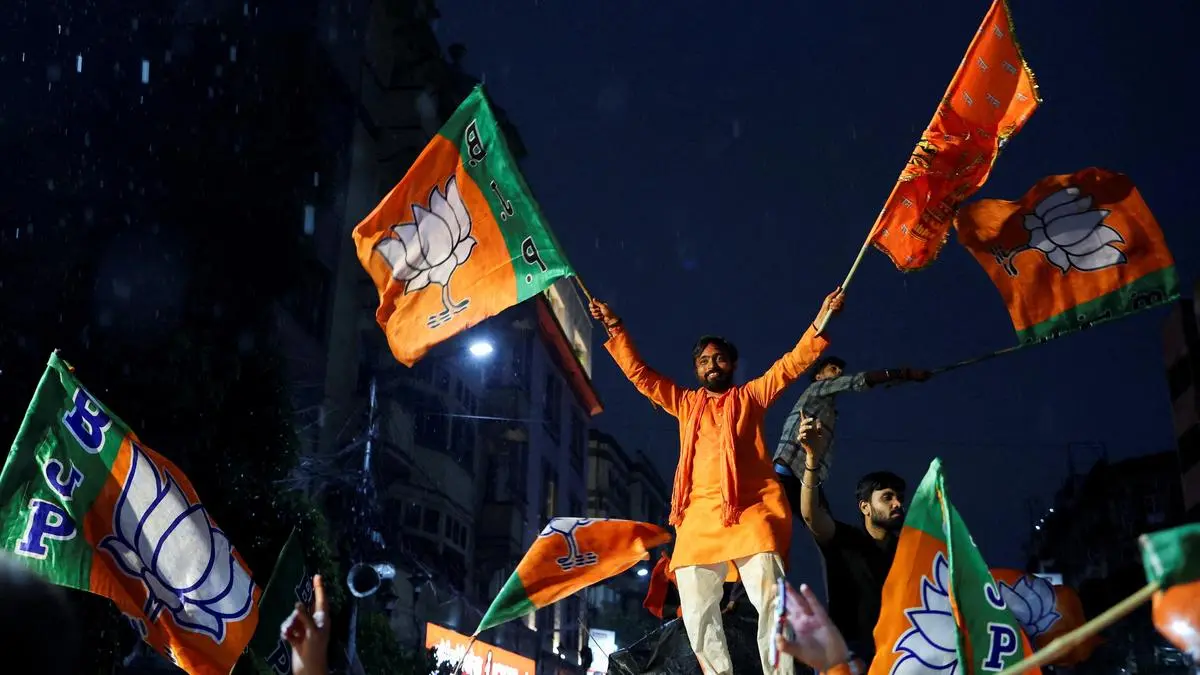
BJP supporters celebrate their party’s lead in the West Bengal Assembly election outside the party’s regional office in Kolkata on May 4, 2026.
| Photo Credit: Reuters
Democracy in India is dead. This sobering conclusion was made clear with the election results on May 4, which were not unexpected. Given the massive deletions of voters in West Bengal, several of whom were shown in fact to be citizens of standing (newspapers, etc., can’t give anecdotes of all 27 lakh voters; the electronic media is just the regime’s soundtrack), it was no surprise that in constituency after constituency, the margin of victory was less than the number of voters deleted. We have known for several years that our judiciary, which enabled the vote-theft, is both rotten and shameless.
The regime’s supporters claim that all names deleted were of infiltrators, an expectedly lazy claim by those who have for decades been clamouring for strongman rule. “India needs a dictator” has been a common middle-class mutter since I was a boy in the 1970s. This talk of infiltration is a bogie. The same people who echo talk about Bangladeshis as termites are the same people who can’t live without Bengali cooks, cleaners, or garbage collectors.
In Assam, my wife was subdued by the result. She had the impression that Chief Minister “Himanta (Biswa Sarma) had gotten too big for his boots” and had annoyed a lot of voters. Apparently, the only ones annoyed were the ones deleted by the Special Intensive Revision (SIR) of electoral lists, or worse, by the 2019 exercise of the National Register of Citizens (NRC). The rest of Assam bought into the CM’s loud and vulgar demonisation of “Miya” Muslims. What hogwash. Ever since I first visited Assam in 1988, I have been seeing headlines warning of “demographic threat” to Assam. Thirty-eight years later, the same headlines appear, though Assam seems intact.
I am not a Tamil, and despite having lived four years in Chennai in the late 2000s, I cannot say much about the youthful-faced Vijay, whose party knocked both established parties off their feet. All I have heard is that he is not even a good actor. Some friends claim that all he is interested in is “the chair” and keeping an actress as his consort (emulating earlier CMs). They predict that he will fail quickly. All that this suggests to me is that the regime will make use of him.
Ironically, the regime’s supporters are celebrating around the country at having finally won Bengal, on the same day that the alliance that India’s Great Leader pledged public allegiance to, lost. Yes, the US-Israel-UAE axis (of which India became an unofficial member in February) has lost the Iran war. US Secretary of State Marco Rubio announced on Tuesday that the combat operations of “Epic Fury” had “concluded”, while his boss President Donald Trump announced that “Project Freedom”, meant to escort ships through the Strait of Hormuz, was “paused”. This is as close as the Americans will come to admitting defeat.
This is yet another example of India’s regime’s failure at policy, governance, and diplomacy. That we upended a perfectly able foreign policy and then ended up on the losing side and isolated on the global stage is an act of incompetence that Indian history may never record again. All because of the Great Leader and his parent organisation’s stubborn anti-Muslim agenda, expanded to the world stage as some civilisational war against Muslims: a “demographic threat” on a global level.
Electoral capture
The only competence that this regime has shown has been its capture of the exercise of electoral democracy. The State election results only confirmed a trend that has come to characterise elections after 2024, when the regime was reduced to 240 seats, requiring the support of other parties to garner a majority and form the government: a naked and ruthless display of electoral theft. Haryana, Maharashtra, Bihar; one was only waiting for the result from the last opposition bastion of West Bengal.
Now it is clear. In India, democracy is dead. Not only for digging up the pitch that is the level playing field provided by elections (“one person, one vote”), but for the capture of institutions like the judiciary for predetermined outcomes. Of course, even the one-person-one-vote idea is being taken apart to the extent of creating a federal-state imbalance, with the aim of delimitation that the government recently tried to sneak in with the Trojan horse of a superfluous women’s representation bill. A new Parliament, with 50 per cent more seats, will ensure that India is dominated by the regime’s home State, UP. With Vijay now in the saddle in Tamil Nadu, one wonders if he too will be a Trojan horse for the regime’s agenda.
What can the opposition do? One can hardly take comfort in the way that the Congress leadership patted itself on the back with a win in Kerala, where the BJP is not a substantial political force—yet. Also discomfiting is the manner in which some Congress members have begun proclaiming that the entire opposition must line up behind the Congress if the regime is to be dislodged. They point to Hungary’s recent election where the formerly fragmented opposition rallied behind Peter Magyar’s Tisza Party, won in a landslide and ousted Viktor Orbán, who had been in power for 16 years. Yes, an opposition unity must begin ASAP, but it must be earnest—not the default grouping that the Congress thinks is its God-given right to lead.
One can’t see that unity happening soon. So, unless there is a global economic recession (as many in the West are predicting and which Trump is trying desperately to avoid) and the voters decide to throw the regime out, we are stuck. The smug Indian voter will embrace a non-democratic polity, while the marginalised and dispossessed will see it as business as usual.
The Indian voter only cares about showing the Muslims their place and realising Akhand Bharat. He does not care about democracy. He only wants to see his Great Leader cosplay a King. The king does not believe in democracy, only in his own righteousness. Therefore: RIP, democracy.
Aditya Sinha is a writer living on the outskirts of Delhi.
Also Read | Pahalgam’s ghosts
Also Read | All for a failed war plan