







Rahul Gandhi’s statement in Parliament—“The RSS does not allow the young to become students”—should have been a media headline the next day. TV channels should have made it their talking point. It should have made us stop and think. But most people seem to have heard it without really listening to it. Perhaps they did not understand either the truth contained in it or its significance.
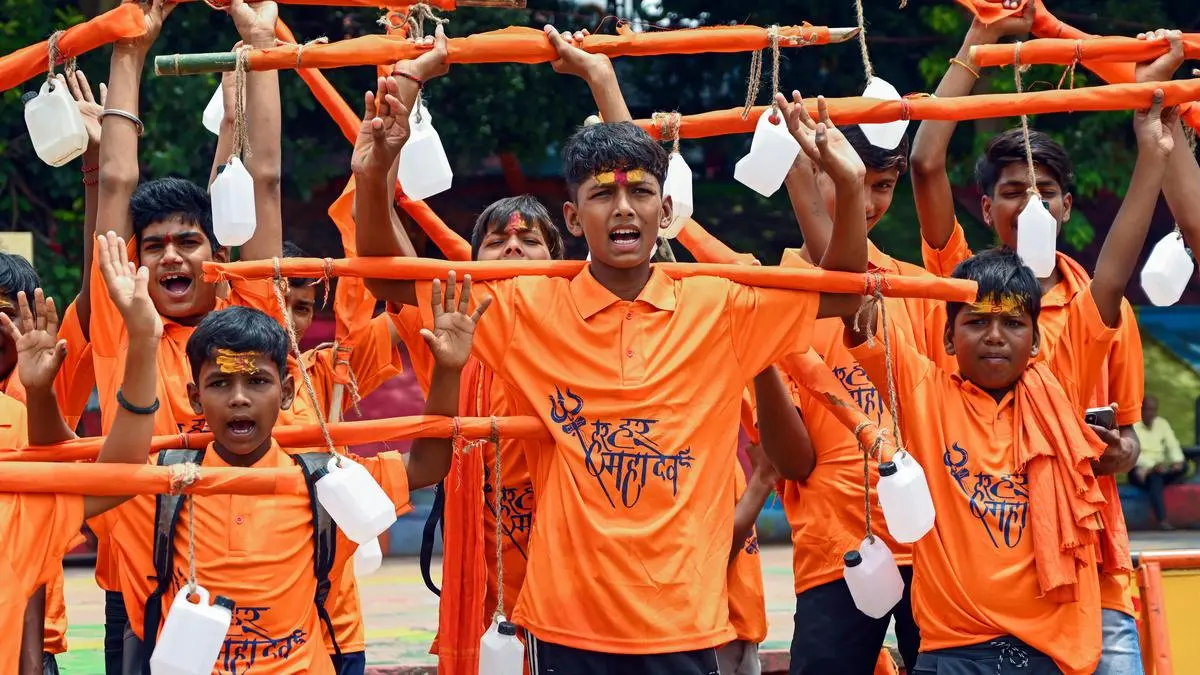
I was reminded of Rahul Gandhi’s words when I read that, because of the Kanwar Yatra, all schools, colleges, and madrasas in Meerut and Muzaffarnagar have been shut for a week, in some places for 10 days. One can say that the kanwariyas will disrupt traffic and students will find it difficult to reach their schools and colleges, and that the administration has therefore taken this step. But if this is the reason, then offices and shops should also have been closed. Are schools and colleges being shut because the administration is indirectly encouraging students and teachers to participate in the Kanwar Yatra?
One may say that this is taking the argument too far. But there is some basis for asking the question. Just four years ago, in Lakhimpur Kheri in Uttar Pradesh, schools were closed every Monday during the month of Sawan. Not only that, teachers were told that they would serve the kanwariyas in their resting camps. When there was an uproar, the administration said that the service was voluntary. But it also issued a list of the teachers who had performed it. The implication was quite clear: the names of those who had not participated had also been noted. It would be safe for them to volunteer for this holy duty.
In previous years too, schools in Meerut, Budaun, Ghaziabad, Muzaffarnagar, Bareilly, Haridwar, and Hapur have been closed for a week during the Kanwar Yatra. In a country where Friday prayers on a road are enough to bring the sky crashing down because even a half-hour interruption of traffic is supposed to bring the country’s progress to a halt, there is not even a murmur when schools and colleges remain closed for an entire week because of the kanwariyas. Education is steadily slipping down the list of society’s priorities.
Have schools become irrelevant to education?
The RSS is not demanding that schools and colleges be closed. So, in the strict legal sense, accusing it of having ordered their closure would be wrong. This is much like what happens whenever it is accused of the demolition of the Babri Masjid or of Gandhi’s assassination: its people immediately threaten to take the matter to court. But can one deny that in Uttar Pradesh and Uttarakhand it is governments led by the RSS’ political organisation that are in power? Has the morality of governance ceased to be constitutional and become the morality of the RSS? Are administrative decisions now being taken according to that morality?
Rahul Gandhi was saying that the RSS has today acquired control over almost all educational institutions. In institutions controlled by the RSS, students are not allowed to pursue their dharma. And what is this dharma? The freedom to ask questions. The freedom to express one’s thoughts. The freedom to pursue one’s interests and do what one wishes to do.
One must understand that the freedom to think on one’s own or the freedom to ask questions can only be exercised if the right of the student to know is respected. Students should have the right to access information and knowledge from all sources. It is the duty of the institutions and teachers to expose them to diverse sources of knowledge. That right is in peril today.
Over the past 12 years, slowly and steadily, people have been placed in the positions of Vice Chancellors and Directors in Central universities, educational institutions, and research institutions who are either ideologically trained in the RSS worldview or willing to work according to it. It is now common knowledge that, in the recruitment of teachers over the past decade, particular care has been taken to ensure that people of a “nationalist” orientation are appointed.
Many who had been critics of the RSS, or had never been close to it during their student years, have deliberately undergone their own process of becoming “nationalist”, because without this transformation, getting a teaching post was not possible. Such teachers, whether willingly or under compulsion, establish and propagate this nationalism in the classroom and on the campus.
Those teachers who do not do so have gradually fallen silent. Or they have learnt to speak in their classrooms with great caution. The guardians of nationalism are everywhere. They are in the classrooms too. Teachers have been suspended and removed from their jobs because “nationalists” complained against them. Even college principals and teachers have been punished because books that nationalists objected to were found in their libraries.
The classroom has now become a place of fear. Independent academic dialogue can take place there only at one’s own risk. This is no longer true merely of Delhi University or Jamia Millia Islamia. It is true of Jindal, Ashoka, and other private universities as well.
The classroom is largely governed by the curriculum. And the curriculum is now under close watch. Anything in it that is inconvenient to Hindutva nationalism cannot be allowed to remain. Questions of caste and gender, conflicts and contradictions within society, and the facts of different kinds of divisions in society are being censored. Writers and thinkers whom the RSS regards as left wing or non-nationalist are being removed.
But a campus has never been merely a classroom, nor merely a curriculum. Campuses have always given students and teachers opportunities, through activities outside the classroom, to express their creativity and exercise their independent intelligence. For the past 12 or 13 years, however, hardly any scholar or intellectual other than an RSS pracharak or someone sympathetic to its worldview has been invited to campuses. And if, by mistake, someone does get invited, they are promptly disinvited.
The consequence is that students are being deprived of the experience of diversity of intellectual resources. Yet this is not some luxury that students may or may not be granted. It is their basic right.
Participants of the 20-day training programme for college students, organised by the RSS at Kancheepuram in Tamil Nadu, took out a procession with the Saffron flag to mark the culmination of the training programme, in June, 2018.
| Photo Credit:
B. Velankanni Raj
Slowly, our educational institutions are being turned into versions of the Saraswati Shishu Mandirs run by the RSS. Studies of the pedagogy, curriculum, and daily routine of the Shishu Mandirs show how young minds are ideologically conditioned into Hindutva. The same work is carried out through RSS shakhas and its intellectual programmes. The RSS’ own educational network has long treated education as an important means of shaping the cultural and political imagination of the young; studies of its schools have documented how history and social identity can be taught in ways that make non-Hindus appear as enemies.
Long in the making
This conditioning is not accomplished in a day. It is a long process. And through this prolonged process, students gradually lose the capacity to think independently. Their minds become soft, pliable. Only some of them are fortunate enough to find an opportunity to escape from this web. It is only then that they realise what has happened to them all these years.
They were not, in the true sense, receiving an education. They were being initiated into a Hindutva idea of hatred and separation. This is the deeper meaning of Rahul Gandhi’s statement. The RSS does not have to close a school to prevent a young person from becoming a student. It only has to make the young person incapable of asking questions. It only has to make them believe that there is only one acceptable answer, one legitimate history, one nation, one culture, one way of being Indian, one way of doing science. The body of the student remains in the classroom, but the student in them slowly disappears.
I was speaking to an RSS volunteer about this. He said that in the Sangh everyone’s head is shut, and that they are terribly afraid that people might begin to think for themselves. Those whose minds are shut want to break open the heads of those whose minds are open—with lathis.
The young with an open mind are confronted with closed minds. On one side are closed heads and sticks in their hands; on the other are young people with curious minds. Who will win?
Apoorvanand teaches Hindi at Delhi University and writes literary and cultural criticism.
Also Read | Saffron scissors tears into CBSE syllabi
Also Read | Communal curriculum