









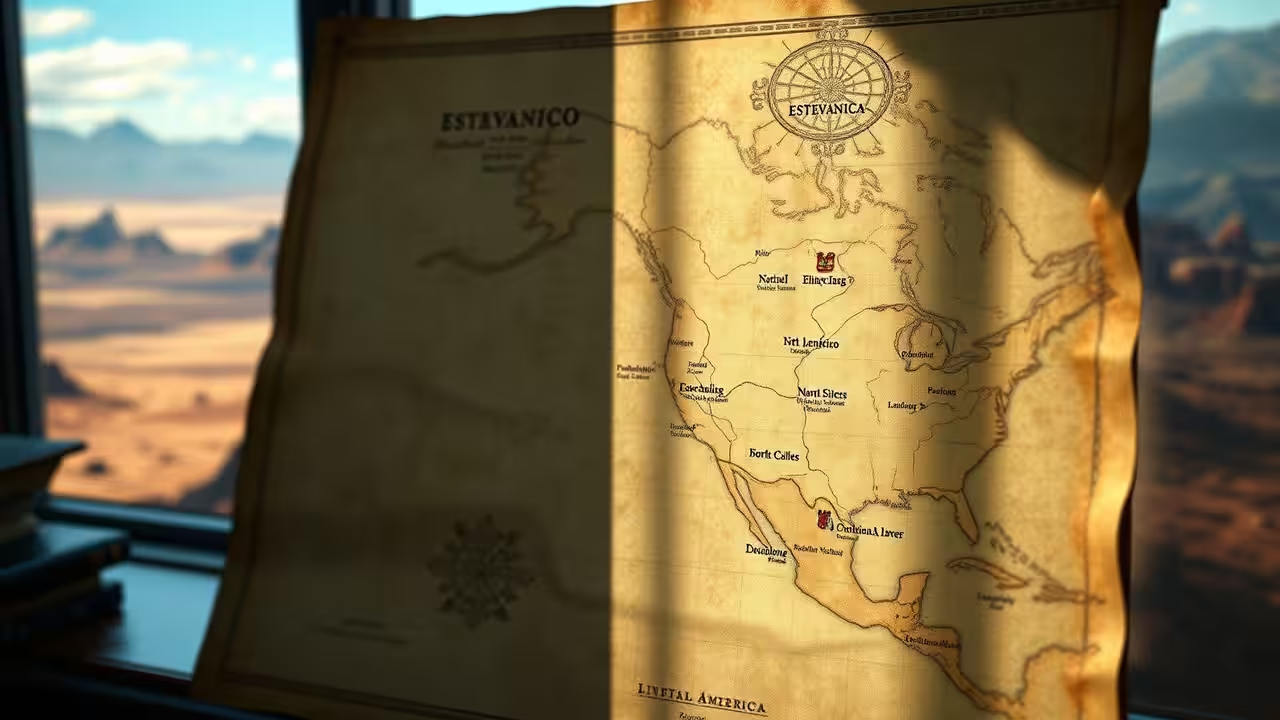
Long before English colonists ever set foot in North America, an enslaved man born in Morocco had already walked thousands of miles across it, surviving shipwrecks, years of captivity and a journey that took him through present-day Florida, Texas and deep into the Southwest. His name was Estevanico, and his story is one of the earliest and least known chapters of American history. What makes his journey so remarkable is not just the distance he covered, but how he did it, going from an enslaved outsider to a man Native communities across the region came to see as a healer and guide, at a time when almost everyone else on his expedition had already died.
Who was Estevanico and where did he come from
Estevanico was born around 1500 in Azemmour, a coastal town in Morocco, and was sold into slavery in the 1520s to a Spanish nobleman named Andrés Dorantes de Carranza. According to the Handbook of Texas, maintained by the Texas State Historical Association, he was baptised as a Christian while still in Spain, since Spanish law at the time barred non-Christians from travelling to the New World. In 1527, Estevanico joined his master aboard the Narváez expedition, a Spanish mission that set out to explore and settle Florida, becoming one of roughly 300 men who landed near present-day Tampa Bay the following year.
How the Narváez expedition fell apart
The expedition went wrong almost immediately. After marching north along Florida’s coast in search of riches that never materialised, the group found itself stranded once their support ships vanished from sight. By late summer, disease, hunger and repeated attacks had already cut the group down to under 250 survivors. Left with no way to reach their ships, the men made a desperate decision, killing their remaining horses and using the materials on hand to build five crude rafts, hoping to sail along the Gulf Coast toward Spanish territory in Mexico.
Shipwrecked and enslaved on the Texas coast
The raft carrying Estevanico, placed under the joint command of Dorantes and fellow survivor Alonso Castillo Maldonado, set sail in September 1528. After roughly a month at sea, it was wrecked near Galveston Island. Estevanico, Dorantes and Castillo were among the few men from their raft who survived, and they eventually made their way south on foot to Matagorda Bay. There, they were captured and enslaved by Coahuiltecan communities living along the coast, beginning what would turn into years of captivity.
The escape and the long walk across the Southwest
Everything changed in 1534, when Estevanico and three other survivors, including Álvar Núñez Cabeza de Vaca, who had been enslaved separately and later reunited with the group, managed to escape their captors. Together, the four men set out on foot across what is now Texas, northern Mexico and parts of the American Southwest, a journey historians estimate covered close to 2,000 miles. Along the way, they began presenting themselves as healers, and their reputation quickly spread ahead of them, with some Native communities reportedly welcoming them with genuine warmth and offering food, shelter and safe passage as they moved from one settlement to the next.
Why Estevanico became the group’s de facto guide
Of the four survivors, Estevanico appears to have taken on an especially important role. He picked up local languages quickly and often moved ahead of the main group to prepare communities for their arrival, effectively acting as a translator, negotiator and advance guide rolled into one. By the time the group finally reached Spanish territory in Sinaloa, Mexico, in July 1536, after roughly eight years since the expedition first landed in Florida, their stories of the lands and peoples they had encountered had already begun to capture the imagination of Spanish officials in Mexico City.
A fatal return expedition to find the Seven Cities
Word of rich, undiscovered civilisations to the north eventually reached Antonio de Mendoza, the Spanish Viceroy of New Spain, who commissioned a new expedition to search for the legendary Seven Cities of Cibola. Since Estevanico was seen as uniquely qualified to guide the mission, he was sent ahead of the main party in 1539, travelling with a group of Sonoran guides toward Zuni territory in what is now New Mexico. When Estevanico reached the village of Hawikuh, accounts suggest the Zuni inhabitants viewed his arrival with suspicion, and he was killed there, bringing his extraordinary journey to an abrupt end.
Why Estevanico’s story still matters today
Estevanico’s journey predates the arrival of English-speaking colonists in North America by nearly half a century, yet his story remained a footnote in most historical accounts for centuries, mentioned mainly in the writings of the Spanish companions who survived alongside him. Today, historians increasingly recognise him as one of the earliest documented figures of African descent to explore the American interior, a reminder that the history of exploration across North America includes voices and lives that mainstream accounts have long overlooked.