









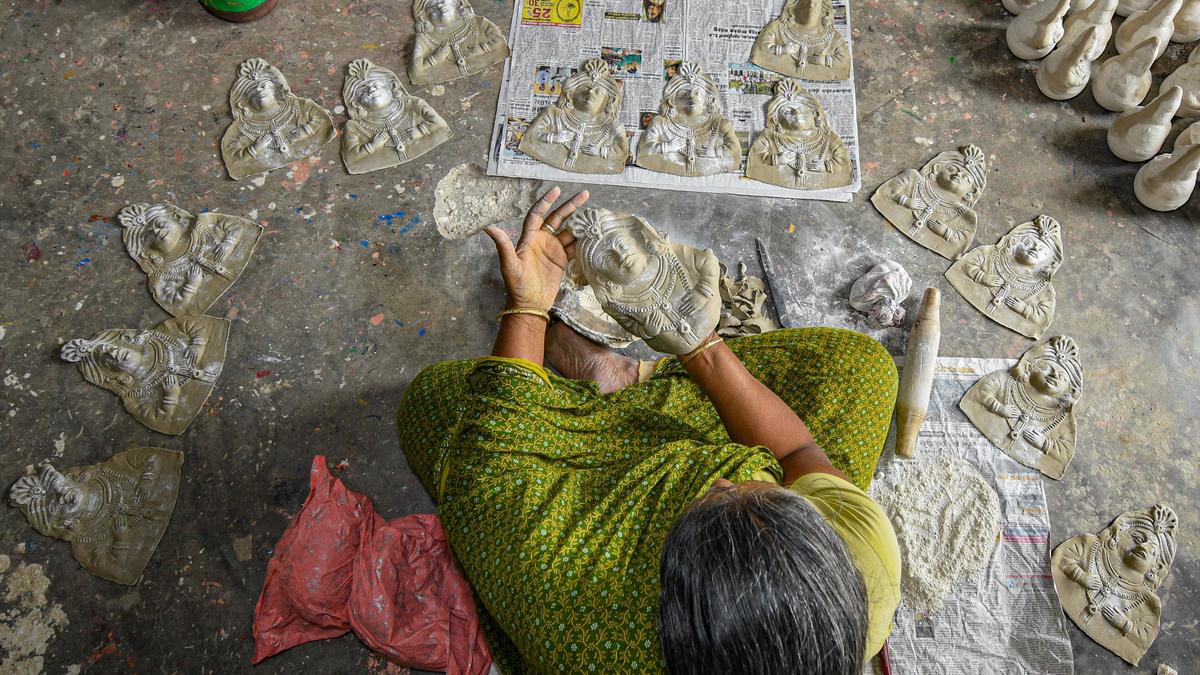
A worker creates Thanjavur doll faces using moulds. Image used for representation
| Photo Credit: R. Vengadesh
A study conducted in the five States of Tamil Nadu, West Bengal, Assam, Rajasthan, and Uttar Pradesh in the handloom and handicraft sectors found that the average monthly earnings of an estimated 61.1 lakh workers stood at a mere ₹7,000, well below the minimum wage rate. These artisans formed nearly 26% of workers engaged in manufacturing establishments.
This reflects the financial vulnerability of a majority workforce comprising family workers and other unpaid labourers. It also raises critical concerns about future patterns of fair earnings and fair trade, the study said.
Covering 33.9 lakh establishments, of which 17.8 lakh were handloom units and 16.1 lakh were handicraft units, the survey titled ‘Economics of Indian Craft’ was conducted by the Institute for Human Development for the Crafts Council of India during 2023-2024 and published recently.
A larger share of these units – 55% – are located in rural areas where handicraft is perceived as an alternative, even a fallback option in difficult times and as a source of livelihood stability when disaster strikes. The study brought to fore the fact that 45% of units were located in urban areas, suggesting new forces of change.
Women’s role
Another aspect that the study found was the significantly larger role of women as owners of units. In the perception of artisans, exhibitions have not contributed to sales and profits. The export sector, too, seems to have not touched the artisans covered in this survey.
Manufacture and sale in the sector continue to be based on the old system of a middle man-master craftsperson taking orders from buyers and then distributing the work among artisans who are provided raw material and designs. Artisans still appear to have little control over design, quality, and pricing of products, the study found.
What needs to be done
As a way forward, the study underscored the need to converge and integrate various schemes initiated by different Ministries, such as MSME, Textiles, and Culture since findings indicated low access by artisans to official schemes of assistance. It called for careful analysis by authorities and activists so that barriers are better understood and addressed.
In this context, strengthening key institutions including Weaver Service Centres, handicraft and handloom clusters, cooperatives, and self-help groups (SHGs) was crucial as these institutions played a vital role in extending the reach of government schemes to artisans and weavers.
Regular census and data collection; skill development and design innovation; building demand; market linkages, branding, and entrepreneurship; simplification of administration procedures; adoption of low-cost technology; and monitoring of government programmes were some of the suggestions from the study for a better future for the artisans.
Published – May 27, 2026 01:22 pm IST


