



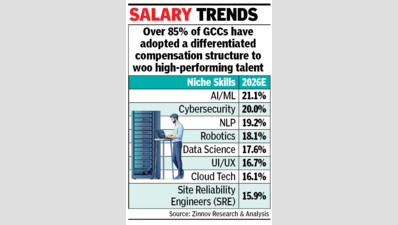
Bengaluru: In 2026, GCCs in India are paying higher salary increases than traditional IT services firms, even as compensation patterns become increasingly differentiated, driven by AI-led pay polarisation and a growing emphasis on skills.The sector is registering an average annual salary hike of 9.8%, according to a Zinnov report on compensation, attrition, and hiring trends. Hiring activity remained strong at around 27.4% annually, while average attrition stood at 16%, indicating continued employee movement across the industry.The findings suggest GCCs are maintaining a healthy pace of talent expansion, although hiring is becoming more selective. Compensation trends were significantly stronger for specific employee groups. Professionals with niche skills recorded average salary increases of 18.1%, highlighting the premium placed on specialised capabilities. High performers also received above-average rewards, with annual salary growth of around 17.2%.The hiring mix is also shifting. Lateral hiring averaged 17.8%, while fresher hiring stood at 9.6%, indicating a stronger preference for experienced talent.“Some routine functions such as testing and L1 support are becoming automated. At the same time, demand is shifting towards AI-centric roles such as prompt engineers, forward deployment engineers, AI forensic specialists, MLOps specialists and data annotators,” said Namita Adavi, partner at Zinnov.The nature of hiring itself is evolving, with GCCs increasingly building smaller, more specialised teams focused on outcomes.“There is a shift towards quad-based delivery, where small cross-functional teams come together to execute specific product sprints and then disband. AI has compressed the product development cycle significantly. Organisations increasingly want full-stack teams combining technical and functional expertise rather than only technical specialists,” Adavi said.The report said salary increases have stabilised after the volatility seen during the post-pandemic hiring surge. During 2021-22, GCCs offered aggressive salary hikes amid an intense war for talent. As attrition declined from more than 20% to 16%, job switching moderated, reducing the need for outsized retention-led salary increases and enabling more predictable compensation planning.Rather than increasing salary expenditure across the board, GCCs are reallocating spending through a “skill over seniority” approach.Nikita Goel, managing partner at Zinnov, said companies are increasingly experimenting with new reward structures, including impact bonuses, stock-based compensation, skill allowances, AI certification incentives and learning wallets.“For some AI and cloud roles, firms are even accelerating vesting schedules for stock rewards,” Goel said.Companies are also reshaping performance and promotion criteria around AI-enabled productivity and skills-based capabilities.GCCs now expect employees to demonstrate AI-enabled productivity through tools such as AI-assisted coding, workflow automation and call summarisation. High performers are increasingly viewed as force multipliers capable of delivering larger impact through technology adoption.“Low-complexity coding roles could face increasing pressure as AI-assisted development becomes more mainstream,” Goel said.Promotion decisions are moving away from experience-led models towards skills-first frameworks, where verified, in-demand capabilities such as MLOps, cybersecurity and ethical AI outweigh years of experience. Adaptability and learning agility are also gaining importance as skills become obsolete faster.Employees who lead cross-functional initiatives or internal projects, mentor colleagues and contribute to organisational resilience are increasingly being prioritised for leadership roles.Employee retention challenges also varied across categories. Voluntary attrition averaged 11.2%, while high-performer attrition reached 16.5%, underlining the continued challenge of retaining top talent in a competitive market.


