





Even as “Thalapathy” (commander) C. Joseph Vijay, movie-star-turned-politician, transitions to “Madhippukkuriya Mudalvar” (Honourable Chief Minister), nothing has changed in Tamil Nadu’s outstanding development performance or in its charter of demands of the Union.
“Thalapathy” M.K. Stalin had a clear understanding of Tamil Nadu’s key requirements and its enhanced role in national politics. So, Chief Minister Vijay should take lessons in constructive politics from Arivalayam, the Dravida Munnetra Kazhagam’s (DMK) headquarters in Chennai, instead of needling his predecessor and encouraging defections.
Apart from taking the State to unprecedented heights of inclusive growth, Stalin’s conception of Dravidian Tamizh Nadu and its vital role in de-saffronising India are without peer. Electorally defeated he has certainly been, and he has accepted his reverses with singular dignity, but his vision for the State is what needs to be persevered with.
For good governance is not about fancy new dance steps. It is about consolidating Tamil Nadu as the leading State of the Union in equitable and socially just rapid economic growth and building on a spectacular record in all spheres of human development: education, health, the vulnerable, the aged, women, children, and poverty reduction. If, instead, governance is treated as dismantling the Dravidian parties’ legacy, dark days are ahead.
Happily, in the much-contested field of secularism, Vijay has shown his mettle. He is secular through and through and there is not a fibre of compromise with communalism in his political being. That makes for an exceptional asset for the nation, as the BJP cannot make Bharat into a Hindu Rashtra without converting the very religious Tamil into a raving maniac of the “bhakt” kind.
But be warned, the BJP’s solitary seat in the Tamil Nadu Assembly is not regarded by them as rejection. It is treated as the foundation on which to clamber to power by fair means or foul, promoting hate as they did in Ayodhya. Lighting the “deepam” at Thirupparankundram in the shadow of the Sikandar dargah is being contemplated with the same frenzy that brought down the three domes of the Babri masjid.
Vijay has stood firm. The people are behind him, as is Tamil Nadu’s millennial record of not “othering the Muslim”. Yet, for both sides, this is not a one-day battle but a prolonged war. Vijay is showing the stamina for fighting it but is that grit to be seen in the hordes of defectors joining his bandwagon? Will he rein them in?
It is also worrying that Vijay has no T.R.B. Rajaa, Stalin’s Industry Minister, and no Palanivel Thiaga Rajan, Stalin’s first choice as Finance Minister, to maintain the astonishing but little-celebrated record of Tamil Nadu’s “economic growth with social justice” that Indira Gandhi aspired for the whole country.
Galloping Tamil Nadu
Tamil Nadu under Stalin became the lone horse galloping towards that goal. Consider this: the State gross domestic product (GDP) growth soared in Stalin’s last year to 11.19 per cent, outstripping the modest 7.4 per cent national average. Moreover, sustained high growth was not only built on the back of the country’s highest level of human capital, it also generated the resources for unparalleled inclusive development with revenue buoyancy fuelling massive social welfare programmes ranging from widespread education, especially for girls, to spiralling employment and income generation.
Manufacturing contributed an astonishing 13.35 per cent to national manufacturing GDP, through 40,000 factories and an industrial work force, including a huge women’s component, of a quarter crore. This was backed by strong infrastructure: reliable power, extensive road and rail connectivity, and industrial corridors, all these sustained by intensive focus on technical education and skilling (The Hindu, April 30, 2026).
Then why the stunning electoral defeat? Because young people, the bulwark of Vijay’s fandom, are politically “indifferent” and politically “illiterate”, as a reputable newspaper suggests. The “cockroach” movement shows a very politically alert Indian youth running a social media campaign that has resulted in a panic-stricken Central government cracking down on a Boston-based Instagrammer as if he were Lenin in Zurich when the Red Revolution unfolded. The DMK lost without panicking to a similar social media campaign based on “cinema augmenting reality”.
The real danger is that, as in cinema, who cares for what becomes of the hero once the lights come on? Well, for the people of Tamil Nadu, and indeed for all Indians, Chief Minister Vijay cannot carry on as if the auditorium is emptying. And, fortunately, he has inherited a legacy that merely has to be kept humming. The irony is that this is best done in partnership with the opposition DMK and its experts than the unprincipled and inexperienced opportunists piggybacking on him.
The road ahead for INDIA
For, apart from the inclusive development legacy he has inherited, there is also the agenda for future constitutional change outlined in the Justice Kurian Joseph report presented by Stalin on the last day of the previous State Assembly, which not only offers an agenda for the State in its relations with Delhi but also constitutes a manifesto for the INDIA bloc to take the mickey out of the saffron forces in the general election just a thousand days away, in 2029.
That report’s recommendations substantially enhance the federal character of our Constitution. Over the years of its own growing prosperity and striking social welfare performance, Tamil Nadu has prevailed despite being subjected to severe financial unfairness by successive central Finance Commissions.
Once linguistic/ethnic States replaced administratively convenient colonial provinces after 1956, ethnic and caste issues began to be addressed, at least constitutionally, but not the financial implications of differential development performance of linguistically constituted States.
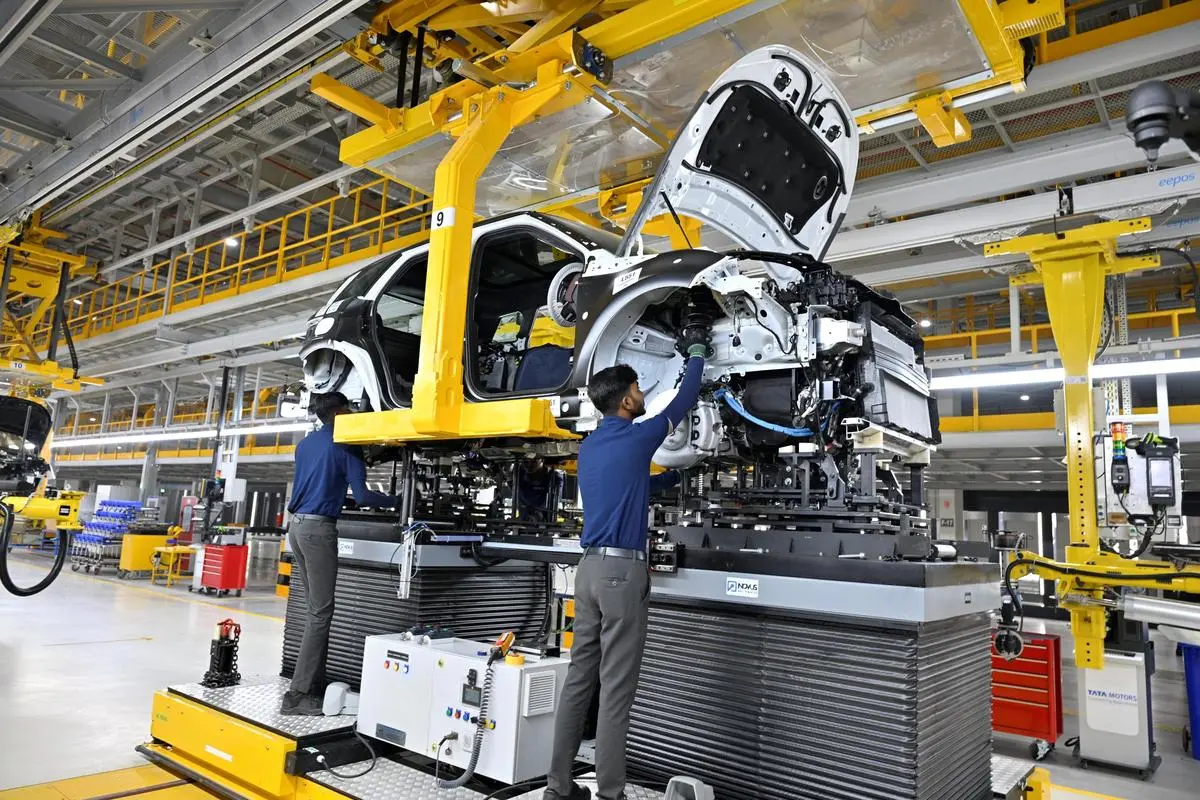
At a car manufacturing plant of Jaguar Land Rover and Tata Motors in Ranipet district on February 9, 2026.
| Photo Credit:
C. VENKATACHALAPATHY
The constitutional devolution of State functions set out in Schedule VII is totally out of sync with the constitutional device for the devolution of funds, namely, the Finance Commission, to determine the distribution of the “divisible pool of resources” vertically between the Union and the States, as also horizontally between the States themselves. And since 2014, there is no Planning Commission as an appellate court of last recourse.
Worse, Terms of Reference are unilaterally drawn up by the Union with no role for the States, not even the approval of Terms by the Inter-State Council, which too has been rendered moribund over the last 12 years.
Promoting federalism
We cannot genuinely ensure the constitutional promise of each vote carrying equal weight unless we reimagine “fiscal federalism”. Shruti Rajagopalan, a senior research fellow at George Mason University, argues quite correctly that “lower fertility means smaller populations but higher incomes and revenue generation”. Therefore, losing seat shares would result in ever declining control for States over the revenue generated by the productivity of their own people. This would be to cut one’s nose to spite one’s face.
Practical jurisprudential solutions to these and other conundrums have been set out in Justice Kurian Joseph’s report. They must engage Chief Minister Vijay’s attention. In particular, fiscal and functional devolution have to be constitutionally synchronised; work can then begin on the “double majority” principle for the constitutional amendments recommended by Justice Joseph.
The report also says that two-thirds approval in both Houses of Parliament separately would need to be reinforced by the approval of two-thirds of the nation’s population, as reflected in State Assemblies, to strengthen both “cooperative federalism” and “fiscal federalism”. This will require summitry at a high level for which an all-party Tamil Nadu front, or even an open-ended South Front, may be readied.
And if such federalism is promoted as the centrepiece of the INDIA manifesto, Stalin, Vijay, and Mamata Banerjee can be brought on board with other State leaders and Congress reinforcement to forge a common front as co-equals of INDIA.
Posing radical constitutional reform in the interest of the States will inevitably be opposed by the centralising BJP, which, in turn, will result in the BJP losing seats to regional federalists. And once political power is wrested from saffron hands, other measures of ensuring regional equity will be possible after the saffron usurper is driven out and Bharat Mata is restored to her throne.
Mani Shankar Aiyar served 26 years in the Indian Foreign Service, is a four-time MP with over two decades in Parliament, and was a Cabinet Minister from 2004 to 2009.
Also Read | How Vijay achieved a breakthrough in Tamil Nadu
Also Read | Why Modi’s delimitation exercise makes Stalin see red