




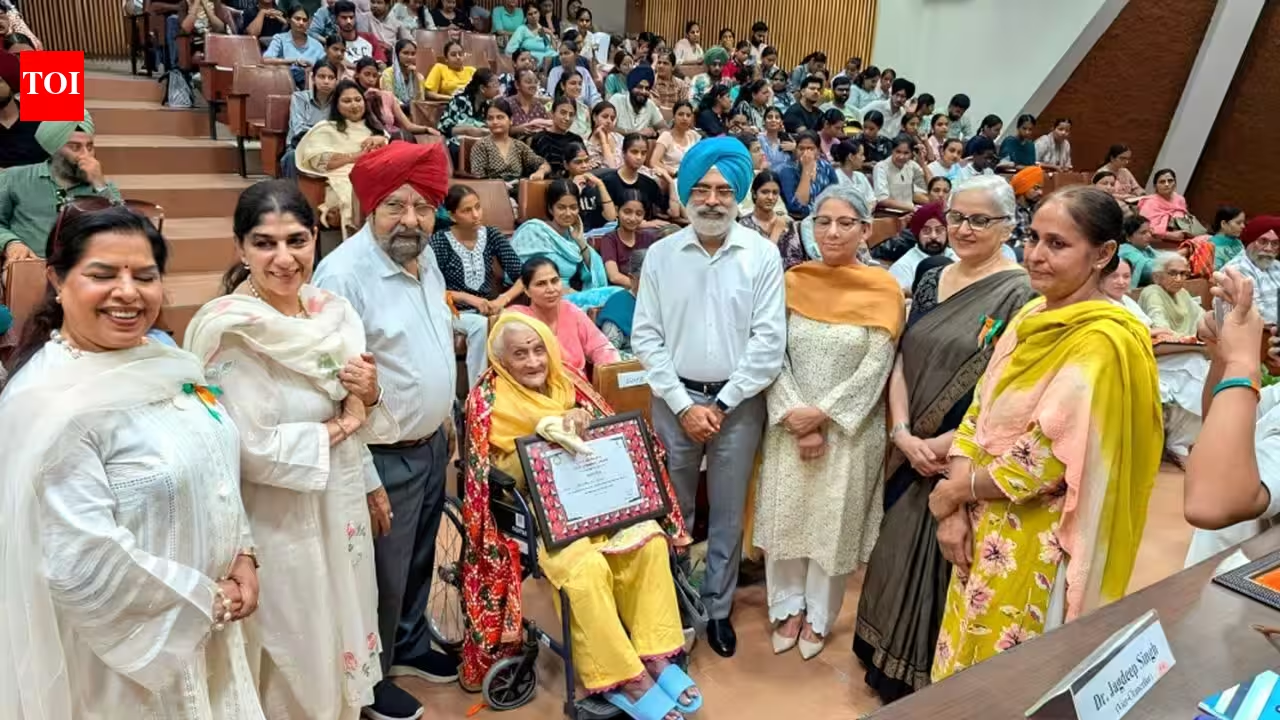
PATIALA: Nearly eight decades after the Partition redrew the map of the subcontinent and uprooted millions, women who survived the violence of 1947 gathered at Punjabi University Patiala on Friday to revisit memories of loss, displacement and extraordinary resilience.Some of the survivors, now in their nineties, sat in the audience at the university’s Science Block as their stories were narrated to a younger generation during a seminar organised by the Centre for Women’s Studies ahead of Independence Day.Titled ‘Women and the Making of Independent India: Freedom, Partition and Rehabilitation’, the seminar sought to bring women’s largely undocumented experiences of Partition into the mainstream historical narrative.Former Panjab University professor Rajesh Gill, while addressing the gathering, described the experience of women during the freedom struggle and Partition as a “double struggle.” Women, she said, participated in the movement for India’s freedom while simultaneously confronting restrictions and struggles within their own homes.She also highlighted the gendered violence suffered by women on both sides of the newly created border, much of which, she said, remained absent from official accounts of Partition.Centre director Prof Naina Sharma said the elderly survivors present at the event were “living history”. Their accounts, she said, provided a rare opportunity to understand how ordinary women rebuilt their homes and identities after being uprooted from their ancestral lands.The highlight of the programme was the screening of Vand Ton Vajood Tak (From Partition to Existence), a documentary produced by the centre in collaboration with the university’s department of journalism. It traces the journeys of Partition survivors from displacement in West Punjab to rebuilding their lives in India.Among those honoured were 97-year-old Bibi Kartar Kaur and nonagenarians Bibi Balbir Kaur, Bibi Basant Kaur and Bibi Baljinder Kaur, besides Bibi Ram Kaur, Bibi Harbans Kur, Sardar Mittha Singh, Sardar Jaswant Singh Kaulli, Bibi Saroj Bala, Bibi Tejinder Kaur and Sardar Virender Singh.One of the most harrowing testimonies came from Basant Kaur, who was a seventh-grade student when communal violence engulfed Thoa Khalsa in Rawalpindi district in March 1947.Recalling the siege, she said villagers took shelter in a newly built gurdwara after the village was set ablaze.“The military arrived at 3.15 PM. Otherwise, people were saying to kill the women. There was a well. They were saying, ‘We must not fall into the hands of the Muslims; jump into the well and die, or we will kill you. We have to protect our religion,'” Kaur recalled.She remembered desperately trying to stop her elder sister, who was holding her infant daughter, from jumping into the well.“I was pulling my sister back, ‘Sister, don’t jump yet.’ Other people were killing the women then. I would pull her, and she would go towards the well again,” she said.The arrival of the military eventually interrupted the tragedy and saved the sisters. “Because of the military, we were saved,” Kaur said, recalling how the survivors subsequently left the gurdwara barefoot and penniless.Another survivor, Balbir Kaur, recalled the uncertainty of leaving Nankana Sahib as a young girl. “Everyone kept asking, ‘If we leave all this behind, where will we even go?'” she said.Yet, she offered a perspective that went beyond the brutality of Partition, emphasising the strength of women. “I feel that women helped a great deal in facing the situation,” she said.For another survivor, the deepest wound was the sudden collapse of relationships between communities that had lived together for generations.“The greatest tragedy was how a feeling of enmity suddenly emerged among those we had been living with for ages, and how it came between us,” the survivor said. “To this day, this remains an unexplainable thing to me as to why this happened.”In his presidential address, Punjabi University vice-chancellor Jagdeep Singh said the hurried Partition of the subcontinent by the British govt had inflicted a catastrophic human cost, particularly on ordinary people. He praised women who, despite losing everything, rebuilt their lives and instilled resilience in their children.Prof Amandeep Kaur presented a report on the Centre’s oral history project, describing the survivors as the university’s “true source of inspiration”.