






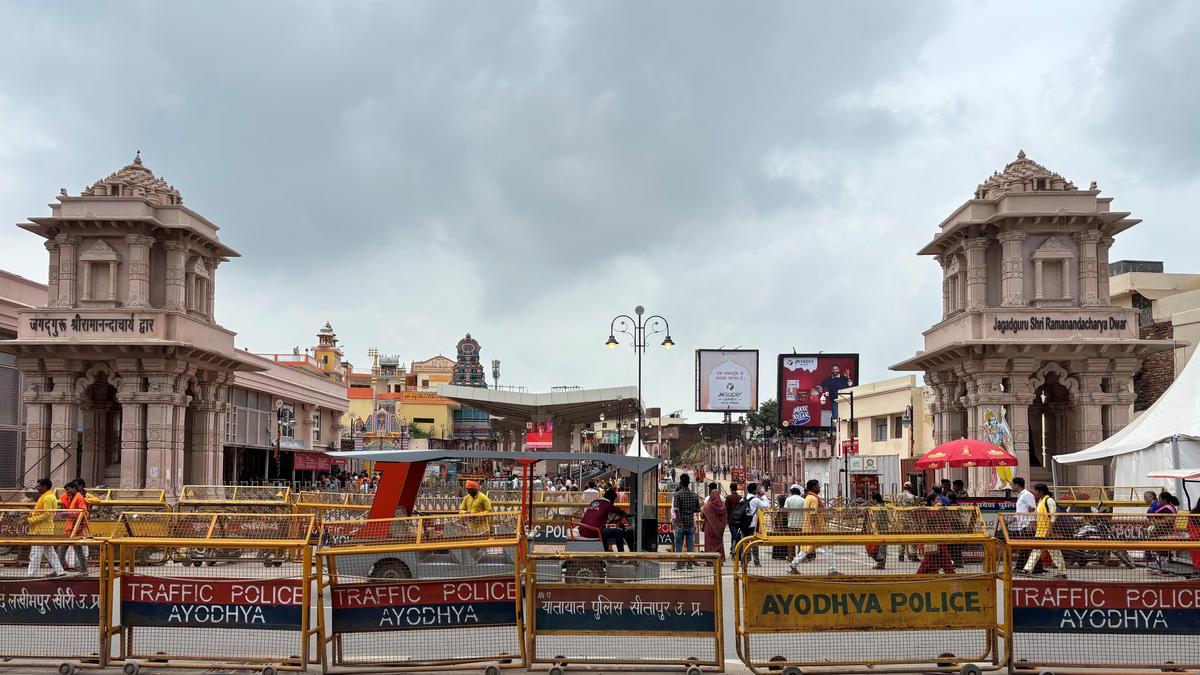
On a sultry July afternoon, with the sun playing hide-and-seek behind the 161-foot-tall spire of the Ram temple in Ayodhya, people pass through the steel crowd-control barricades that regulate entry. People from across generations and genders gather outside the Jagadguru Shri Ramanandacharya Dwar, the main entry point of the shrine, which took seven years and ₹1,900 crore to build.
They walk through the familiar ritual of passing through metal detectors, being frisked, depositing their belongings at counters in an expansive courtyard, before entering the main temple. Bare feet on warm pink stone, foreheads smeared with sandalwood and vermilion paste, folded hands and the low murmur of “Jai Shri Ram” carrying from one group of devotees to the next.
After roughly 40 minutes in this process, 67-year-old Saraswati Devi, from Mathura, reaches the sanctum. She folds her hands before the black stone idol of Ram Lalla and prays silently. As a security guard gestures for her to move on so others can take their turn, she pauses at the donation box in the hall. In her palm are a few sweat-dampened currency notes. She turns them over once, looks at them for a second or two, then slips in the smallest denomination, a 10-rupee note, withholding the rest.
Outside, she says, “The last time I came here, in October 2024 (the year the temple was consecrated), I offered (₹)1,000. I even donated (₹)2,100 for the temple construction in 2021, when they were collecting door to door,” she says, admitting that this time, “Vaja sabko pata hai (Everyone knows the reason).”
The reason she refers to is the alleged theft of cash from the counting tables of donation money that came to the temple managed by the trust Shri Ram Janmbhoomi Teerth Kshetra (SRJBTK). In May, a security guard discovered bundles of cash in a temple washroom, triggering an internal inquiry. In June, some employees were found smuggling cash out of the temple. Soon, Opposition parties took it up, with Samajwadi Party head and former Chief Minister Akhilesh Yadav calling it a multi-crore scam. The temple trust was forced to file a First Information Report.
In mid-June the Uttar Pradesh government under Chief Minister Yogi Adityanath constituted a Special Investigation Team (SIT) to fix accountability. The investigators have spent weeks analysing CCTV footage, matching surveillance records with duty rosters, entry registers, and cash-counting logs to identify possible breaches. So far, eight persons have been accused in the alleged theft, ₹80 lakh in cash has been seized, and 30 bank accounts linked to the accused have been frozen. The State Bank of India, which was overseeing transactions, is also under a shadow.
The larger fallout has been that the 15 all-male temple trust office-bearers are being held morally responsible by people. One of them is general secretary Champat Rai, a senior leader of Vishwa Hindu Parishad, who was also among the original cohort of people who had called for the making of the Ram Mandir in the late 1980s. He and trustee Anil Mishra resigned. Now, the temple is looking for a CEO, which many devotees are not in favour of.
The largest fallout though is playing out in the temple town itself. Devotees insist nothing has shaken their faith in Ram or the temple. What has been shaken is their trust in those entrusted with managing the offerings. Many like Saraswati Devi now hesitate before dropping money into the donation box. The once-crowded donation box areas are empty.
In a city that has tied its future to faith-driven tourism, the allegations have also stirred uncertainty. If the custodians have failed, several devotees say, then protecting the sanctity of Ram’s legacy and the trust it rests on, has become a responsibility they must now share.
Broken trust and shared responsibility
Sushil Vyas, 69, from Mohali, and his wife Meena Vyas, had no plans to visit Ayodhya in weather so humid an hour outdoors leaves a shirt sweat-soaked. They have visited the temple four times since construction began after the Supreme Court’s 2019 order.
The donation theft changed that.
“The donation theft has disturbed all of us. But what disturbed me more was the news on social media saying footfall at the temple had declined after the incident. I decided right away to come here with my friends, to help increase footfall in whatever way I could,” Sushil says, his wife nodding.
For Meena, a house does not stop being sacred because someone dishonest walked through its door. “I have full faith that Ram Lalla himself will make sure the truth comes out and the guilty are punished. That is not my job. My job is only to keep believing in Ram,” she adds.
Asked if the couple had made any offerings at the temple, Vyas nods: “I offered what I felt like giving. But yes, this time it took me a second to slip the money into the donation box. I asked myself if my money was going into the right hands.”
Sanjeev Bhargava, who accompanied the Vyas couple, says he feels a responsibility to make sure no non-believer gets to mock his god amid the current situation. “These Opposition parties refused to accept Lord Ram’s existence earlier. They’re so interested now that his money has been stolen,” he says, noting that Uttar Pradesh is due for Assembly polls in six months. The donation embezzlement was first brought to public notice by SP chief Akhilesh Yadav, he points out. They also say much of the hype around the alleged chanda chori (donation theft) has been the media playing it out.
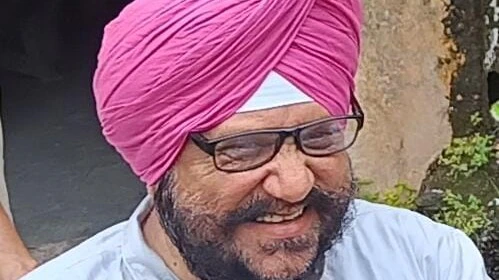
The three are sitting in Radha-Ratna, a hotel at Ayodhya’s Lata Mangeshkar Chowk between the Ram temple and the Saryu river, at a busy intersection. They have also called in Pramod Kumar Mishra, the president of the Tour Guide Welfare Association of Ayodhya, who they formed a bond with on their previous visits. “They wanted to meet my son,” Pramod says, as his wife and child play at the next table. He says Ayodhya builds relationships among believers. One member of his team of about 50 core and 300 peripheral members is there, explaining that a big part of the feeling of being deceived is because the temple’s inauguration was accompanied by so much “PR”.
In the temple and around the city

Temple entry rows, of which 4 of 5 were almost empty;
| Photo Credit:
Sunalini Mathew
Inside the temple premises, there are still crowds, but it stays confined to the sanctum sanctorum, the parks, the food distribution counters, and the shady spaces the premises offer.
Outside, at the Pilgrim Facility Centre, a hall people use to relax before or after darshan (obeisance), Rakesh Rungta, 70, a businessman from Mumbai, says he has found a better way to send his offerings: paying online, which he feels will have better accountability. The money is for “the Hindu cause”, he says, walking away after swiping his debit card. “Chori kahan nahi hoti hai? Kya masjid mein nahi hoti hai? Church mein nahi hoti hai?” (Where does theft not happen? Doesn’t it happen in mosques? In churches?), he says.
After sunset, the crowd moves towards the Saryu river for the evening’s aarti, the sound-and-light show projected against the white structures of the ancient city, street food, and revolving selfie points against heart-shaped backgrounds.
Standing at Naya Ghat, constructed as part of city’s beautification, Niranjan Das, 78, from Odisha, looks once at the river, then at the people around him. He has come to Ayodhya with 13 family members and relatives to immerse the ashes of his sister-in-law at the Sangam in Prayagraj, another holy city for the Hindus, 200 kilometres from Ram’s birthplace. Ayodhya, Prayagraj, and Varanasi are the saffron triangle that pilgrims often plan to visit together.
“Something doesn’t feel right. This temple theft case must have a clear and quick resolution. It’s very important to keep our trust intact,” Das says. Another problem with the city, he feels, is the lack of cleanliness. At Saryu Ghat, rainwater has flooded some areas; monkeys swim here to beat the heat. There is the stink of rotting flowers. The bylanes of the city are no different, with the fear of monkeys at every corner, including within the temple.
“This is how you keep your showcase city? So much dirt and filth,” he asks, comparing the civic condition of Ayodhya with Odisha.

Mahant Dinendra Das, member of Shri Ram Janmbhoomi Teerth Kshetra.
| Photo Credit:
Sunalini Mathew
For Mahant Dinendra Das, member of Shri Ram Janmbhoomi Teerth Kshetra and leader of Nirmohi Akhara, a Hindu monastic order belonging to the Ramanandi sect whose members are devoted to Lord Ram, the problem is in intention.
“They built the temple, owned it, and cut off the sadhu-sant. Look at the condition of our akharas. The old buildings of the town. There is so much to take care of,” he says, unhappy with the idea of appointing a CEO. If it all that happens, he must be from a religious community, as only seers can ensure that the trust of devotees is not shattered, he feels. He also wonders why, in a Ram temple, only two people on the trust are from a Vaishnavite sect. Lord Ram is considered an avatar of Vishnu, the preserver, among the Hindus.
City still betting on tomorrow
For Ayodhya’s residents, this chapter goes beyond political debates, institutional failures, or trust betrayal. It is about the lives they rearranged, the careers they left behind, and the faith they placed in the promise that the temple’s rise would become their own. They are careful, almost defensive, about how much of the slowdown to blame on the scandal itself.
Atul Pandey, 32, left his job as a hotel manager in 2023, months before the temple’s consecration, and bought a car on loan to run as a taxi.
For him, the alleged donation theft has put a speed breaker in his hopes for a better life. “Business had been booming until last month. Customers have dropped off now,” he says, before quickly adding that one reason is also that schools have reopened.
“Is shaher ko Sita ka shraap hai.Yahaan kabhi kuch hamesha sahi nahi hoga (This city is cursed by Sita. Nothing here will ever stay right forever),” hesays, referring to the Ramayana, where Sita, Lord Ram’s wife curses the city when she was exiled.
As he drives down Ram Path, the road broadened during the temple construction with land acquired from the shops around, he passes one entry point to Hanuman Garhi, the second-most-visited temple in Ayodhya that claims to date back to the 10th century.
Here, the lanes continue to be narrow, and the temple cramped.
Sunil Kumar Singh, in his 40s, who converted his home on Ram Path into a guesthouse anticipating growing crowds, says the uncertainty around the temple theft keeps him up some nights. Sooraj Yadav, 28, who left a job in Patiala to become a photographer at Naya Ghat, echoes the same hope for a quick resolution and a return of the crowds.
Mishra, the guide who left a bank job to become a guide when he sensed an opportunity in the town, remains unshaken by the episode. “Ayodhya has survived so many attacks in 500 years. It survived Aurangzeb, the British, and more. You think this city will fall over such a small episode?” he says, adding that he expects the town to emerge even stronger from this.
Nitin Chandra from Patna, who says he graduated with an MBA degree from IIM Kolkata and worked in corporate jobs before Ayodhya called him, shares Mishra’s thoughts. “Don’t judge Ayodhya from outside. Come, spend some days here,” he invites. He runs Radha-Ratna, the hotel where Mishra and the Mohali couple meet.
For him, since 2019, Ayodhya has seen a “disruption” for the better: wider roads, symmetrical markets, everything that is needed for a city to become a pilgrim town. This disruption is the reason the Bharatiya Janata Party was voted out of Faizabad, the constituency Ayodhya is a part of, in the Parliamentary elections in 2024, he feels. He thinks this will change soon.
Durgavati, in her late 60s, sits on a cracked wooden platform on the banks of the Saryu, selling flowers and diyas for the evening aarti. The offerings, in a leaf dona, range from ₹7 to ₹20 depending on the customer’s bargaining power. People will float these down the river, asking for blessings. Tucking some money into a purse she puts into her blouse, she offers, almost without meaning to, a summary of where Ayodhya currently stands: unsettled, but not without hope.
“Chori se man kharaab to huahai (The theft has troubled the mind),” she says. But underneath the disappointment is something steady. “I believe Ram is watching everything, even what happens behind closed doors. His devotees are waiting, and praying, and in the meantime, they’ll keep coming,” she says.