





One of the world’s fastest growing cancer populations and one of the world’s most powerful and pricey cancer drugs intersect in a story set in a modest house in Punjab.
In early 2022, a 56-year-old woman near Chandigarh began treatment for liver cancer at PGIMER, where doctors recommended Keytruda — an immunotherapy drug manufactured by US pharma major Merck & Co (MSD) that most families cannot afford at an official market price of over Rs 1.5 lakh for a 100 mg vial.
Weighed down by the burden, the patient’s family bought 12 vials between September and December that year from a local medical store at a “discount”, for approximately Rs 16 lakh. But that “small relief” turned to alarm when police from Delhi called: the drugs they had used were counterfeit — filled with antifungal medication.
This is just one among several cases at the heart of a growing black market of counterfeit Keytruda in India, an investigation by The Indian Express in association with the International Consortium of Investigative Journalists (ICIJ) has found.
The investigation is based on scrutiny of more than 12,500 pages of police and hospital records, and interviews with several hospital staff members, including oncologists. The Indian Express also investigated records of more than 150 patients across the national capital who had received the original Keytruda — and found that the batch numbers matched what investigators had seized from employees at top Delhi hospitals.
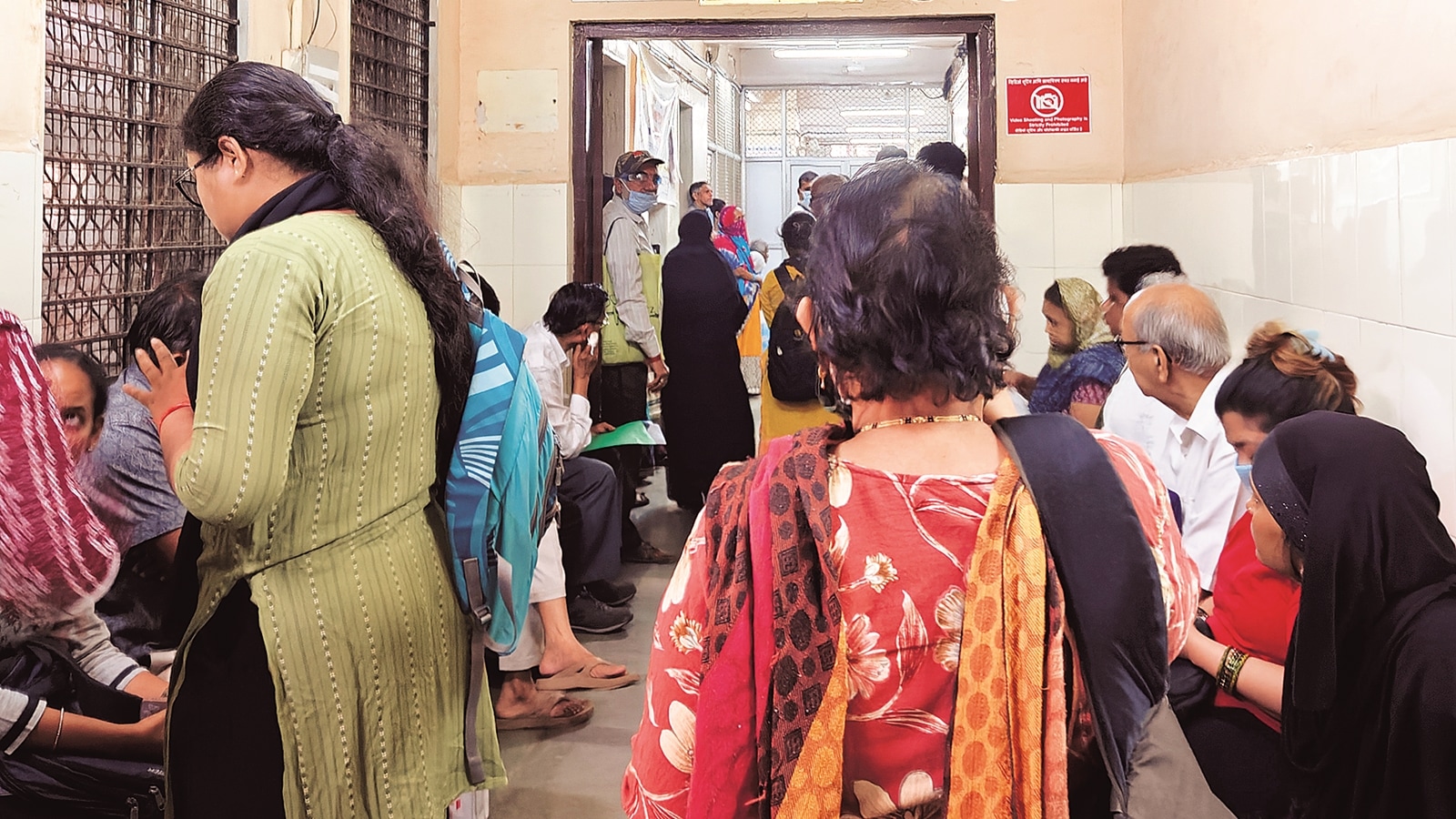 Outside the medical oncology department of Nair Hospital in Mumbai. (Express photo by Nayonika Bose)
On a global level, the ICIJ investigation reveals how one of the world’s largest drugmakers deployed tactics to inflate the volume of prescriptions and keep the price high through lobbying, while seeking to prevent cheaper versions of the drug from reaching hundreds of thousands of cancer patients — and counterfeit rackets operating from Nepal to Mexico.
In India, counterfeiting is common across medicines from antibiotics to antacids, but as The Indian Express spoke to patients who received fake Keytruda, a larger story emerged: of the grey zone between global pharma, government regulations and hospital oversight, where an unscrupulous nexus operates with impunity, selling the adulterated life-saving drug.
Story continues below this ad
Test case: Chandigarh to Delhi
The vials for the Chandigarh patient, hailing from a family of small-time farmers, arrived in temperature-controlled packaging with labelling that appeared authentic and were administered at the hospital. At no point, the family said, did the packaging raise suspicion. “We trusted what we were buying was genuine,” the patient’s granddaughter said. “One needs to understand that the financial burden of cancer treatment is immense. We are still paying interest on the loans we took. We have now stopped Keytruda, we just can’t afford it anymore.”
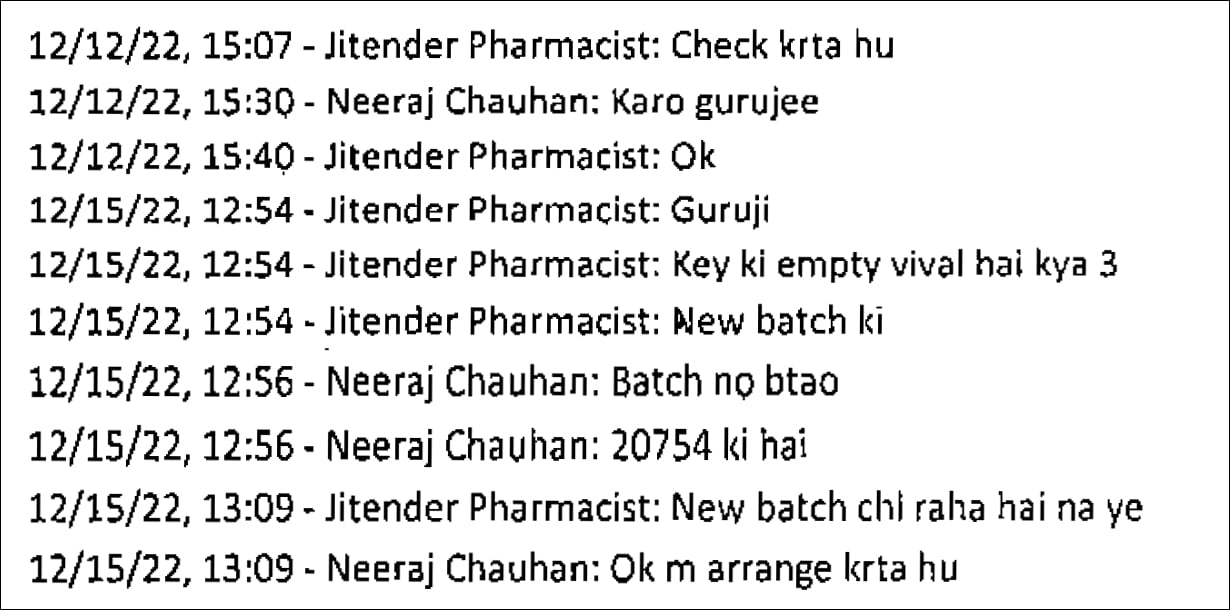 Excerpts from a purported WhatsApp chat between a supplier of fake vials and a pharmacist — both are in custody
For this patient and her family, like most others this newspaper spoke to, there was no insurer, no reimbursement scheme, no safety net. And what they didn’t know was that their Keytruda vials had been supplied to the local medical store by a “distributor” who was being tracked by the police.
By the time police contacted the family, investigators had already begun piecing together what they describe as a multi-city operation involving counterfeit versions of high-value cancer drugs, including Keytruda. The “distributor” Neeraj Chauhan (38), arrested along with 11 others, is accused of acting as a key conduit within a broader network and remains in judicial custody. Following the Delhi Police FIR, the Enforcement Directorate has initiated a case of alleged money laundering.
According to investigators, the operation relied on a sophisticated method: empty vials of Keytruda were collected, refilled with other injectable substances, often antifungal medications, and resealed for sale at amounts as low as Rs 90,000 for a 100-mg vial, a 40% cut from the market price. “Even a small discount matters,” the granddaughter said. “If something is slightly cheaper, it feels like a small relief. In the middle of all the uncertainty, you don’t question, you just trust the system.”
On March 11, 2024, police detained Chauhan in Gurugram and searched his residence. Inside a wooden cabinet, they allegedly recovered multiple vials labelled as Keytruda tied to batches X018554, X026725, X020722, and W033216: 46 filled vials, 165 unfilled vials and 239 empty packing boxes. Those batch numbers became a critical link in the probe, investigators say.
Story continues below this ad
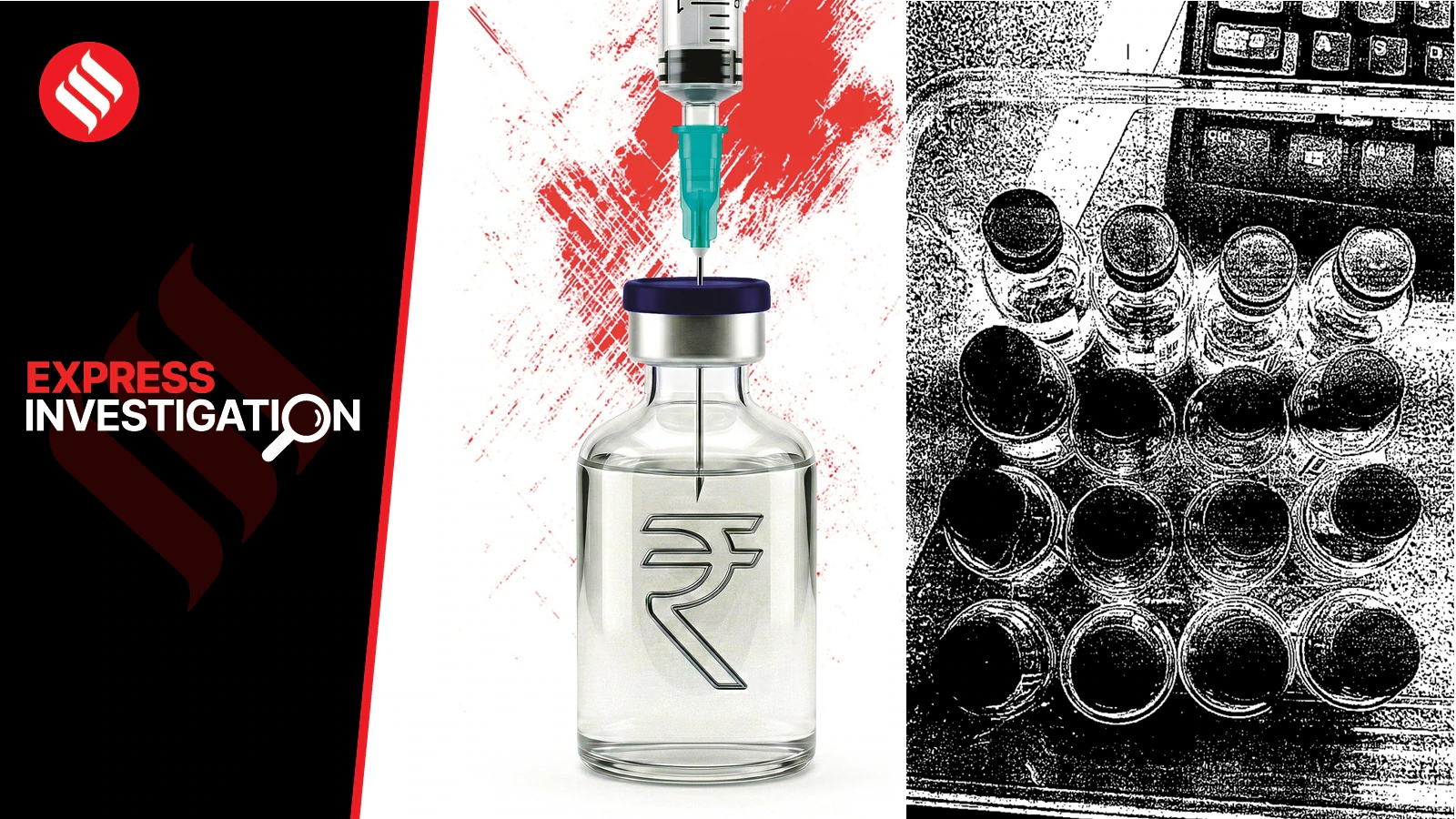
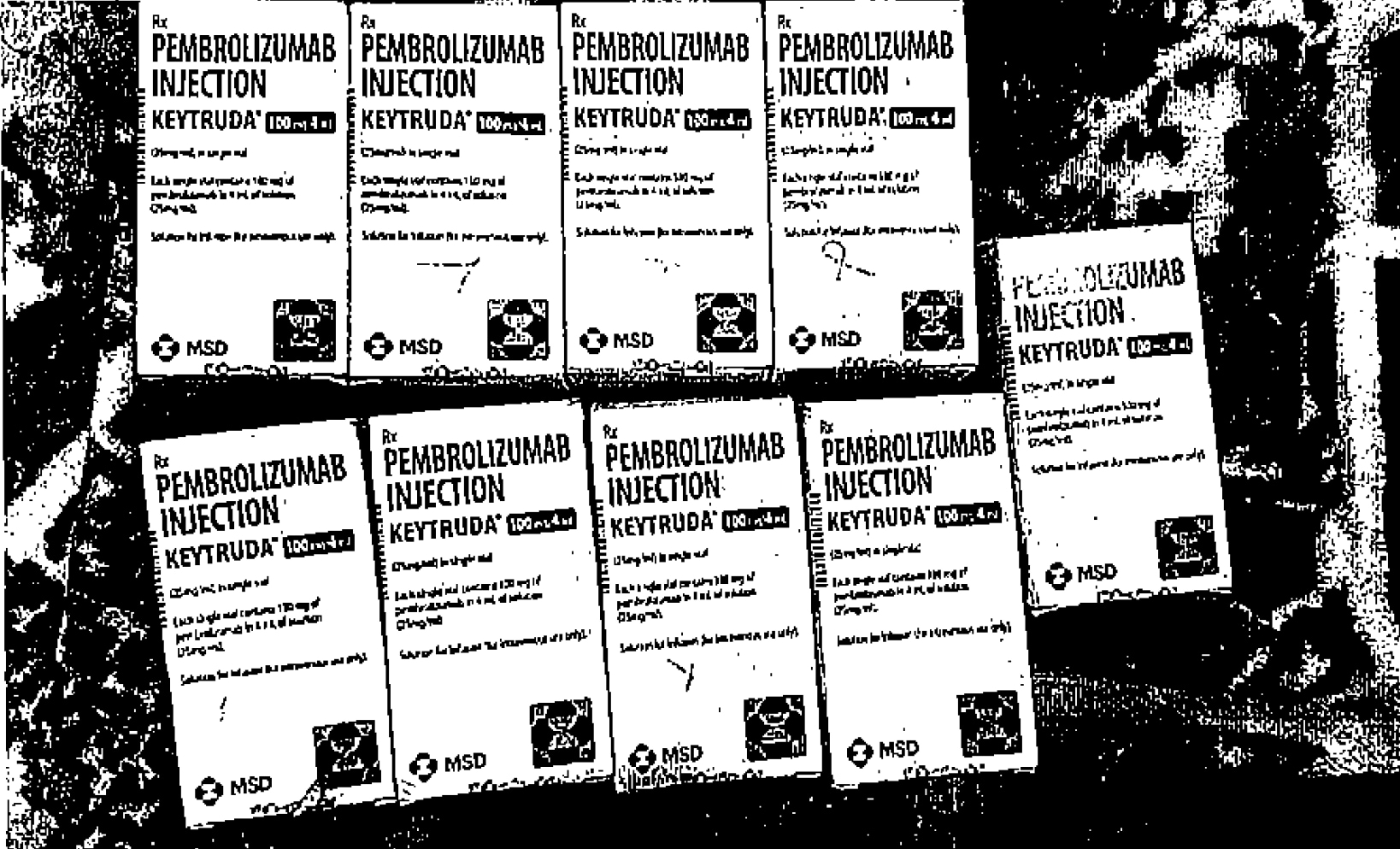 Vials of counterfeit Keytruda seized by Delhi Police.
Breach within: 2 pharmacists in top oncology dept walk out with half vials, empty boxes
The search for answers led investigators to one of India’s most respected oncology departments. On March 12, 2024, two men walked out of the cytotoxic mixing unit on the second floor of D Block at the Rajiv Gandhi Cancer Institute and Research Centre (RGCIRC) in Delhi — a pharmacy facility under constant CCTV surveillance where potent anti-cancer drugs are measured, prepared and dispensed. One carried a black and blue bag; the other, a backpack. Neither made it to the exit gate. Komal Tiwari (39) and Abhinay (30), both pharmacists at the institute’s oncology department, were stopped by officers from the Crime Branch.
Komal’s bag allegedly contained five semi-filled vials of Keytruda (100 mg/4ml) — four bearing batch number W031928 and one with batch number X018554 — along with three empty Keytruda boxes from batch W031928. Abhinay’s backpack held another five semi-filled vials: one each from batch numbers W008961, W029734, and W023257, and two from batch number X018554, along with two empty boxes bearing batch numbers W031928 and W034646.
Together, the two were allegedly carrying ten semi-filled vials of one of the world’s most expensive cancer drugs and five empty boxes, concealed in ordinary luggage, through the corridors of the hospital that had dispensed them. The items were placed in a plastic container, sealed with tape, and stamped “SS”. These are now among the most critical pieces of evidence against a 12-member syndicate. Tiwari and Abhinay have obtained bail.
 Police records indicate the semi-filled Keytruda was allegedly meant for a former colleague, Parvez (33), a key accused who remains in judicial custody. Parvez joined RGCIRC as a pharmacist and worked there until February 2022 before moving into the real estate business in Yamuna Vihar. He had known another accused, Viphil (in judicial custody now), since 2014 through a mutual contact who ran a medical store in Budh Vihar, Rohini. A month before their arrest, Komal and Parvez had opened a pharmacy shop named Doctor Pharmacy near the cancer hospital.
Story continues below this ad
Parvez was arrested in Delhi carrying a black laptop bag that allegedly contained six semi-filled vials of Keytruda — five bearing batch number X018554 and one bearing batch number W020754 — along with two empty boxes from batch W034646. In his disclosure statement, Parvez described how the operation worked.
About a year before his arrest, Viphil had proposed a plan to refill used anti-cancer injections with antifungal medicine and sell them at lower prices. “I spoke to Komal and Abhinay… They said they could easily retrieve used Keytruda from patients. I told them I would buy each empty vial for Rs 3,000. If they provided filled injections, I would buy them for Rs 40,000-50,000,” Parvez stated. “They were tempted by this and started giving me empty and filled vials. In this way, over the last 8-9 months, I bought about 10-12 filled vials and about 120-125 used vials from Komal, and about 100 empty vials and 10-12 filled injections from Abhinay.”
Nearly a month later, hospital authorities examined six months of data, from September 2023 to March 2024, to determine whether batches recovered by police matched those administered to patients. At least 84 patients had received Keytruda during this period. At least six batch numbers matched hospital usage data: W023257 for one patient, W031928 for 19, W034646 for 39, X018554 for 29, X020722 for 20 and X026725 for six.
The Indian Express found clear overlaps: batches X018554 and W034646 matched vials recovered from Parvez; W031928 and X018554 matched those from Abhinay; W008961, X018554 and W031928 corresponded to vials from Komal — all pointing to the possibility that hospital vials were being diverted and repurposed.
Story continues below this ad
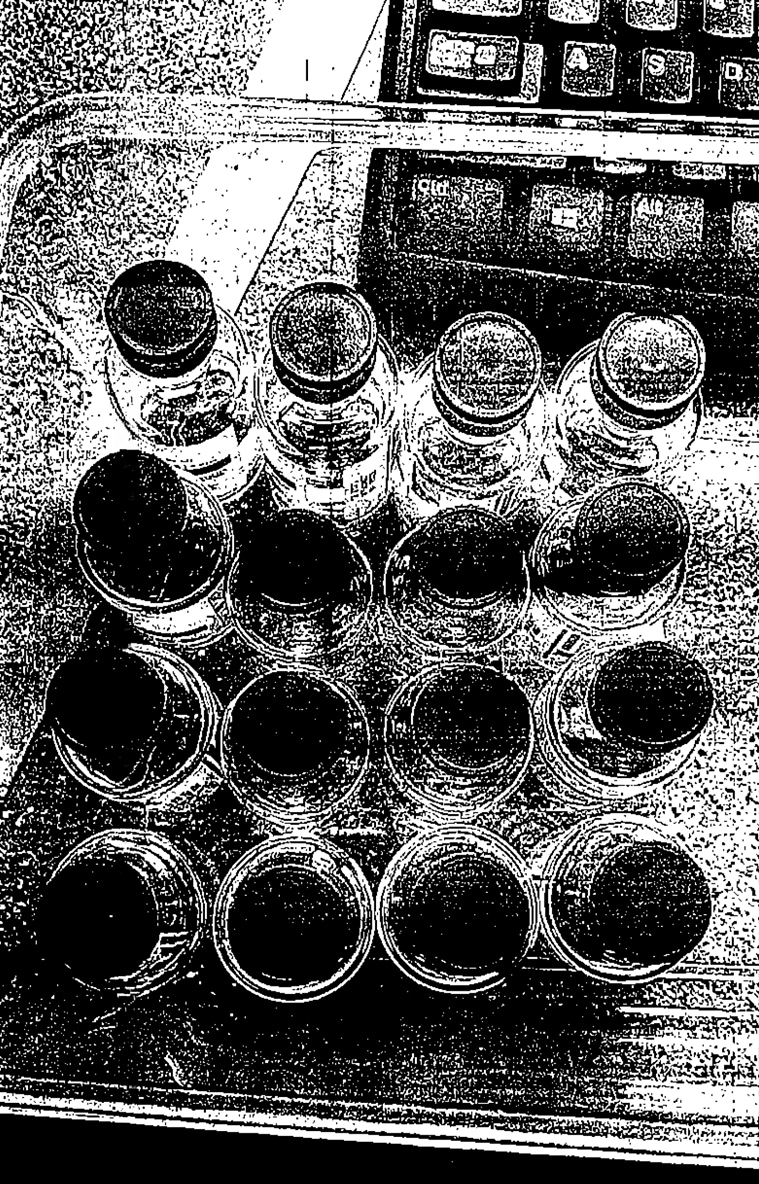 Vials of counterfeit Keytruda seized by Delhi Police.
Hospital had system to check fake drugs — how it didn’t work
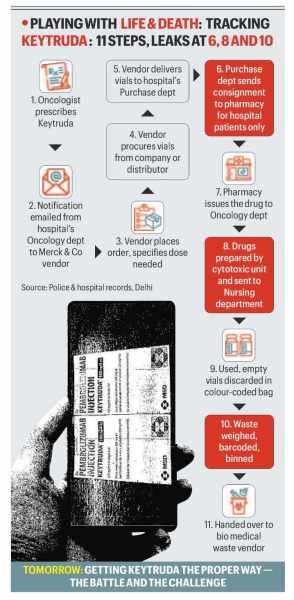
The breach occurred despite strict protocols: cancer drug mixing under CCTV surveillance, used vials discarded in marked waste bins, and biomedical waste barcoded and weighed before handover to disposal vendors. Investigators found what hospital authorities themselves described as a critical loophole — no formal process for counting disposed vials. It was not “practically feasible” to do so, the hospital told police, records show. That gap, investigators were told, created an opportunity for diversion at the point of disposal.
Responding to queries from The Indian Express, Dr Sudhir Rawal, Medical Director, RGCIRC, said the hospital has since implemented critical changes. “Expensive cancer drugs like Keytruda, which are sent for mixing, are now prepared in the presence of patient attendants. We have also installed CCTV cameras in all areas where chemotherapy drugs are mixed,” he said. “A system is in place for counting each vial and matching it with the number of prescriptions, as well as documenting the disposal of expensive cancer drugs. This process is supervised by an administrator.”
On vial disposal, Rawal said: “First, we are defacing all vial labels and destroying chemotherapy drug packaging by tearing off the top layers. Next, we have installed fully locked cytotoxic waste bins for empty expensive chemotherapy drug vials in day care units as well as in all patient wards. Finally, there is a fixed, supervised schedule for transferring cytotoxic waste to the central waste storage site. The main biomedical waste storage site is now locked at night, from 7 pm to 8 am, to restrict any unauthorised access.”
The loophole: Hospital’s nursing team leader compromised
On July 9, 2018, Rohit Singh Bisht (36) joined Venkateshwar Hospital in Dwarka as nursing team leader at its Onco Day Care unit. By April 2021, he had been promoted to in-charge — a role that placed him at the centre of the unit’s daily operations at the nursing station on the second floor of Block II. “When he became in charge, all chemotherapy medications came under his supervision,” a staff member said. Pharmacists billed patients for drugs before handing them to the nursing team Rohit led. He was responsible for ensuring cancer drugs were administered under strict monitoring and that biomedical waste protocols, particularly for chemotherapy vial disposal, were followed. “He had to make sure everything, including the handling of used vials, adhered to protocol,” the staffer said.
Story continues below this ad
On March 14, 2024, Rohit was arrested, accused of stealing vials of Keytruda from the same unit he oversaw. Out on bail now, Rohit’s alleged involvement began about a year and a half earlier when he was contacted by Neeraj. “…Then I started talking to Neeraj… he asked me to steal and provide anticancer medicines. Initially, I refused, but then the theft seemed easy, and I was tempted by the money because Neeraj offered Rs 65,000 for Keytruda. I started stealing through mixing,” he allegedly told police. Records show that roughly eight months before his arrest, Rohit had allegedly supplied about 40 injections and 10-15 empty vials to Neeraj.
Batch-level data added to suspicions. Vials from three Keytruda batches — X018554, X026725, and X020722 — allegedly recovered from Neeraj matched those used on patients at Venkateshwar Hospital: 19 patients received vials from batches X018554 and X020722 each, while 18 received vials from batch X026725.
In the aftermath, the hospital reported procedural changes to police: empty vials would be collected daily in puncture-proof containers labelled “CYTOTOXIC – FOR DISPOSAL”; patient-wise records of discarded vials would be maintained; and a designated storage area would be kept under CCTV surveillance. Besides, each container would be sealed in the presence of two witnesses — the housekeeping supervisor and the security supervisor — before handover to the authorised biomedical waste contractor. Records show the hospital also committed to maintaining detailed documentation of all collected and sealed ampoules, including dates, quantities and transfer records.
Venkateshwar Hospital did not respond to a request for comment from The Indian Express.
Story continues below this ad
The nexus: Inside hospital and beyond, pharmacist turns smuggler
On the same day Rohit was arrested, Jitender (33) was intercepted by Delhi Police while on his way to Neeraj’s residence in Gurugram, with two filled vials of Keytruda allegedly “saved” from a patient at Fortis Memorial Research Institute.
In October 2023, Jitender had joined Fortis in Gurugram as a clinical pharmacist in the Department of Hematology, Hemato-oncology, and Bone Marrow Transplant, responsible for preparing and mixing oncology drugs. On paper, he had no access to other hospital areas where chemotherapy drugs were handled. His recorded employment history began in 2011 at Apollo Pharmacy, followed by a stint at Artemis Hospital in Gurugram’s oncology department.
“I met Neeraj Chauhan…in late 2022 during an interview, and since then, I have been in contact with him,” Jitender allegedly told police, records show. “He told me to give him the empty vials and packaging material of Keytruda injections after patients used them, and in return, he would give me Rs 5,000 for each empty Vial Set. He also offered 40% of the market rate for any filled injection that I could provide.” He further stated: “Over the past ten months, I have supplied Neeraj with approximately 15-16 of the above-mentioned filled injections and about 15-20 empty vials of the above-mentioned injections.” Jitender is out on bail.
WhatsApp chats seized from devices form a central pillar of evidence in Jitender’s case, used to reconstruct communication patterns between hospital staff and alleged members of a procurement network. A scrutiny of purported exchanges between Jitender and Neeraj shows repeated discussions around demand, sourcing and arrangement of Keytruda materials, including references to “empty vials”, “complete” units, caps, seals and specific batches. An excerpt:
Story continues below this ad
Neeraj Chauhan: “Beech me kuch keytruda ka bol rahe the… Kya hua uska” (You were talking about some Keytruda in between… What happened to that?)
Jitender: “Hai kya demand” (Is there a demand?)
Chauhan: “Yes”
Jitender: “Check krta hu” (I’ll check)
Further chats reveal the granular, batch-level coordination of the alleged operation. An excerpt:
Jitender: “New batch ki” (Of the new batch)
Chauhan: “Batch no btao” (Tell me the batch number)
Chauhan: “20754 ki hai” (I have of 20754)
Jitender: “New batch chi raha hai na ye” (This is the new batch, right?)
Chauhan: “Ok m arrange krta hu” (Ok, I’ll arrange it)
Jitender: “Pir krta hu kuch jugad” (Then I’ll make some arrangement)
Responding to queries from The Indian Express, a Fortis spokesperson said the institute “follows stringent protocols for the procurement, handling, and administration of oncology drugs, with robust controls and multi-level verification at each stage”.
According to the spokesperson, CCTV surveillance and monitoring are in place “across critical areas to ensure oversight and accountability”. “Disposal of used vials is carried out strictly in accordance with biomedical waste management guidelines through authorised agencies, as per established protocols. These systems are periodically reviewed and further reinforced with additional safeguards and enhanced monitoring,” the spokesperson said.
Asked about the investigation’s key takeaway, Devesh Chandra Srivastva, Special Commissioner of Police (Crime & Perception Management and Media Cell), told The Indian Express: “This was an important investigation, as it directly concerns safety of critical patients. The probe has exposed how vulnerable patients, often in search of affordable options, are at risk of being duped into purchasing counterfeit medicines through informal channels. There is an urgent need to protect these patients. We are also continuing to track whether more such syndicates are exploiting them.”
After death, the call
For patients desperate for a cure but without access to drugs such as Keytruda, the arrests and seizures offer little comfort. In January 2022, a 38-year-old housewife from Khajauli in Bihar noticed a neck swelling, persistent cough, pain and unexplained weight loss. By March, she could barely swallow.
Local doctors found no answers, so her family travelled to Delhi’s Rajiv Gandhi Cancer Institute, where she was diagnosed with metastatic carcinoma inside the cheeks and lips. After four chemotherapy cycles, the financial strain forced them to shift to Buddha Cancer Centre in Patna. Unable to afford the market price for Keytruda, they purchased two injections through an e-commerce site at a “discount” of Rs 90,000 each. Following the second injection, her condition rapidly deteriorated. On September 11, 2022, she died, leaving her family to blame fate for the loss.
Nearly two years later, on April 17, 2024, they got a call. It was the Delhi Police.