









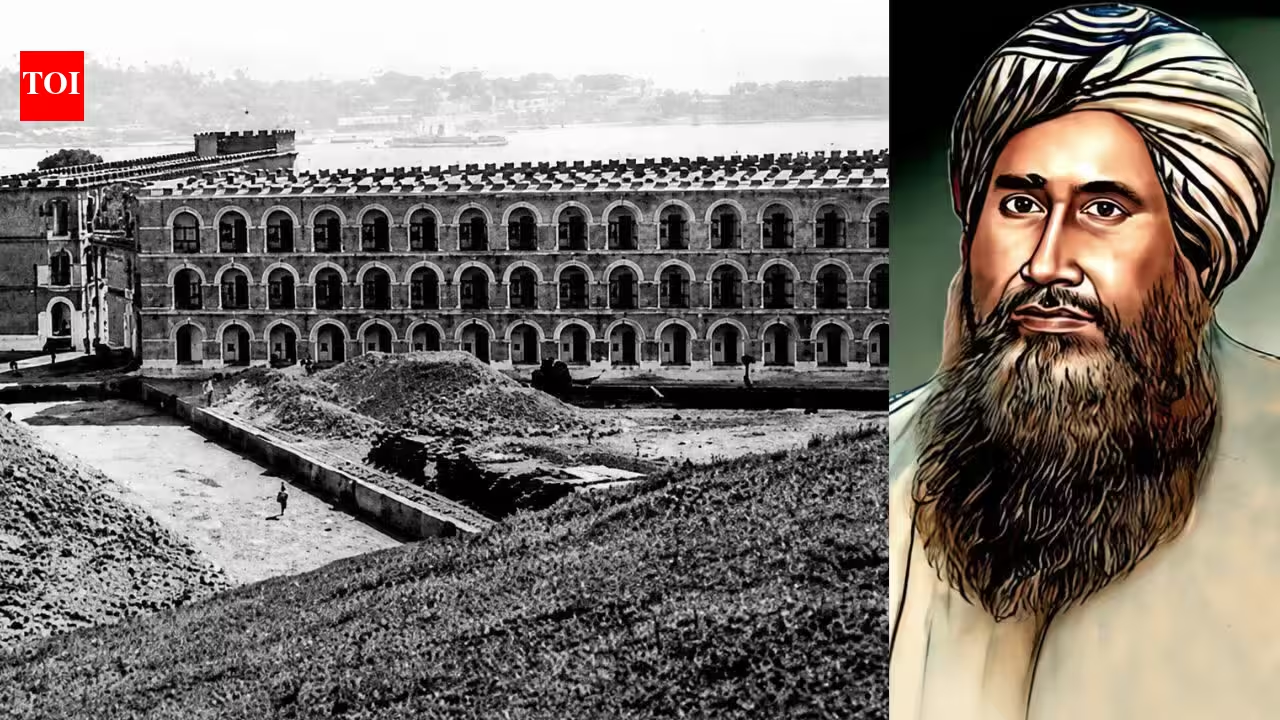
HYDERABAD: The British not only crushed the First War of Independence in Hyderabad in July 1857 but also insisted on collecting income tax from one of its principal leaders decades later.Recently digitised archival records reveal that Moulvi Syed Alauddin, who led the armed attack on the British Residency in Hyderabad on July 17, 1857, and was sentenced to transportation for life to the Andamans in 1859, was released after spending 26 years in prison. However, his release came with a condition: he had to spend the rest of his life in the Andamans.
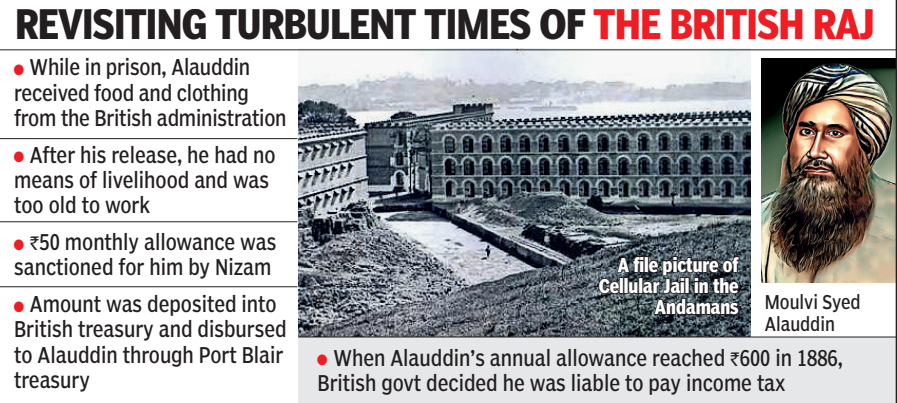
While in prison, Alauddin received food and clothing from the British administration. After his release, however, he had no means of livelihood and was too old to work. At the British govt’s request, the Nizam of Hyderabad sanctioned him a monthly allowance of Rs 50. The amount was deposited into the British treasury and disbursed to Alauddin through the treasury at Port Blair.Ironically, when his annual allowance reached 600 in 1886 — exceeding the income tax exemption threshold of Rs 500 under the Income Tax Act of 1886 — the British decided the freedom fighter was liable to pay income tax.The issue first surfaced in August 1886 when the Department of Finance and Commerce sought clarification on the taxability of the allowance after the Comptroller of India Treasuries, in a letter dated July 26, 1886, raised the question.“A question has now been raised as to whether this allowance should be liable to income tax or not. The Chief Commissioner, Andamans, recommends exemption,” the Comptroller wrote, describing the matter as “a novel one” with no precedent.The Finance Department took a firm view. In a note dated August 2, 1886, its secretary observed that the allowance was “clearly taxable” and that there appeared to be “no sufficient reason” to grant an exemption. The department nevertheless referred the matter to the Foreign Department for its opinion.“It is a curious fact of a life convict being in receipt of a regular income,” one official remarked.The Superintendent of Port Blair, however, argued that the Income Tax Act of 1886 did not contemplate taxing an allowance paid by a native state to support one of its subjects imprisoned in British India. The debate ended on August 16, 1886, when the Foreign Department ruled that the allowance was taxable.“If money paid by Native States to persons resident in British territory is taxable under any circumstances, I see no reason to exempt this allowance,” the department noted, while adding, “But I doubt the principle.”.