




Last Updated:
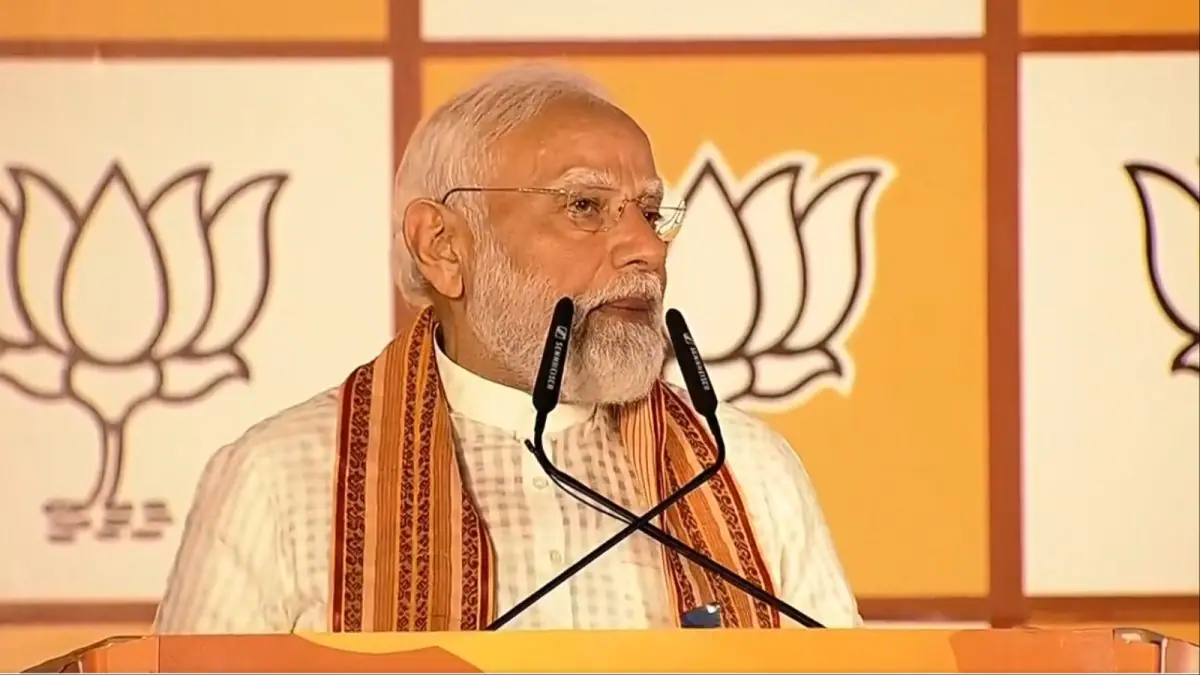
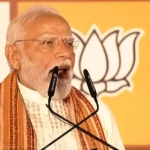
PM Narendra Modi arrived wearing a dhoti — white, crisp, unmistakably Bengali — as the party’s Bengal campaign anthem “Paltano Dorkar Chai BJP Sarkar” played in the background.




The dhoti is common in states like West Bengal, Bihar, and Uttar Pradesh — a long, unstitched cloth, typically white or off-white, wrapped around the waist and legs and tied in a knot.
When Prime Minister Narendra Modi walked into BJP headquarters in New Delhi on the evening of May 4, he wasn’t wearing a suit, or his signature kurta-jacket. He arrived wearing a dhoti — white, crisp, unmistakably Bengali — as the party’s Bengal campaign anthem “Paltano Dorkar Chai BJP Sarkar” played in the background. No words were needed. The garment said everything: Bengal had been won, and Modi was saluting it in its own language.
It was a moment that felt less like politics and more like poetry.
What Was The Song Playing When Modi Walked In?
The choice of soundtrack was as deliberate as the attire. Modi arrived to BJP’s Bengal campaign theme song “Paltano Dorkar Chai BJP Sarkar” — a Bengali phrase that translates to “We need a change, we need a BJP government.”
The song had been BJP’s rallying cry across Bengal’s constituencies for weeks. Hearing it echo through BJP headquarters in New Delhi on victory night, with Modi walking in draped in a Bengali dhoti, was a moment that collapsed the distance between Delhi and Kolkata into a single, charged image.
What Exactly Is A Bengali Dhoti — And What Makes It Special?
For men, the staple of Bengali traditional clothes is the dhoti — an unstitched piece of cloth elegantly draped around the lower body, typically paired with a Panjabi, the regional term for a kurta.
Unlike its counterparts elsewhere in India, the Bengali dhoti has a distinct draping style — precise pleating that allows ease of movement, worn at everything from agricultural work to religious rituals.
The dhoti is common in states like West Bengal, Bihar, and Uttar Pradesh — a long, unstitched cloth, typically white or off-white, wrapped around the waist and legs and tied in a knot.
The finest Bengali dhotis are woven from tant — a lightweight, breathable cotton that Bengal’s weavers have crafted for centuries.
Suited to the hot and humid climate of West Bengal, tant is amongst the most favoured fabrics, designed for everyday use, distinguished by its light and airy feel.
For special occasions, dhotis are woven from Bengal muslin — once the most prized textile in the world. Banglar Muslin was recognised as a Geographical Indication product of West Bengal in 2024, a heritage that Modi’s choice of garment quietly honoured.
Is This The First Time Modi Has Done This?
Not at all — it’s a pattern as deliberate as it is elegant. Modi has often opted for regional attire as a mark of cultural acknowledgment during state visits.
During campaigning for the 2026 Kerala elections, he arrived in Palakkad in a crisp white mundu with a simple kurta, draping a kasavu stole with golden edging over his shoulders — and then stepped up to play the chenda, Kerala’s traditional percussion instrument.
When he welcomed Chinese President Xi Jinping in Tamil Nadu’s Mahabalipuram, he wore a traditional veshti and a round-neck half sleeve shirt — the classic Tamil men’s formal wear. The dhoti in Delhi today was simply the Bengal chapter of a long, unspoken sartorial tradition.
Why Does This Gesture Matter So Much In Bengal?
In Bengal, the dhoti-panjabi is not just clothing — it is cultural identity. It is what a Bengali man wears to Durga Puja, to a wedding, to a temple.
For decades, the BJP’s critics argued that it was a north Indian, outsider party that could never truly understand Bengal’s soul.
Amit Shah had addressed this head-on during campaigning, assuring voters that the next Chief Minister of Bengal would be born in Bengal, educated in Bengali medium, and would speak Bengali.
Modi’s dhoti on victory day was the visual completion of that promise — a Prime Minister from Gujarat, standing in Delhi, wrapped in Bengal’s most intimate tradition. It was a bow, not a boast.
What Has Modi Said About Bengal’s Cultural Legacy?
Modi posted on X: “The 2026 West Bengal Assembly Elections will be remembered forever. People’s power has prevailed and BJP’s politics of good governance has triumphed. I bow to each and every person of West Bengal.”
The words “I bow” take on an entirely different weight when the man saying them is standing in a Bengali dhoti. It wasn’t ceremony — it was reverence.
Read More