


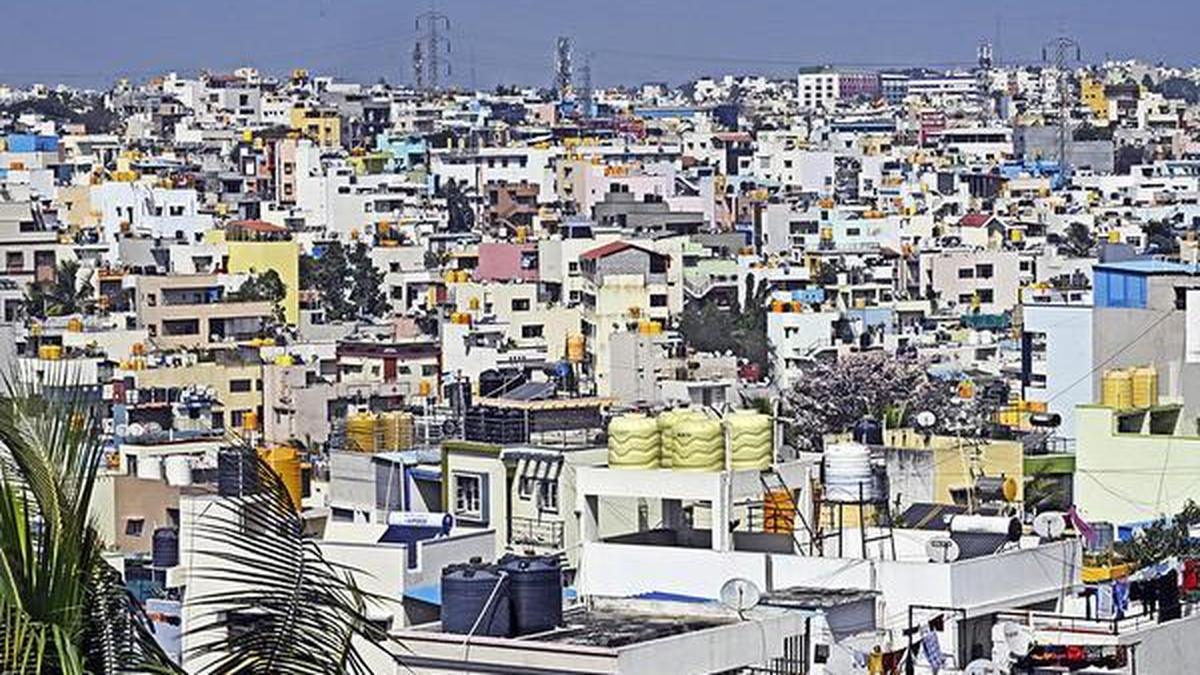
In a move that could help small builders thrive in Bengaluru while also creating affordable housing for middle-class families, the Karnataka government has proposed amendments to the zonal regulations of the Revised Master Plan (RMP) 2015 for the Greater Bengaluru Area.
The draft notification issued by the Urban Development Department (UDD) on June 4 introduces new provisions governing family sub-division of plots, amalgamation of A-khata properties, and bifurcation procedures.
The proposed move is expected to make the Karnataka government’s B-to-A Khata conversion scheme more attractive, while contributing to densification of the city.
Under one of the proposed amendments, two or more adjoining building sites with A-khata will be eligible for amalgamation, provided the resulting site is contiguous, upon payment of a nominal fee to the corporation.
This means that two separate sites can be amalgamated into one and become eligible for a single plot approval for construction, effectively enabling the development of larger apartment complexes.
K.R. Ramesh, property consultant and developer, said the move gives small builders an opportunity to thrive in the city while also providing affordable housing.
“Once implemented, builders will have greater space availability, leading to denser construction, which will also force a revision and correction of rates. The impact will be that costs become more affordable for the middle class,” he said, welcoming the move.
Interestingly, the conversion scheme, which has seen dismal progress so far, is also likely to receive a boost as private developers look for sites on the city’s fringes, and will be willing to pay more. This would create a win-win situation for both site holders and developers.
The proposal also permits amalgamation where a stormwater drain or nala, other than a primary drain, runs between or within the sites, provided the resulting amalgamated property remains contiguous and all applicable buffer requirements and conditions relating to the drain are complied with.
In such cases, the construction of cross-drainage works connecting different portions of the amalgamated property will be permitted. Following amalgamation, a single property identification number will be assigned to the combined site.
Bifurcation amendment
The other amendment seeks to add a new clause under sub-division regulations relating to the family sub-division of plots having A-khata (e-khata).
As per the proposal, a vacant plot, or a plot with a building of up to 2,000 sqm, will be eligible for family sub-division, provided each subdivided plot has a minimum area of 50 square metres. Each subdivided plot must have road access, and a minimum frontage of six metres.
A registered town planner or an architect, or an engineer will be required to prepare the family partition plan in accordance with the regulations.
The sub-division will be permitted upon payment of a family sub-division charge of ₹1,000, or such amount as may be notified by the government from time to time.
However, where at least one of the joint owners seeking sub-division is not a family member of the khatedar, or where an A-khata has been issued without approval under Section 17 of the Act, sub-division charges will be levied at 5% of the guidance value of the site or plot proposed for sub-division.
The sub-division of the site will be approved, and a subdivided A-khata (e-khata) will be issued by the city corporation.
Sub-division of plots exceeding 2,000 square meters was allowed earlier as well.
Published – June 05, 2026 05:51 pm IST