

Hearts and messages are generally carved on the wooden desks of colleges. “Today’s a gift, that’s why it’s called present” is one of the cheesier ones. The BJP didn’t study in one of those small-town colleges. A big part of its education came from the streets of competitive post-Independent India, where survival was the primordial instinct, and tomorrow was always the concern.
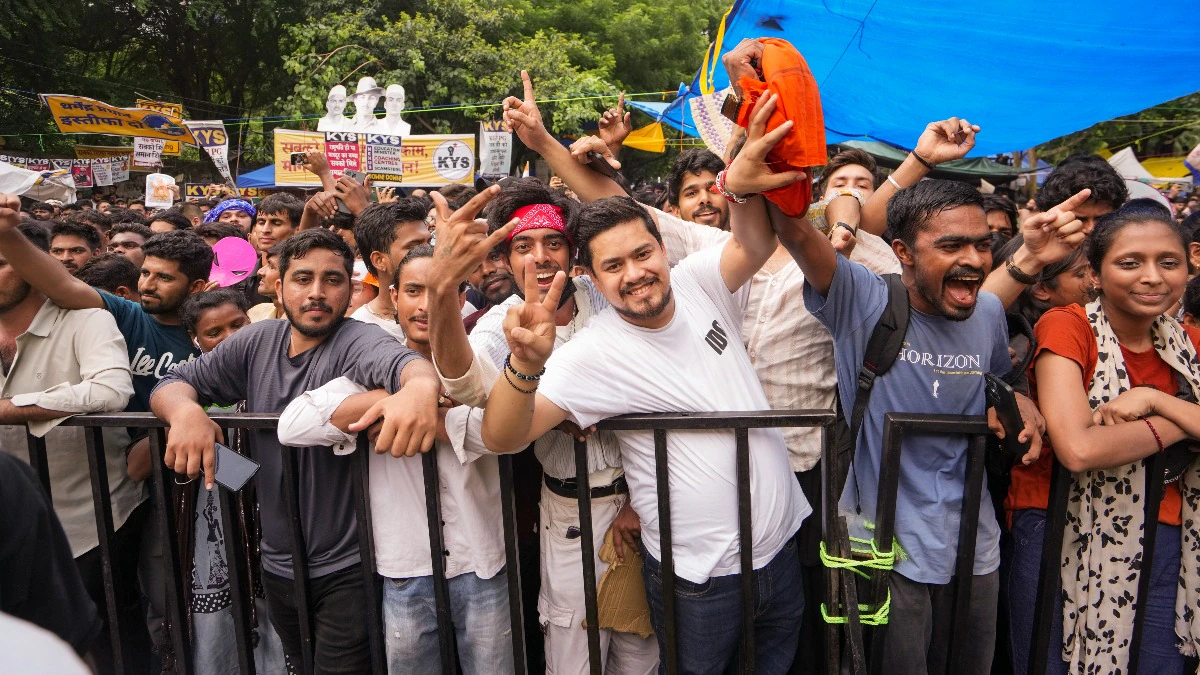
Millions in India believe Union Education Minister Dharmendra Pradhan should have gone long before the crowds swelled at New Delhi’s Jantar Mantar seeking his head. There was the NEET-UG paper leak, followed soon after by the CBSE online marking scheme fiasco.
There was neither action nor communication from the party and the government as India’s higher education looked like the crumbled blocks of Jenga on a table.
With the Opposition missing, the cockroaches turned up on the table. Sonam Wangchuk fed the fledgling movement with his hunger strike. But what they might have failed to achieve was done by Delhi Police and the RAF. The brutal use of force on July 20 on protesters, thousands of whom were minors, pushed the BJP into the proverbial cul-de-sac.
With ‘what if tomorrow…’ on its mind, the BJP tried to delay what was destiny. That Pradhan’s resignation might create a precedence was one of the key reasons why the brass tried to save him.
However, the more the delay in packing off Pradhan, the more it presented itself as a rigid regime, showing no flexibility to accommodate people’s demands.
With the monsoon session of Parliament about to begin, political activity in the capital intensified. Leaders from Opposition parties started streaming into Jantar Mantar to be seen with a fasting Wangchuk.
The monsoon session began on July 20 and the first week was a washout.
Rahul Gandhi, the Leader of the Opposition in the Lok Sabha, protested both in the House and in front of the PM’s house and got detained. The Opposition was in no mood to let Parliament function. It knew what the government was aiming for. The government knew what the Opposition was striving for.
Two senior ministers — JP Nadda and Jitendra Singh — succeeded in getting Wangchuk to end his fast, toning down his demand for Pradhan’s resignation. But by then, the protest had become way bigger than Wangchuk or the Cockroach Janta Party. The fire had spread and it needed a sacrifice made.
No stringent laws or fast-track courts or portrait-mode videos would satiate the leaping flames. It needed Pradhan, who had become the face of the crumbled Jenga blocks.
The BJP now thought, and thought seriously about tomorrow. About the future. Precedence can be taken care of, and the bigger goals, thus, took precedence.
The crucial delimitation bill, sources have revealed, might be introduced in the monsoon session. Though it wasn’t among the five bills listed by the government, reports suggest the landmark bill could be brought in the session that would continue till August 13.
The Bill is special, and in April, the Modi government convened a special session to tie it with the women’s reservation bill and get it passed. It was defeated as the treasury couldn’t muster the support of two-thirds majority.
That was the first time that a constitutional amendment bill moved by the Modi government had been defeated. But the political landscape has changed since April.
Recent defections, inner-party feuds, lack of Opposition cohesion and political realignments have given the government hope that it could try and get the delimitation bill passed.
After the 2024 Lok Sabha election, the NDA had 293 MPs, including the BJP’s 240. Its tally rose to 318, mainly because 20 rebel Trinamool MPs aligned with the NDA and six Shiv Sena (UBT) MPs merged with the Shinde Sena faction.
In the Rajya Sabha in mid-June 2024, the NDA had 101 members. The number has now increased to 152.
The growth wasn’t a miracle. They have been managed shrewdly and painstakingly towards the one big delimitation goal. Other than the engineering, it needed Sharad Pawar and MK Stalin to be persuaded. No mean task.
Consequently, this monsoon session was going to be all about the BJP’s guts, guile and the splintering of the Opposition, especially of the Congress. But the CJP agitation consumed every other issue. The Congress had seized the opportunity to derail the BJP’s parliamentary agenda. The government couldn’t have brought its agenda up as long as Jantar Mantar remained combustible. Pradhan thus became the offering.
So, it was a choice between prestige and Pradhan on one hand, and hard work and big goals on the other. So, the Modi government tapped out to save the situation, and fight a bigger fight, on another day.
The optics had already gone bad. Senior leaders Nadda and Singh negotiating with rookies Saurav Das and Ashutosh Ranka, both seated with crossed arms, wasn’t the best image for the veteran duo.
But the Modi government has been known, though rarely, to make a tactical retreat when it becomes an absolute necessity. The withdrawal of the three farm bills after the prolonged farmers’ agitation is one such example.
That protest too, like the one at Jantar Mantar, was taking an altogether different shape. No government wants a protest to be hijacked and turned into an inferno that goes beyond its control.
The stakes in Parliament were already very high and Pradhan was a small sacrifice. Though everyone knows what parampara, pratishtha and anushasan mean for the party steeped in tradition and aiming for civilisational goals, what would remain a question is why the BJP let the issue fester. Why didn’t the BJP, which is always planning for tomorrow, not sacrifice Pradhan yesterday itself? Why can’t a party on the climb get rid of the dog Nietzsche named ‘Ego’?
– Ends