




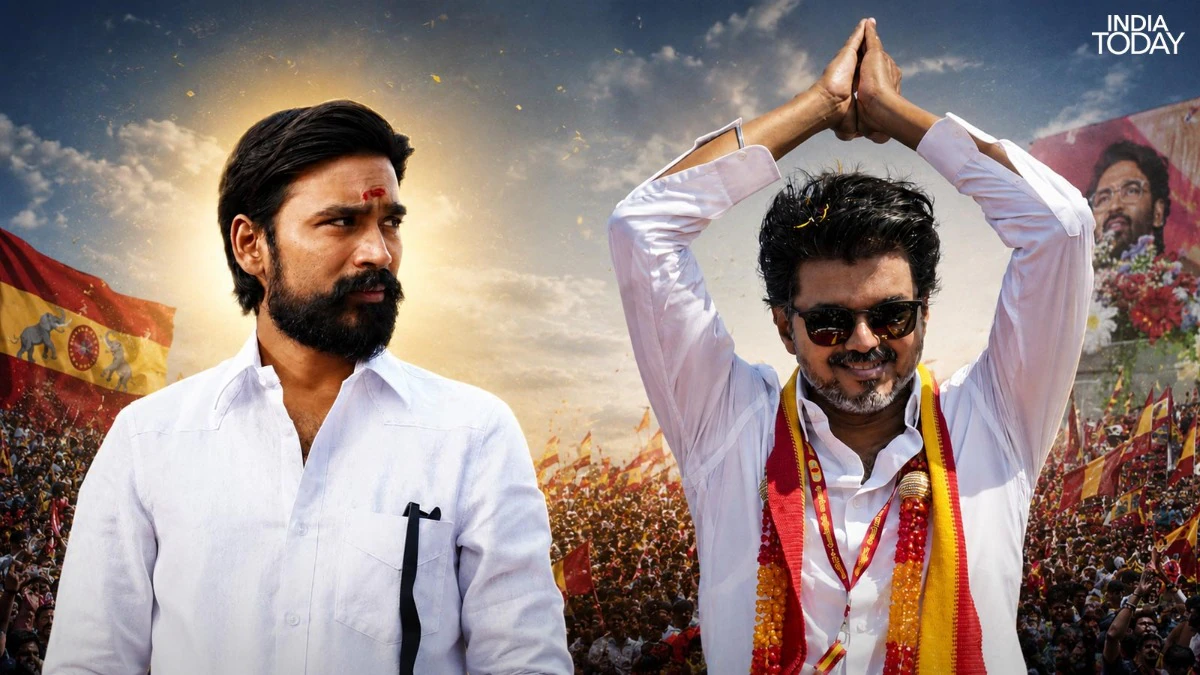
Tamil actor Dhanush’s speech at a recent fan event has renewed a familiar question in Tamil Nadu: Is another film star preparing for a political innings?
Addressing hundreds of supporters in Tiruvallur, the National Award-winning actor delivered a passionate speech on Sunday. It drew cheers from the crowd as he urged his fans to move beyond celebrations and channel their collective strength into public service. “Beyond just audio launches and meetups, we need to engage in even more welfare activities. Understand the needs of the people in your area… I need to feel even prouder of you,” he said.
In most states, such remarks might be dismissed as a celebrity call for philanthropy. But in Tamil Nadu, where cinema has historically served as a launchpad for politics, every carefully crafted public message is scrutinised for political intent. And for the same reason, the internet was quickly flooded with, “Welcome to politics, Dhanush” messages.
There is a striking background for this speech that fuelled the buzz, marked by a series of developments. Earlier this month, his fan organisation launched an official flag featuring the actor’s image in red and white, carrying the slogan “Ennampol Than Vaazhkai”. The slogan translates to “Life is as your thoughts”. Shortly after, Dhanush’s filmmaker father, Kasthuri Raja, was asked whether his son was preparing to enter politics. He did not deny it outright, simply saying anyone has the right to join politics.
Neither Dhanush nor his team has confirmed any political plans. Yet this sequence has invited comparisons with actor-turned-politician Vijay, whose Tamilaga Vettri Kazhagam (TVK) delivered a stunning victory to emerge as the southern state’s largest party in the recent Assembly election, after years of meticulous preparation.
FAN CLUB VS POLITICAL ORGANISATION
Perhaps the biggest misconception about Vijay’s political rise is that it began with the launch of TVK in 2024. No. The groundwork had been laid over more than a decade through the Vijay Makkal Iyakkam (VMI).
What started as a fan association gradually evolved into a disciplined grassroots organisation. The Iyakkam members contested and won local body elections in 2021, while the organisation regularly conducted constituency-level welfare initiatives, honoured top-performing students, organised relief operations and maintained an active district-level presence.
By the time TVK was formally announced, Vijay already possessed a statewide organisational network capable of contesting elections.
Dhanush’s position today is markedly different.
Though his fan clubs have existed for nearly 15 years, they remain active in welfare initiatives such as blood donation drives, educational assistance and charitable activities. His films win massive applause and the actor commands an enormous popularity that extends across Tamil Nadu, the Tamil diaspora and audiences beyond the state through his multilingual film career.
Yet, popularity is not organisation.
His fan groups remain decentralised volunteer collectives rather than structured units. Unlike Vijay Makkal, they have never functioned as electoral machinery.
If Dhanush wishes to transition into politics, his first task would be transforming fan clubs into disciplined cadres capable of booth management, voter mobilisation, constituency outreach and sustained grassroots engagement. Welfare activities would need to evolve from occasional charity programmes into continuous community interventions.
STAR POWER ALONE IS NOT AN IDEOLOGY
Tamil Nadu has repeatedly demonstrated that electoral politics cannot be won on celebrity frenzy alone. The state’s political trajectory remains deeply rooted in the ideological traditions of the Dravidian movement. People expect leaders to articulate positions on social justice, education, welfare, caste equity, language rights and federalism. Vijay successfully took up this challenge.
This presents perhaps the biggest uphill for Dhanush.
Unlike Vijay, who carefully positioned TVK around social justice, good governance and Tamil identity while presenting himself as an alternative to the traditional Dravidian parties, Dhanush has largely remained apolitical throughout his public life.
Ironically, his strongest political identity may already exist, not in his speeches, but in his films.
Through critically acclaimed movies such as Asuran and Karnan, Dhanush has consistently portrayed characters confronting caste oppression, rural inequality, institutional injustice and social discrimination. These films have cultivated an image of Dhanush as a voice associated with marginalised communities and social justice.
If Vijay’s political brand centred on mass welfare and anti-establishment politics, Dhanush could potentially build a platform rooted in social equity, dignity and inclusive development, the issues that resonate deeply within Tamil Nadu’s political landscape.
But doing so would require moving beyond symbolic welfare appeals to clearly defining what he stands for politically.
A FAR MORE COMPETITIVE LANDSCAPE
The spectrum has fundamentally changed since Vijay entered politics. When TVK was launched, Tamil Nadu’s political environment presented an unusual opportunity, a vacuum. The AIADMK was grappling with internal divisions, while anti-incumbency sentiment against the DMK created space for a new political force.
That opening no longer exists for Dhanush.
Following the 2026 Assembly election, TVK has firmly established itself as a major political player, fundamentally disrupting the state’s traditional DMK-AIADMK duopoly. Although no party crossed the majority mark, Vijay subsequently secured the support of the Congress and smaller alliance partners to form the government.
This dramatically alters Dhanush’s political calculations.
He would not merely compete against the DMK and AIADMK. He would also have to carve out political space against an already established TVK and Seeman’s Naam Tamilar Katchi (NTK), both of which seek to position themselves as alternatives to the traditional Dravidian parties.
NAVIGATING COMPLEX SOCIAL ARITHMETIC
Tamil Nadu’s elections are shaped not only by ideology but also by intricate caste and regional equations.
The DMK and AIADMK continue to derive support from complex social coalitions. Vanniyars dominate large parts of northern Tamil Nadu, Gounders remain influential in the western districts and Thevar communities exercise considerable influence in the south, while Dalit communities constitute nearly one-fifth of the state’s population and remain politically significant through parties such as the Viduthalai Chiruthaigal Katchi (VCK).
Unlike several political leaders, Dhanush has never publicly projected a caste identity, which may allow him greater flexibility but also deprives him of an established social base.
Instead, his appeal cuts across urban and rural audiences, particularly among younger voters, families and Tamil diaspora communities. If he enters politics, he would likely need to expand that appeal by cultivating relationships with community leaders while positioning himself as a pan-Tamil figure rather than the representative of any specific social bloc.
POLITICS REQUIRES MORE THAN PARALLEL COMMITMENTS
Perhaps the most immediate obstacle is Dhanush’s continuing dominance in cinema. Unlike Vijay, who gradually distanced himself from films before fully embracing politics, Dhanush remains one of India’s busiest actors and filmmakers.
He continues to juggle multiple large-scale projects, including biopics on music legend Ilaiyaraaja and former President APJ Abdul Kalam, alongside his directorial ventures and pan-Indian productions. The biopics, however, have been paused for now, without citing specific reasons.
Tamil Nadu politics, however, demands a full-time commitment. Building a statewide organisation requires constant travel, district-level engagement, candidate selection, alliance negotiations and direct interaction with voters. Dhanush would eventually need to demonstrate that governance, not cinema, is his primary vocation.
SHOULD HE LAUNCH A PARTY, OR JOIN ONE?
If Dhanush decides to enter electoral politics, two broad options exist. The first is launching an independent political party, following the model adopted by Vijay. While this offers complete autonomy over leadership and ideology, it also demands enormous organisational investment, fundraising, cadre development and constituency-level infrastructure.
The second option would involve joining an established political formation.
Some observers believe that, given TVK’s occupation of the alternative political space, Dhanush could find greater strategic value in aligning with the DMK-led Secular Progressive Alliance rather than creating another regional party that competes for the same anti-establishment voters.
Such an alliance would provide immediate organisational strength but would inevitably limit his independent political identity. At present, however, there is no evidence suggesting Dhanush is actively pursuing either course.
WHAT ELECTORAL IMPACT COULD DHANUSH HAVE?
Any assessment of Dhanush’s political potential remains hypothetical, but his entry could reshape electoral arithmetic in several ways.
In a best-case scenario, if he aligns with an established alliance and successfully attracts a significant share of youth and floating voters, he could strengthen an existing coalition without substantially fragmenting opposition votes.
A more moderate outcome could see him attracting five to seven percent of the vote, largely from urban youth and undecided voters. While such numbers may appear modest, even small vote shifts have historically altered dozens of constituencies in Tamil Nadu’s closely fought elections.
The biggest risk would be a vote-splitting scenario. If Dhanush draws support primarily from the same voter base targeted by TVK or the DMK-led alliance without expanding the overall electorate, his entry could inadvertently benefit rivals by fragmenting opposition votes. Tamil Nadu’s electoral history shows that even a swing of three to five percentage points can decisively alter seat outcomes.
Should Dhanush enter politics, his communication strategy would require significant evolution.
His current messaging revolves around welfare, social responsibility and Tamil pride. These themes resonate with the state’s political culture but are insufficient on their own. He would need to articulate clear positions on employment, education, economic development, caste equity, federalism and governance.
– Ends