


No venue could have been more appropriate than Balan Illam, the headquarters of the Communist Party of India (CPI) located in Chennai, for the recent protest in solidarity with the Cockroach Janta (CJP) Party and against NEET in Tamil Nadu.
Balan was the popular name of K. Baladhandayutham, a towering CPI leader who began his political career as a student activist. He was expelled from Annamalai University in 1938 for his political activities. His life was, in many ways, quixotic, marked by an unwavering commitment to communist ideals. He was only 20 when his university education came to an abrupt end, after which he plunged into full-time politics.

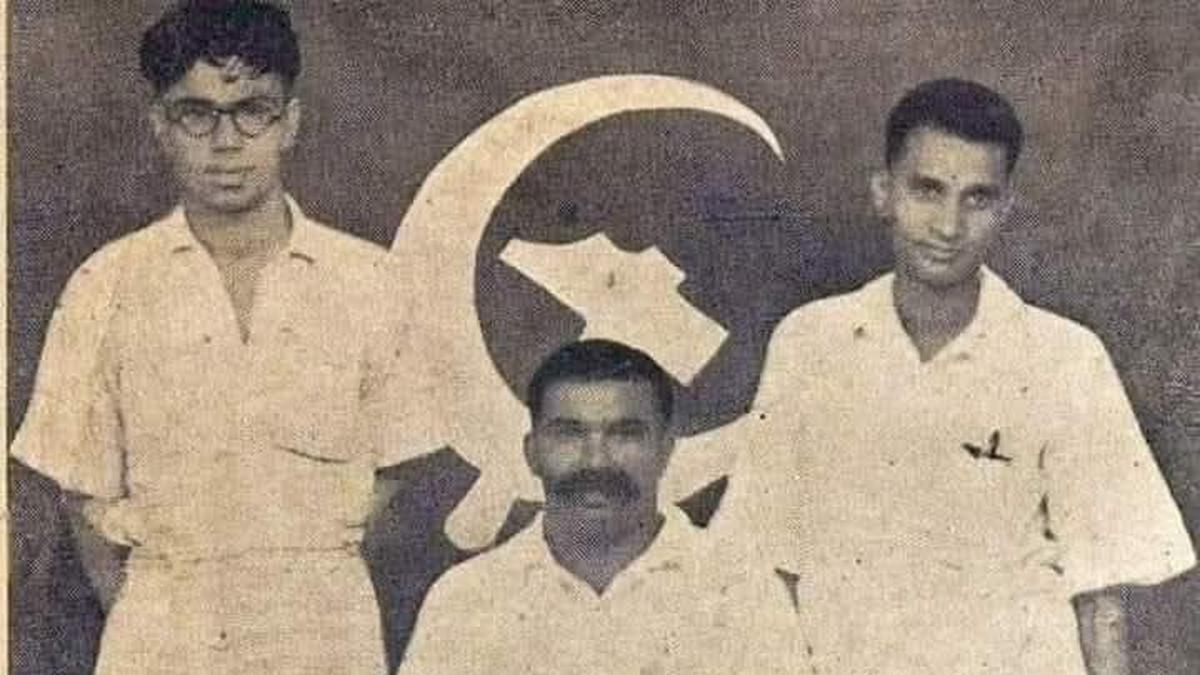
The protests against NEET continued at Balan Illam, the office of the CPI in Chennai. File
| Photo Credit:
Bijoy Ghosh
The Vice-Chancellor of the university at the time was the Right Honourable V.S. Srinivasa Sastri. Baladhandayutham famously quipped: “He is neither right nor honourable.”
A year after his expulsion, he married his classmate, Claudius Wills, an Anglo-Indian. However, barely six months into their marriage, he was arrested. After serving a one-year prison sentence, he was re-arrested at the gates of Coimbatore Prison and spent another 18 months in Vellore Central Prison.
Claudius Wills, whom Balan renamed Nirmala, hoped he would abandon political activism and pursue another career. He refused. Recalling the episode in a letter to his fellow communist Balraj, Balan wrote: “She waited for me for 12 years. But it was of no use. She obtained a divorce in 1951 and remarried. Her remarriage gave me immense joy.”
A gifted orator and writer, Balan spent several years underground after the Communist Party was banned. He was later sentenced to life imprisonment in the Nellai Conspiracy Case, in which veteran communist leaders R. Nallakannu and P. Manickam also received long prison terms. Registered in 1949, the case named Balan as the first accused. His experiences as a life convict were serialised in Samaran magazine and later published as the book Yen Aayul Thandanai Anubhavangal.

K. Baladhandayutham (artistic sketch) Photo credit: Special arrangement
Balan was only 55 when he was killed in an air crash alongside Mohan Kumaramangalam, the communist-turned-Congress leader and Union Minister. In his lifetime, he spent more than 16 years in prison and several more living underground. When the Communist Party split in 1964, he remained with the CPI. At the time of his death in 1973, he was the Lok Sabha member representing the Coimbatore constituency.
Reflecting on the purpose of his life’s struggles, Baladhandayutham wrote to Balraj: “If a young person reads or hears my story and dedicates his life to the service of the nation, I will have the satisfaction that I have not wasted my life.”

One of those inspired by Balan was the renowned Tamil writer Jayakanthan, who rejoined the Communist Party after listening to Baladhandayutham speak at Chintadripet in Madras following his release from prison.
“He spoke for two hours. It was not merely a speech; it was as though Bharathi and Tilak had come together in the form of a lion and roared. Standing amidst the crowd, I lost all awareness of myself and listened with the conviction that he was my leader. As Balan stood on the dais, he seemed, on the one hand, to resemble Bharathi and, on the other, Bhagat Singh,” Mr. Jayakanthan wrote in Oru Ilakkiyavathiyin Arasiyal Anubhavangal.
Mr. Jayakanthan writes that Baladhandayutham was a hero to educated youth and communists alike. His daring exploits, powerful oratory and personal sacrifices were recounted almost as legends, he says.
Born into a wealthy agricultural family at Makkinanpatti near Pollachi, Balan recalled in his letter to Balraj that he organised a children’s union and led protests against toddy shops and textile merchants selling foreign cloth. “Our heads were not broken and we were not sent to jail because we were children,” he wrote. While still in high school, he founded the Radical Youth Club, which served as a political training ground.
After his expulsion from the university and release from prison, Balan worked among railway workers at Ponmalai. In 1945, the party sent him to Tirunelveli to build its organisation. He went underground in 1946 after a warrant was issued for his arrest in the wake of the railway strike.
“In 1948, I attended the Party Congress in Calcutta. A warrant was issued for my arrest again, forcing me to go underground. I remained underground for five years,” Balan recalled in his memoirs.
He was arrested in 1949 in the Nellai Conspiracy Case on charges that the communists had conspired to overthrow the Nehru government. After the judgment was delivered in 1953, he was brutally assaulted inside the police van while being taken to prison.
“They abused me. They punched me. They rolled me on the floor and hurled me into the lorry. After chaining my hands, they felt victorious. Their hatred suffocated me,” he wrote.
While lodged in Madurai Prison, Balan undertook a fast unto death along with 13 other communists convicted in the case. He was subsequently shifted to Madras, then to Nagpur, before finally being brought back to Tamil Nadu.
Even in prison, Balan remained intellectually active. He started a handwritten magazine called Thudaippam (Broomstick). The “magazine” consisted of a display board on which prisoners pinned their writings for others to read.
“I learnt wrestling in prison. But I could not persevere for long. I even became the subject of a caricature in the magazine,” he recalled with characteristic humour.
Balan was also a regular contributor to the party organ Janasakthi and its literary magazine Thamarai. He once wrote that he could not continue watching the film Kappalottiya Thamizhan, based on the life of V.O. Chidambaram, because tears prevented him from remaining in the theatre.
Nellai S. Velayutham, a senior communist leader and one of Balan’s close associates, recalled the words Balan uttered after his release from prison: “I was born a full-time worker, and I will die a full-time worker.”
He lived true to those words.
Published – July 29, 2026 06:00 am IST


