







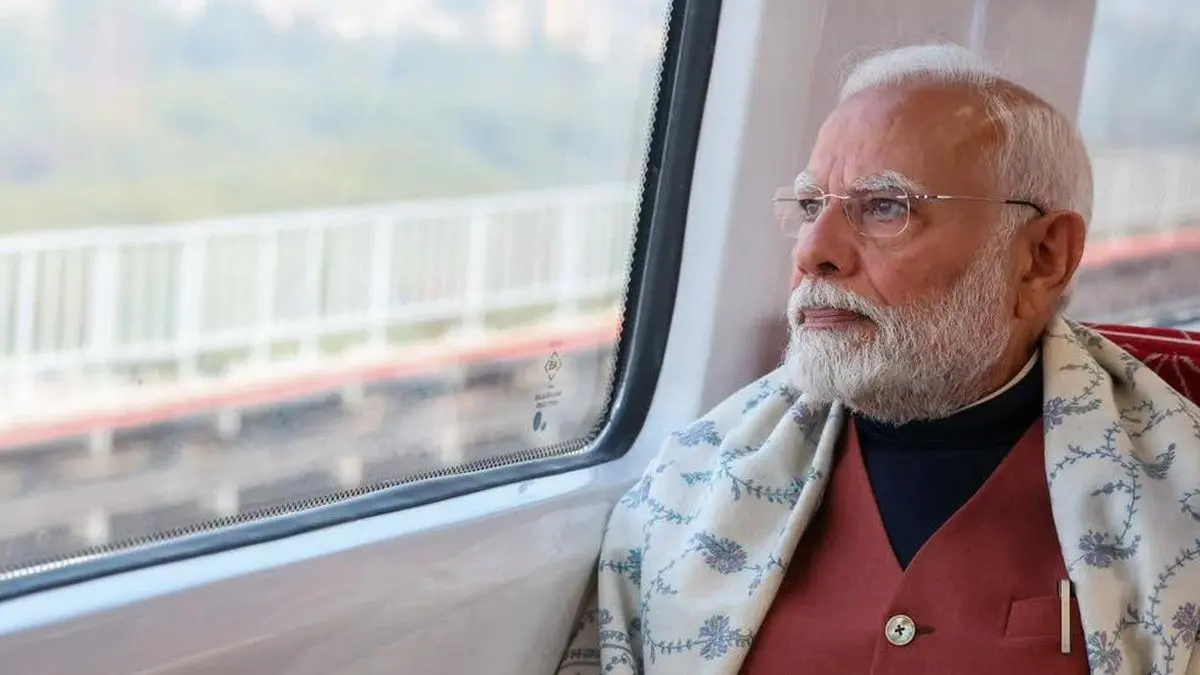
In his 12th year at the helm, Prime Minister Narendra Modi faces a grave challenge to his government from young people who are refusing to cede an inch at Jantar Mantar in New Delhi. For two days running and well past midnight, youth stay up, holding out placards that ridicule the Prime Minister and mocking the BJP’s governance record at the Centre. Within the span of a few days, the Modi government has run into an unexpectedly strong opposition led by youngsters. Led by the Cockroach Janata Party (CJP), the students’ movement has sent the BJP on a learning curve, as the past models of countering agitations seem of no use against this generation.
Modi’s government arrived at its 12th anniversary arguably with a bad omen. Having built a custom of leading almost two months of celebrations each time there has been a government anniversary in the past few years, which have included carpet-bombing the media with interviews of ministers, authored articles, and series of press conferences (with everyone except the Prime Minister), this anniversary date lost its lustre within two days. Not only was it rocked by the CBSE Class 12 Board Exam On-Screen Marking controversy, but that itself came close on the heels of the NEET paper leak and subsequent cancellation of the exam. The anniversary celebrations were prematurely shut down as the government machinery went into defensive mode.
Dharmendra Pradhan, the Education Minister, was the target of the protests. The Prime Minister had the opportunity to get rid of Pradhan with a Cabinet reshuffle, which was widely expected before the Monsoon session of Parliament, but the CJP became both tormentor and saviour of Pradhan. By singularly demanding Pradhan’s resignation, the CJP seemed to give him a shield in the Union Cabinet, since Prime Minister has dropped several Cabinet ministers in the past but never on the demand of any group.
The challenge, however, might not be so simple and goes deeper than what is apparent on the surface. A few weeks earlier, the Department of Personnel and Training (DoPT) recalled three Personal Assistants who served in the office of the Union Minister of Environment and Climate Change, Bhupender Yadav, and terminated the services of another. Yadav was already mired in a controversy about the Aravalli Hills, which exploded on social media, when he staunchly defended his Ministry’s proposal to use a 100-metre norm for classifying hills in this ecologically fragile mountain range. The Supreme Court stepped in to stay the Ministry’s proposal.
Also Read | Delhi Police crackdown turns CJP protest into a national challenge for Modi
Political observers believed that both Yadav and Pradhan would be shown the exit whenever the Prime Minister announced a Cabinet reshuffle. Both Ministers, however, showed no signs of panic; their close aides said that “nothing would happen”. It seemed they were right.
The two Ministers enjoy the patronage of the Union Minister for Home Affairs, Amit Shah. Unlike in Modi’s first two terms, Shah has emerged as a power centre of immense importance in the third term, according to senior officials in the government as well as sources in the BJP. Credited with the BJP’s electoral turnaround after its setback in the 2024 Lok Sabha election after he engineered victories in Maharashtra, Haryana, Delhi, Bihar, Assam, and West Bengal, Shah’s stature has grown exponentially in the Modi government. For some senior officials, Shah is a parallel power centre along with the PMO.
Gradual narrowing of internal discussion
A former advisor in the Niti Aayog recalled a moment from the first term of the Modi government, when the then Cabinet Minister M. Venkaiah Naidu had sternly counselled Shah when an issue about agriculture was being discussed. The advisor was present at the meeting, and Shah was attending it as the BJP president. “I was stunned when Naidu addressed Shah as ‘Amit’,” said the adviser. “Shah looked upset, but the Prime Minister intervened and said, “Naidu ji knows a lot about agriculture,” and asked Shah to meet Naidu separately. These, said the former advisor, were the equations in the Modi Cabinet in his first term.
Now, the only person in government who calls Shah by his first name is the Prime Minister. Besides Naidu, the late Arun Jaitley also commanded an assertive role in the Modi-led Cabinet. The Prime Minister often consulted Jaitley, who, according to insiders in the government, freely shared his views at Cabinet meetings. The late Ananth Kumar and the late Manohar Parrikar also commanded spaces of relative individual strength in the Modi-led Cabinet. The former Union Minister Ravi Shankar Prasad was another vocal minister in the Cabinet.

A CJP supporter holds a placard as she drinks ORS at Jantar Mantar in New Delhi on July 23, 2026. Prime Minister Modi had the opportunity to get rid of Pradhan with a Cabinet reshuffle, which was widely expected before the Monsoon session of Parliament, but the CJP became both tormentor and saviour of Pradhan.
| Photo Credit:
SAJJAD HUSSAIN/AFP
The second term brought a sea change in the Cabinet’s outlook, as Modi’s contemporaries exited the stage one by one, with the exception of Rajnath Singh. Shah’s entry into the Cabinet marked a shift in the overall image of the council of ministers. His five-year stint as BJP president had established Shah’s image as a stern leader, and his entry into the Cabinet sent out the message to other Ministers that Shah and not Rajnath Singh was the real Number Two in the government.
Shortly, a core team loyal to Shah took shape and began to meet very often, consisting of Pradhan, Yadav, Piyush Goyal, and Mansukh Mandaviya. In the BJP’s third term, the council of ministers saw the entry of several of Shah’s handpicked Ministers. Shah’s core team consists only of yes men; Ministers who mostly endorse his line of thinking when faced with any issue.
In the third term of the Modi government, Shah apparently began giving hints that he was seeking to model himself on Sardar Vallabhbhai Patel, India’s first Home Minister. A large portrait of Patel adorns the backdrop of Shah’s sofa where he sits, legs crossed, when meeting visitors. The message is carefully crafted. With his signature on the abrogation of Article 370, Shah is building an image of a leader who is tough on all challenges. The claim of eliminating “Left Wing Extremism” has been added to his overall image. In his watch, the Ministry of Home Affairs is boosting the presence of security personnel in strife-torn Manipur. Shah has vowed to “identify and throw out illegal infiltrators” across India.
CJP protest and Shah’s strategy
As the Modi government’s strategy to deal with the CJP protest emanates from Shah’s core team, the response is first one of denial. That the CJP protest posed any serious crisis was dismissed. It seemed that the government believed the protest would fizzle out in due course. The thin attendance at Jantar Mantar for a few days boosted the government’s confidence that it had assessed the situation correctly.
Any dialogue with the leaders of the CJP, Shah seemed to believe, would give legitimacy to the protest. Besides, the CJP’s demand to sack Pradhan was crossing a red line, for it directly challenged Shah while also threatening to make the Modi government look weak.
Shah has already dealt with activist Sonam Wangchuk in the past. Wangchuk has held indefinite hunger strikes earlier too in Ladakh; his last hunger protest ended with his arrest and with the protests of the people in Ladakh fizzling out afterwards.

Books lie beside a portrait of Sonam Wangchuk on the bed that he had been using before police took him away from the protest site at Jantar Mantar in New Delhi on July 22, 2026.
| Photo Credit:
Anushree Fadnavis/Reuters
As the Monsoon session approached and Wangchuk stayed firm with his hunger strike, Shah and his team weighed the prospects of the protest inviting larger media attention and people’s interest when Parliament is in session. Shah’s past experience of removing Wangchuk from the scene of action to end the protest in Ladakh guided the government’s actions this time too, with the Delhi Police picking up Wangchuk swiftly just ahead of the planned march to Parliament on July 20.
The idea was drawn from Shah’s playbook premised on the hope that Wangchuk’s absence from Jantar Mantar would deprive the CJP of a known face and thereby the youngsters would disperse gradually.
But the script went badly astray. The visuals of the police using a bedsheet to cover their movements and forcibly removing Wangchuk to hospital electrified the agitation, drawing much larger numbers of people to Jantar Mantar. The CJP’s Sansad Chalo (march towards Parliament) call gained in force from the high-handedness of the police in not only removing Wangchuk but also confining him to Safdarjung Hospital in New Delhi. The subsequent police action, the ruthless lathi charges and tear gas firing, also drew heavily from Shah’s tough guy posture. The rest is now history.
Also Read | Flash flood
Shah’s heavy-handed security-led response is yet to find a breakthrough in Manipur. The police-led response in Delhi has, contrarily, unleashed a wave of huge protests across the country, with protestors now directly targeting Modi. Posters with his face are being defaced and hit with slippers. Aggressive slogans and mocking memes against Modi are now part of the protests across cities and are flooding social media. In Mumbai, people are flooding the streets. In Patna, a BJP leader’s car came under attack from protestors. Patna already saw massive student protests ahead of the Bihar Assembly election last year.
Now, the BJP finds itself faced with the prospect of several variants of the CJP protest having spread across the country and merging with the original student agitation. Farmers in Gujarat have been agitating against land acquisition for several weeks, and have joined in. Punjab’s farmers heading to Delhi had to be blocked at the Haryana border.
In three short weeks, the BJP, which seemed to have acquired the status of a party with almost no opposition to speak of, now faces its most debilitating challenge yet. At stake is the BJP’s principal poll mascot—Modi’s image. That electoral brand has been the BJP’s single and most effective election-winning USP since 2014.
Strategically built over the years, Modi’s electoral brand was cemented during his second term, when he stood at the helm with most of his contemporaries out of the picture. The beginning of his third term strengthened the belief that Modi alone wins elections for the BJP. Now, in the third year of that term, the BJP faces a direct attack on Brand Modi, leaving the muscular Shah and his aides to figure out how to contain the damage.
Manish Anand is a senior Delhi-based journalist, who has reported for over two decades on the BJP, the RSS, and the PMO for leading English dailies.


