Leader of Opposition Rahul Gandhi’s dissent on the night of May 12, over the procedure followed for choosing the next CBI Director, brings a harsh spotlight not just on the selection process but also on the participation of the third member on the selection committee: the Chief Justice of India.
The judge’s seat in the Prime Minister-led three member committee produces neither neutrality, nor transparency, nor accountability. So what purpose does it then serve?
It merely produces a halo to a process that Gandhi now describes as “biased”.
The dissent note he shot off to Prime Minister Narendra Modi the same night is being read in most coverage as a political event. But it is more than that. In the note, Gandhi has said that he had repeatedly sought the self-appraisal and 360-degree reports of eligible candidates (running in hundreds), was denied them, and was instead expected to examine the records of 69 candidates for the first time during the meeting. He has said the office of the Leader of the Opposition cannot be reduced to a “rubber stamp” and the process has been reduced to a “mockery” by ensuring that a “pre-decided candidate” is selected.
A day later, the union government notified a further one-year extension for the incumbent Director, Praveen Sood—his second as he was to outgo in May 2025. Whether that extension was the product of consensus or merely the fallout of its absence has not been confirmed. What can be said is that the outcome does not inconvenience the government in the slightest. An incumbent who has served the present Executive’s political priorities, kept on for another year, is not a setback for the government but only a continuity it has every reason to welcome.
Which brings us, again, to the third member of that committee. If Gandhi’s account is accurate, and that indeed the procedure currently only favours a “pre-decided candidate”, then how does it reflect on Chief Justice of India Surya Kant?
As of date, no public note, concurrence, dissent, or set of reasons attributable to Chief Justice Kant has been disclosed. That silence is the difficulty. And it is not occurring in a vacuum. This is not the first time the committee’s procedure has been objected to from the Opposition’s seat. In May 2023, Adhir Ranjan Chowdhury, the then Leader of the Congress in the Lok Sabha, recorded a dissent over the shortlisting. In May 2025, Gandhi, by then the Leader of the Opposition, objected to the process of selection. And now, in May 2026, his note again plainly states that the material he had asked for, without which inputs cannot be given, was never furnished to him. So for over three meetings now, three objections have been raised on the same issue of procedure.
Faced with that pattern, the judicial member ought to have firmly and on the record pressed for the procedure to be set right. And not merely on Gandhi’s behalf. But even for himself.
Because it is not publicly known whether the Chief Justice himself received the full records. This author’s own Right to Information intervention in the CBI Director’s selection process gives real reason to doubt that he did: the Supreme Court’s own Registry has said, in as many words, that the CJI’s office is not the custodian of the relevant material and runs no separate secretariat to handle it. If the Leader of the Opposition was kept in the dark, the judge may well have been kept there beside him. Insisting that both be properly furnished with documents, so that the committee actually functions as a committee, is the bare minimum the Chief Justice’s inclusion on the committee is supposed to bear. On the present record, even that minimum appears to have gone undelivered.
The RTI saga
In May 2023, this author had filed a RTI application addressed to the Supreme Court of India on the role of its Chief Justice in the appointment of the CBI Director. The application sought answers on a few pointed questions: when did the CJI’s Office receive the list of eligible officers being considered for the post, whether service records, integrity records, personal details, and other relevant material were received. And more importantly, what criteria did the Chief Justice’s side apply for shortlisting names and what inputs, if any, did the Chief Justice provide during the Committee’s meeting.
This was the same month when the selection process was on which ultimately led to Sood’s appointment.
One would reasonably assume that the very idea of including the country’s top judge would be to ensure the selection process of an important and sensitive investigative arm of the Executive is impartial, that a government stooge is not positioned, and that a person of unimpeachable integrity makes it to the agency’s head office in Delhi, having the spine to refuse illegal orders. Besides, this would serve to reinforce the public’s confidence in the credibility of the agency which has lost most of its honour in the past two decades.
If this was so, then what ought to have been the logical path to follow?
Transparency. If a citizen’s emails, socials, texts, cloud storage could be broken in on a mere suspicion of tax evasion, then surely, the State too has a duty to disclose why a particular officer is being appointed to its premier investigative agency’s head office.
The response
In reply, the Public Information Officer (PIO) of the Supreme Court rejected the RTI citing three sections of the RTI Act, two of which were exemptions from disclosure. First, section 8(1)(e) which exempts disclosure of information held in a fiduciary relationship. Second, section 8(1)(j) which relates to personal information which has no connection to public activity or public interest. And third, section 11(1) which is actually just a procedure to be followed if information concerning third parties are to be disclosed. It is not a free-standing exemption clause.
As is routine with the Supreme Court’s RTI responses, the rejection was not justified. It is a settled principle of law that the PIO ought to justify why a particular exemption clause has been invoked and how it applies in the facts of the case. This was also perhaps because no attempt at such justification would have justified the non-disclosure since nothing personal regarding any of the candidates were sought for.
Only plain administrative metadata—dates of receipt, number of documents, the criteria followed as a framework—was asked. None of this could have been conceived as third-party information since none were involved!
Following the three-tier process under RTI, a first appeal was filed before the designated First Appellate Authority—a Registrar at the Supreme Court. The Registrar’s order made the contradiction even more visible.
It recorded that the CJI’s office “is not the custodian” of the applications or other information relating to the selection of the CBI Director. That the Chief Justice is only one member of the High Level Committee, and that there is “no separate Secretariat” in the CJI’s office to deal with the matter. Having said all that, the same order proceeded to uphold the denial on grounds of confidentiality, third-party treatment, and privacy, and went so far as to suggest that there is “public interest in the maintenance of confidentiality”— not only for private individuals but “even government”.

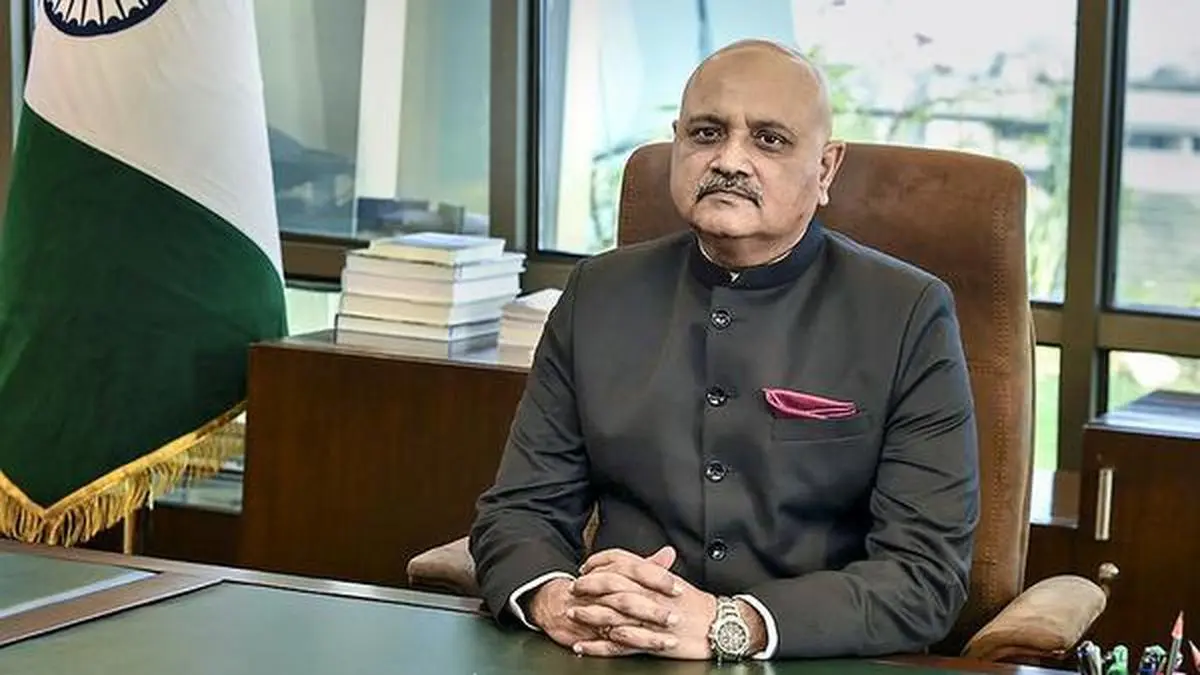
Chief Justice of India Surya Kant during the Fali S. Nariman memorial lecture at University of Mumbai, on January 24, 2026.
| Photo Credit:
SHASHANK PARADE/PTI
On second appeal to the apex forum that adjudicates RTI cases, the Central Information Commission, it held in one short paragraph in its August 2024 order that the reply was “self-explanatory” and that no further intervention was warranted—even after the argument that almost all parts of the request were non-personal in any case.
The point here should not be amiss: the judicial member is invoked as constitutional reassurance at the front of the process and as a non-custodial bystander at the back of it. The present system borrows judicial prestige for the Executive’s most politically charged personnel choice while imposing no public accountability obligation on any of the parties.
Citizens and journalists’ attempts at verifying the judicial members’ role in the process becomes practically unverifiable. The public is asked to be reassured by the presence of a Chief Justice without being given any instrument by which to test what that presence did or did not do.
It is for this reason that calls from legitimate circles for the CJI’s involvement in selecting Election Commissioners and other such authorities does not inspire confidence given the current opaque selection process.
If one expands the issue a little more, they will see a possible, quieter risk. The CBI’s work returns to the courts routinely—in bail, in transfer, in quashing, in larger disputes about political misuse, etc. A sitting Chief Justice, or a judge he nominates, who participates in choosing the very Director whose agency will appear before the bench may be placed in a proximity that no recusal protocol resolves. This is not to say that the Chief Justice or nominated judge should recuse from all cases concerning CBI. But disclosures would be necessitated if proximity is to be judged by a fair-minded litigant who may or may not seek his recusal. But issues of proximity are seldom thought of when the bar of judicial ethics and morality is so low.
The Sood years
One must also ask: what has the previous involvement of the Chief Justice of India resulted in?
The incumbent CBI Director Sood, was first appointed in May 2023 by the selection committee of which the then Chief Justice of India D.Y. Chandrachud was a member. Irrespective of whether LoP Chowdhury voted against the final shortlist of names, Chief Justice Chandrachud ought to have voted in its favour. It is against this backdrop that this author had filed the information request.
The 1986 IPS batch Karnataka cadre officer’s appointment had also not produced consensus in public view: Adhir Ranjan Chowdhury, the then Leader of the Congress in the Lok Sabha and member of the committee, too had submitted a dissent note reporting “procedural infirmities” in the shortlisting process.
Two years on, in May 2025, when Sood’s term ended, the government extended his tenure by one year after the selection committee failed to agree on a successor. The then Chief Justice of India was Sanjiv Khanna. That meeting, too, drew Gandhi’s dissent on the process of selection—and there, too, whether the extension followed from consensus or merely from its absence was never made clear.
Even at the moment of his appointment the politics around Sood were already loud. Karnataka Deputy Chief Minister D.K. Shivakumar had, when Sood was Karnataka DGP, accused him of acting in a partisan fashion—of protecting the ruling party at the Centre while pursuing Congress leaders. The point is narrower: the moment a Chief Justice’s name was attached to the choice, the choice was somehow to be seen as “independent”.
But what did Chief Justice Chandrachud think of the LoP’s dissent, Shivakumar’s allegations?
What followed in Sood’s tenure only deepens this question of what the CJI’s participation had actually achieved. The most consequential prosecution under Sood, in the Delhi excise case, saw the CBI arrest Arvind Kejriwal in June 2024 and file a chargesheet in July 2024. In February 2026, a Delhi trial court discharged Kejriwal, Manish Sisodia, and all 21 others, holding that the prosecution case did not survive scrutiny of evidence and that no overarching conspiracy or criminal intent was made out on the material before it. The Delhi High Court has since stayed the trial court’s adverse remarks and recommendation for disciplinary action against the CBI’s Investigating Officer for abuse of power while it hears its challenge against the discharge order.
But as a public spectacle, one of the agency’s most politically charged prosecutions under Sood ended in a major trial-court collapse.
The Kiru hydropower case against the late former Jammu and Kashmir Governor Satya Pal Malik—searches in February 2024, chargesheet in May 2025—is another such case. Malik had himself earlier flagged corruption in the project, and the case was being read in much public commentary against the background of his open clashes with the union government.
Merits of these cases aside, Sood’s tenure did not assure no politically motivated prosecutions or the freeing of the “caged parrot”. And neither did Chief Justice Chandrachud’s vote prevent controversy at the appointment stage or ensure the kind of independence that many hoped the process would bring due to a CJI’s involvement. There is no reason to assume otherwise even this time with a different Chief Justice of India on that committee.
There is, though, a further point in the extension itself. A Director with Sood’s record is exactly the kind of incumbent an Executive would want to keep. The latest extension, then, is better read not as an awkward stopgap forced by the committee’s deadlock, but as a continuity the government finds entirely congenial—which is precisely why the absence of any pushback from the judicial member matters.
It is not known whether the Chief Justices have failed because they did not independently assess the long list of eligible candidates due to lack of information about them or lack of a systematic evaluation system. Or it could even be the case that the Chief Justices did not attempt to independently assess the candidates in the first place. They may have simply seen their role as a formality and simply went ahead with the Prime Minister’s choice.
In the Modi era, either is a real possibility. The RTI intervention sought to uncover the truth, which was ultimately shot down by the Supreme Court administration and the CIC.
What other systems do
Across democracies, legitimacy for the country’s principal investigative or prosecutorial chief is generated by public confirmation, cross-party panels, open recruitment, published criteria, and, at times, live-streamed interviews. It is not generated by importing a sitting judge into the Executive’s appointment room which also comes with its own risks.
The FBI Director is nominated by the US President and confirmed by the Senate after a public Judiciary Committee hearing. Canada’s Director of Public Prosecutions is chosen by a cross-party selection committee, with the final appointment requiring parliamentary committee approval. New Zealand’s Police Commissioner is recruited through a publicly advertised, contestable process managed by a public service commission. South Africa’s recent National Director of Public Prosecutions process involved media advertisement, public comments on shortlisted candidates, published biographical profiles, and live-streamed interviews.
None of these systems is politics-free. The difference is structural: they confront the legitimacy problem through visibility and counter-institutional check. India’s current model does the opposite: it internalises the process, and then offers the Chief Justice’s silent presence as if that, by itself, settles the question.
A constitutional democracy that wants confidence in its principal investigative agency must build it through reasons, records, and public process. It cannot manufacture it by parking a Chief Justice in a closed room and then declaring the room itself a secret, asking people to have blind “faith and trust” on its representatives.
Until that changes, the Chief Justice’s seat at the CBI selection table will continue to do what the RTI file already shows it does: it will lend the executive a halo, and lend the public absolutely nothing.
Saurav Das is an investigative journalist writing on law, judiciary, crime, and policy.
Also Read | What the Supreme Court missed about hate speech
Also Read | For the ECI, why are some States more equal than others?