









In 2015, this reporter filed RTI applications in every police station in Hyderabad within the limits of the Greater Hyderabad Municipal Corporation, asking for the FIRs registered after the death of any conservancy worker forced into a manhole. Over the next year, after a scrutiny of the FIRs, numbering in the hundreds, these were my findings: one, the majority of the workers were Madiga (a Scheduled Caste); two, and more importantly, every FIR was registered as a Section 174 case, which is done when a death is seen as “suspicious”. And three, most of the FIRs ended with the police filing a B (closure) report and closing the case. Usually, nobody was booked for the deaths.
Enquiries with the surviving wives revealed that the women had taken on their husbands’ roles and were now conservancy workers themselves. They had not been rehabilitated as per the Prohibition of Employment as Manual Scavengers and their Rehabilitation Act, 2013, which mandates that the kin of the deceased receive the state’s support to move away from the caste-imposed occupation.
Historically, Dalits have been forced into the work of disposing of waste and night soil, a practice outlawed only as recently as the 1990s. While B.R. Ambedkar famously called upon Dalits to give up this occupation, it has not been in their control to quit or walk away from it. During Partition, Dalits in Pakistan were not allowed to migrate like the other non-Muslims as their work was considered “essential services”, forcing them to continue in conservancy work.
The modern Indian state has worked in various ways to institutionalise this work and keep it caste-based, as we see today in almost every municipal corporation in the country, rather than professionalise it and open it up to all castes. The apathy that society displays towards the experience of conservancy workers, even when the news of their deaths in manholes are splashed across the media and despite significant literature and visuals of their working conditions, is deeply troubling, affirming that their status quo is probably by design.
Also Read | Feet of clay
According to experts in the field, a rough estimate puts the number of conservancy workers in Tamil Nadu (considering those employed by municipalities, hospitals, the Railways, and so on) at over 5,00,000. If this data are extrapolated to a national scale, the number of Indians working in this sector would easily surpass one crore. The sheer scale of the numbers makes the reality starker as no government to date has formulated a policy to provide hazard pay or safeguards to these workers despite the risky nature of their work. Moreover, conservancy workers are embroiled in a system that is so corrupt that even when every cog in the machine is making money, their struggle remains stuck at demanding minimum wages.
Corruption has become the mainstay of solid waste management in India, under institutions such as the Greater Chennai Corporation (GCC), which is responsible for “public health, sanitation conservancy and solid waste management” under the 12th Schedule. On the sidelines of the 13-day strike led by more than 2,000 of the GCC’s conservancy workers in August, one worker, Marimuthu, 35, told Frontline that it was pointless to discuss caste in the context of their strike. “We know the system is rotten because we, as Scheduled Castes, form the bulk of the workforce. Do you think the city won’t burn if you were to take away the salaries of doctors like this?”

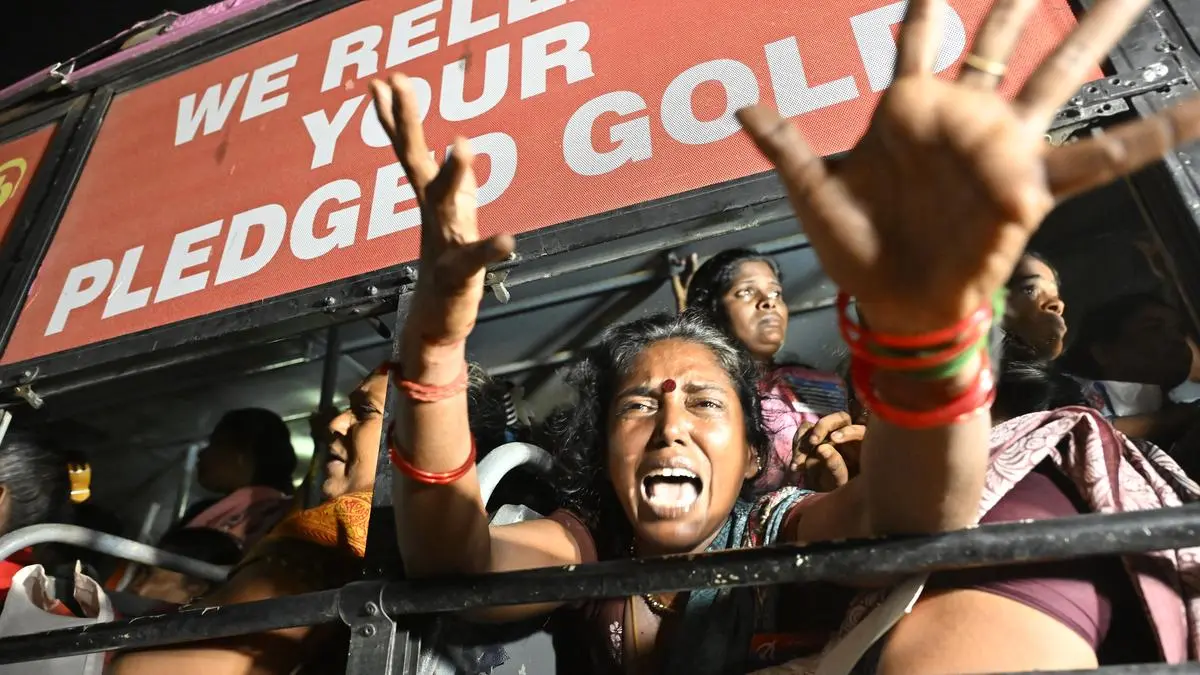
A conservancy worker of the Greater Chennai Corporation detained by the police after nearly two weeks of protest against the privatisation of conservancy operations in the Royapuram and Thiru Vi Ka Nagar zones in Chennai, on August 13.
| Photo Credit:
AKHILA EASWARAN
Conservancy work in Chennai (then Madras) dates back to the mid-17th century, when the then Governor of Madras Presidency, Streynsham Master, employed a team to sweep the streets of the new town. A conservancy tax was levied on businessmen and landowners, which they opposed, demanding the privilege of exemption. From then until now, while the town has expanded into a full-blown metropolitan city, with the largest municipal corporation in Tamil Nadu, the attitude of its residents has remained the same: to resist any participation in the process of sanitation and waste management.
Take, for example, the proposed privatisation of Zones 5 and 6 (Royapuram and Thiru Vi Ka Nagar). When conservancy workers affiliated to the respective unions called for a strike and protested outside Ripon Building (where the GCC is headquartered), politicians and middle-class citizens spoke of the garbage piling up, of their taxes being misused (“I pay tax; I am entitled to a clean city”), of their rage that a section of the city was left unclean. In the conflict between private contractor and workers, both citizens and politicians vouch readily for the efficiency of the contractor and speak of privatisation as the only way to ensure a “clean city”.
The business of solid waste management
The scrutiny that sanitation workers are subject to is missing when the GCC makes decisions, along with politicians, on the future of waste management in Chennai. The tender from the GCC calling for the privatisation of Zones 5 and 6 was issued in 2023, followed by bids submitted by three parties: Delhi MSW Solutions Ltd, Sumeet Urban Services (Chennai), and Swachatha Corporation. Swachatha Corporation’s bid was rejected in the technical round. Delhi MSW Solutions’ bid stood at Rs.360 crore and Sumeet Urban Services’ bid at Rs.278 crore. A Letter of Acceptance was eventually issued to Delhi MSW Solutions, but the tender summary shows glaring deficiencies.
For instance, it should list the methodology used to scrutinise the bids—rankings under technical summary, financial summary, comparison of the BOQ (a document detailing every work item, material, labour, and their quantities required to complete a project), and reasons for award of contract. These are absent, as are an estimation of costs by bidders. Barring a few, most tender summaries of the GCC that are available for online scrutiny seem devoid of details.
Even though the Tamil Nadu Transparency in Tenders (PPP Procurement) Rules of 2012 state that the lowest bidder must be considered the most eligible, Delhi MSW moved from a bid of Rs.360 crore to Rs.277 crore in a process that has become all too familiar.
Bureaucrats who have served in the GCC told Frontline on condition of anonymity that such processes are only carried out for the sake of formality, and that the scrutiny they require has long been neglected. “The demand for privatisation of these zones has come from the Ward Councillors and corporators themselves, channelled through Sekar Babu,” said one bureaucrat, who also explained how all the other zones were making money from waste by projecting more tonnes than what was collected. (P.K. Sekar Babu of the State’s ruling party, the Dravida Munnetra Kazhagam, is the Minister of Hindu Religious and Charitable Endowments Department and represents the Harbour Assembly constituency, which covers many core areas of Chennai. The GCC falls in his sphere of influence.)
In privatised zones, corporators exercise significant sway, whether in the procurement of essentials for workers or in the flow of money generated from solid waste.
A corrigendum to the tender states that the daily wage rate of a sanitary worker, among similar roles, is to be disclosed as Rs.687 at the time of bidding. This, even if lower than the minimum wage, adds up to Rs.21,000 a month, as opposed to the appointment orders that stipulate a daily wage of Rs.565. The difference, when multiplied across thousands of workers, runs into crores, money that vanishes into thin air right at the outset. After the strike, an order of the Madras High Court dated August 20, 2025, has directed Delhi MSW Solutions to pay conservancy workers their last drawn wages.
A retired Municipal Commissioner, S.A. Khader, who was instrumental in transforming districts such as Suryapet in Telangana into a zone of efficient waste management, with workers sharing the incentives from processing waste, offered a blunt assessment: “Everybody in the Municipal Commission, be it corporators, counsellors, engineers, MLAs, ex-MLAs, MPs, or Collectors, knows that a sure-shot way to earn money is through the municipality, especially from what is set aside for sanitation.”
This has also been the experience of the former IAS officer Sasikant Senthil (currently a Congress MP from Thiruvallur constituency), who implemented strict waste management regulations in Raichur, Karnataka, during his term as District Collector. The method of collection was changed from public bins to door-to-door; source segregation was encouraged; the waste collected was processed; and the profit from it turned into an incentive for the workers. However, Senthil said: “The year I left Raichur, corporators were back to their game.”
Origins of public-private partnership
The concept of public-private partnership in solid waste management began in the 1990s. The narrative often hinged on how municipal corporations were unable to do a good job of cleaning cities because of “inefficient workers”. This, according to pro-privatisation voices, meant the government had to outsource the work. In Chennai, the idea was introduced when M.K. Stalin was the Mayor of Chennai (1996-2002), based on the same logic of “inefficient workers” and reportedly after a visit to Singapore where he was struck by the city’s cleanliness. Twenty-five years later, as sanitation and waste management in the city continues to remain abysmal, every zone under the GCC is looking to being turned over to private players while Stalin’s government has reneged on its promise of regularising conservancy workers.

The organisational chart of the Greater Chennai Corporation.
| Photo Credit:
https://chennaicorporation.gov.in
Says the advocate Saravanan, who has been filing PIL petitions in the Madras High Court for more than a decade now: “This is just a ruse: are the workers who are at the lowest rung of the chain the real reason for inefficient sanitation? What is the real reason?” All his PIL petitions have demanded that sanitation workers be given protective equipment to carry out their work, and that dehumanising work, such as clearing human excrement with bare hands from railway tracks, be mechanised.
The GCC’s tender document lists a hierarchy that is responsible institutionally for waste management.
Saravanan said: “In the decades since Independence, there has been absolutely no scrutiny on what these people, all on the government payroll, are doing. The only ones who are blamed at the drop of a hat for a so-called unclean city are the workers.” He reiterated how conversation around the work itself has not moved away from the historically casteist connotations of “dirty work”. While unsegregated waste attracts the strictest penalties and legal notices in countries such as the US and Sweden, source segregation is not even part of government policy in India. “How is it the burden of the most underpaid worker to keep the city clean, when you can’t even give him equipment or when households can’t segregate waste?”
People working with private contractors say that an organisation such as the GCC cannot efficiently manage sanitation because there are “too many leakages”—in other words, corruption. Therefore, they told Frontline, the only option is to give the job to private players. One of them also said: “This is also a way to break the collective bargaining powers of workers and the unions that represent them.”
A major cause for concern for municipal corporations and private contractors is the drop in numbers of those willing to sign up for this work. Instead of speeding up mechanisation, the State has resorted to bringing in migrant workers from other States and underpaying them, as in Tiruppur, or blocking the compulsory regularisation of workers into Group D posts.
Every conservancy worker Frontline spoke to during and after the recent strike outside Ripon Building had similar stories to tell. For decades, their experience has been one of hazardous work that is not clearly defined, safety equipment that is either not provided or is not replaced on time, zero workers’ incentives or benefits, and rampant exploitation. This work, which tripled during the pandemic and natural calamities, goes unacknowledged. But, most importantly, there is a deep-rooted feeling of dehumanisation and disposability among the workers that is reinforced by both the GCC and private players.
Contract workers who have tried to affiliate themselves with a union have been swiftly dismissed, barring a few exceptions where a court order has sought their reinstation. Even the judiciary, according to Saravanan, is far from understanding the worker’s predicament. He referred to a recent statement by a Supreme Court judge who asked that sanitation workers entering manholes be “sensitised not to do so”.
The new contract awarded to Delhi MSW has changed the terms of the contract itself. Now, instead of a single focus on waste collection, workers will be expected to play multiple roles under the broad ambit of “city cleaning”.
This means they can be assigned multiple duties at the discretion of the contractor, without compensation. “What 50 of us used to do, 10 are doing now,” said Vasuki, a conservancy worker from a Chennai zone where the work is already privatised. Sumati, who participated in the strike but had to return to work on Independence Day, said that even though the efforts of the union continue, she felt defeated: “Not because we were manhandled by the police but because this city refused to speak up for us.”

Police remove conservancy workers of the GCC protesting outside Ripon Building,
in Chennai on August 13.
| Photo Credit:
AKHILA EASWARAN
For a nationwide workforce numbering more than one crore, the lack of representative organisations is sorely felt. While there are more than 16 unions in Chennai itself, the reality is that the regularisation of these workers seems almost impossible now, especially with the Tamil Nadu government aggressively moving towards outsourcing every sector that falls under Group D. Khader said that while some unions have been successful in demanding that corporations pay minimum wages, most city corporations in India have moved towards privatisation.
Also Read | Other side of the city
For sanitation to work, Khader believes it must be planned under city corporations, with their working revamped and hiring and payment made more transparent. He adds that private players only become a mode to facilitate corruption along with the administration’s power brokers. In its order dated October 4, 2004, in Almitra H. Patel v. Union of India, the Supreme Court acknowledged Khader’s model in Suryapet, which relied on efficient planning within the town with zero dependence on State or Central funds, as a model that could be emulated by other States. Such directives, though, have almost no takers.
If governments have failed to be fair to conservancy workers, commissions such as the National Commission for Safai Karamcharis or the SC/ST Commission, too, have been largely ineffective in speaking up for their rights. Two members who serve on these commissions told Frontline that such bodies are always constituted in a way that they align with the interests of the state and are never the watchdogs that their role demands. Individuals such as Saravanan and Khader have been calling for reforms in solid waste management, but without real political will, the work will remain rooted in caste and the workers will remain award-winning photo-ops.
Greeshma Kuthar is an independent journalist and lawyer from Tamil Nadu.