








Last Updated:
The next Rajya Sabha vacancies from the state are due only in August 2029, which is when the BJP can begin converting its assembly strength into Upper House seats




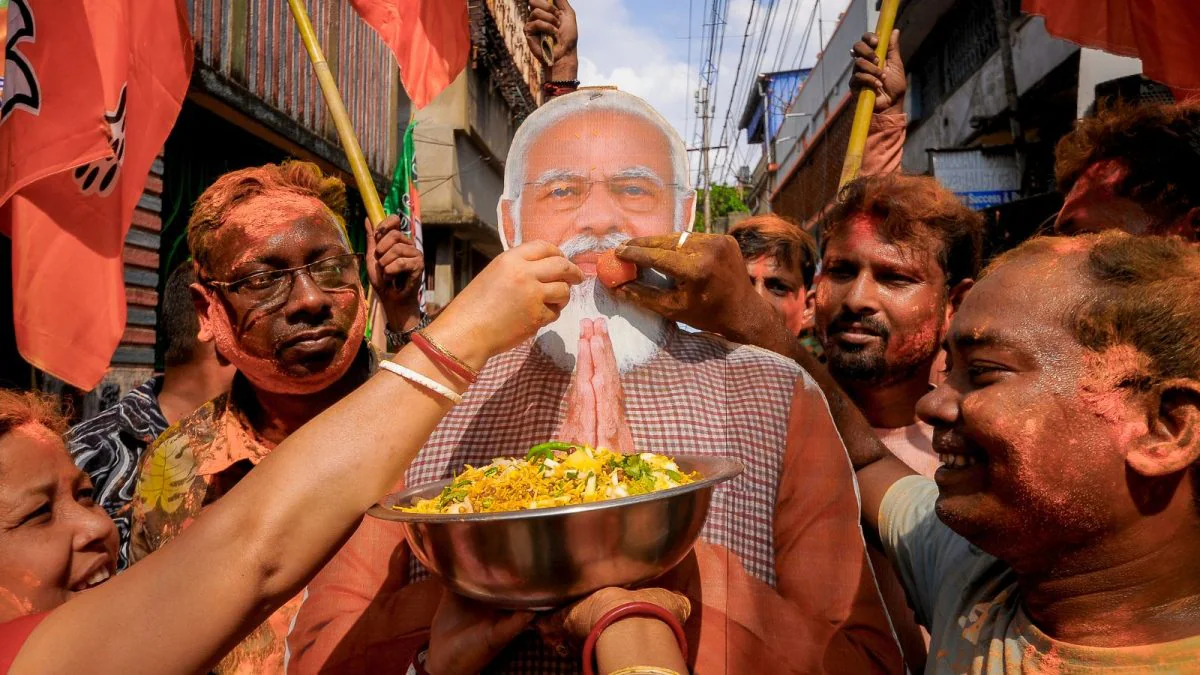
BJP workers offer sweets and jhalmuri to a cut-out of Prime Minister Narendra Modi as they celebrate the party’s win in West Bengal. (PTI Photo)
It looks like a sweeping political victory. It sounds like a number boost in Parliament. But, there’s a catch: the Bharatiya Janata Party (BJP)’s big win in West Bengal may not translate into immediate gains in the Rajya Sabha. The delay is not due to some strategy of the saffron party but how India’s political system works.
The Rajya Sabha isn’t elected directly by voters. Its members are chosen by MLAs in state assemblies and they serve staggered six-year terms. That means election results in a state only impact the Upper House when that state’s Rajya Sabha seats fall vacant.
According to The Economic Times, in West Bengal’s case, that wait is long. The next Rajya Sabha vacancies from the state are due only in August 2029, which is when the BJP can begin converting its assembly strength into Upper House seats.
ALSO READ | Is West Bengal Staring At A Constitutional Crisis? What Next As Mamata Banerjee Refuses To Resign
Until then, the current composition, largely shaped by the previous Trinamool Congress-led Assembly, remains unchanged.
The Numbers Behind The Delay
West Bengal sends 16 MPs to the Rajya Sabha. A chunk of these seats, currently dominated by the TMC, only come up for renewal starting 2029, Hindustan Times reported. In the 2029 cycle, six seats from the state will fall vacant, most of them held by the TMC. Only at that point can a BJP-led Assembly elect more of its own MPs, news agency PTI explains.
ALSO READ | Mamata’s First Political Test After Losing West Bengal CM Chair: Municipal And Panchayat Polls
For now, nothing changes, at least not immediately.
Despite the Bengal win, the BJP-led NDA is still short of a two-thirds majority in the Rajya Sabha, a key threshold for passing constitutional amendments. The alliance currently sits below that mark and will need gains across multiple states over several election cycles to get there, The Indian Express said.
The Bengal result alone doesn’t shift the Upper House balance in the short term but it’s a long-term structural advantage, The Print notes.
A Slow-Burn Advantage
What the Bengal victory does is strengthen the BJP’s pipeline to the Rajya Sabha.
According to The Economic Times, the party’s growing footprint in state assemblies—its MLA count has more than doubled over the past decade—improves its long-term prospects in the Upper House.
This isn’t just about Bengal. Similar delayed gains are expected from other states like Tamil Nadu, where the impact of recent elections will also show up only in future Rajya Sabha cycles. The ET report says the Tamilaga Vettri Kazhagam (TVK) is likely to make its Rajya Sabha debut by June 2028, sending around three members and altering the current balance by snatching seats from the DMK, Congress and AIADMK.
In Puducherry, the NDA’s win is likely to secure its hold over the Union Territory’s single Rajya Sabha seat when it comes up for election next October. In Assam, however, the results are not expected to alter the broader equation much, with the BJP set to retain its existing footing in the state.
While the expansion spells good news for the BJP, there’s also a flip side. As the BJP expands in state assemblies, parties like the Congress risk losing future Rajya Sabha representation. With fewer MLAs, their ability to send MPs to the Upper House weakens over time, a trend already visible in current numbers.
While the Kerala verdict is set to trim the Left parties’ presence in the Rajya Sabha next year, it won’t significantly shift the INDIA bloc’s overall tally. Any losses for the Left are likely to be offset by gains for the Congress, keeping the bloc’s numbers broadly intact.
Read More