




Mamata Banerjee, the founder of the Trinamool Congress (TMC), seems to have lost control over the party founded by her three decades ago. Leaders from all levels, be it the grassroots, MLAs and even MPs have rebelled. Local leaders of the TMC are facing people’s anger, and quitting. But what is the reason that even Lok Sabha MPs of the TMCs are ready to switch allegiance to the BJP-led NDA?
Over 100 councillors have resigned from their posts. At the state level, the rebel camp led by Ritabrata Banerjee commands the loyalty of at least 60 of the 80 MLAs. At the parliamentary level, 20 of the TMC’s 41 MPs, led by Kakoli Ghosh Dastidar, were angling to be part of the NDA. It’s a collapse of control at all levels for Mamata Banejee. And it has been accelerated by at least two factors — widespread public outrage that is making councillors flee and the MPs nervous, and a conducive environment being created by the BJP for those wanting to rebel.
Those rebelling have cited several allegations, including corruption by a section of the leadership and Mamata’s patronage of her nephew Abhishek, who is seen as the prime reason for the TMC’s loss in the election.
While it might seem that the TMC leaders had become self-righteous suddenly, a sense of self-preservation is at play here.
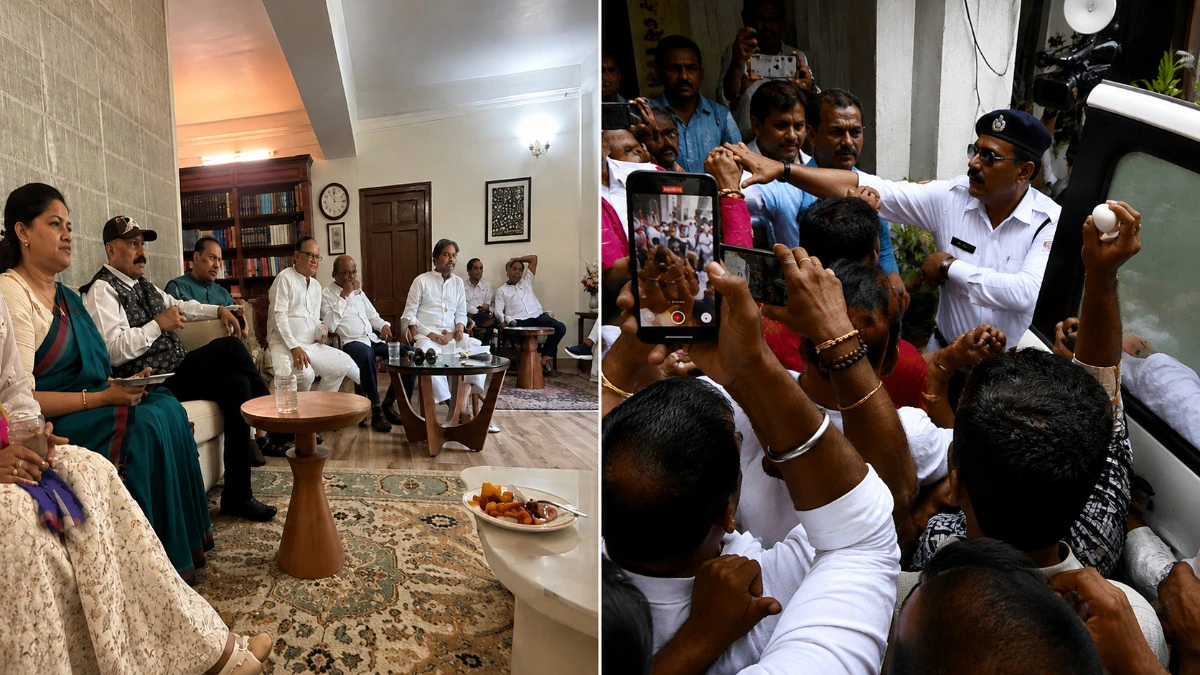
TMC leaders, including Abhishek and Kalyan Banerjee, have been heckled with “chor, choir (thief, thief)” chants. Many of them have been attacked with eggs and tomatoes too. The 15 years of TMC’s corruption, authoritarian rule and repression fed widespread anger. Earlier protected, the TMC leaders are now facing people’s wrath. The MPs are trying to escape this anger.
These MPs will also be the first to face re-election in the general election of 2029. Seeing the Assembly segments of their parliamentary constituencies fall like nine pins, they are worried. Some of them also fear facing action from probe agencies in corruption cases linked to them, and believe that perceived proximity to the ruling regime might shield them.
While the ground is scorching hot, the BJP has reportedly created a conducive environment for those wanting to rebel against Mamata Banerjee and her handful of loyalists. While not fully welcoming the defectors, the BJP is being seen as lending the rebels crucial support.
ARE REBEL TMC LEADERS GETTING NERVOUS OF THE PUBLIC MOOD?
Since May 4, when the BJP swept the West Bengal Assembly elections and pushed the TMC back into the opposition, it is not the party’s top leadership but its grassroots functionaries who have borne the brunt of public anger.
At least 101 councillors have resigned across the state in the weeks following the defeat. The exodus includes eight councillors who quit en masse after the TMC’s humiliating loss in the Falta repolling.
For those who stayed on, the pressure has only intensified. A series of arrests has stripped many local leaders of the political protection they once enjoyed. Kolkata Ward 123 councillor Sudip Polley was arrested on extortion charges on May 23. The arrests of Ward 36 councillor Sachin Singh and Ward 106 councillor Arijit Das Thakur on June 2, Ward 2 councillor Mahesh Kumar Sharma on June 3, and Ward 114 councillor Biswajit Mondal on June 4.
The arrests have been accompanied by a remarkable display of public hostility. Dozens of TMC local leaders and councillors have been assaulted and had eggs thrown at them.
According to a report in The Hindu, the fear of people attacking TMC councillors ran so high that a planned meeting at Trinamool Bhavan on June 7 had to be called off.
The backlash isn’t limited to councillors. Abhishek Banerjee, once regarded as the party’s de facto number two, was attacked and pelted with eggs and stones in Sonarpur on May 30. The following day, MP Kalyan Banerjee was heckled outside Chanditala Police Station in Hooghly and struck on the head by an object thrown from the crowd. On June 6, Kamarhati MLA Madan Mitra’s convoy was chased through his constituency by protesters who showered it with eggs.
It is this atmosphere of public fury that might be pushing some MPs away from Mamata.
Some rebel MPs who are exploring a shift towards the NDA are motivated more by their self-preservation instincts than by ideology, said author and political analyst Sayantan Ghosh, professor at St Xavier’s College and author of Battleground Bengal.
“Many of these rebelling MPs who are angling to join the NDA are nervous that they would be similarly heckled and mobbed if they go to their constituencies,” Ghosh told India Today Digital. “Their hope is that by aligning with the NDA, the BJP-led state government will grant them security cover to avert such incidents.”
Some rebels might view the proximity to the ruling establishment as a shield against ongoing investigations and possible arrests.
Pointing to the case of Topsia MLA Javed Khan, whose constituency was among the first to witness demolition drives targeting alleged illegal constructions, Ghosh argued that several leaders facing scrutiny see rebellion as a form of self-preservation.
“Khan and his son [Faiz Ahmed Khan, a councillor] are complicit in much of the illegal construction now being demolished,” Ghosh said. “He, like many others, rebelled against the TMC in the hope that the BJP state government, in the course of its investigations, will not end up arresting them.”
The TMC’s internal revolt among both its MPs and MLAs thus seems to be driven by political survival. It may also reflect a growing fear among some of its leaders that, after years of electoral dominance, they are now confronting something far more unpredictable: the mood of the street.
IS SUPPORT FROM THE BJP DRIVING TMC MP MUTINY?
While public fury might be one reason, equally compelling is the welcoming environment being actively cultivated by the BJP leadership, say experts.
On Monday, the 20 rebel MPs under the leadership of Kakoli Ghosh Dastidar wrote a letter “with 19 other MPs’ signatures” to Lok Sabha Speaker Om Birla, saying they would like to be considered as a separate bloc of MPs that would support the NDA. “We [the 20 MPs] have written to the Honourable Speaker that we want to be a part of the NDA,” she said. There was a possibility of the MPs merging with the BJP, she added.
With the TMC having 28 MPs, the rebels have the numbers to comfortably bypass the anti-defection law and stake claim to the Trinamool’s name and symbol, mirroring the actions of Ritabrata Banerjee-led legislative party’s move last week.
The sequence of events and the locations indicate how the BJP leadership has emerged as enablers for the rebellion in the TMC.
Fourteen of the TMC rebel MPs were reported to have attended a meeting at Union Minister Bhupender Yadav’s home in New Delhi on Monday. They were joined by West Bengal Chief Minister Suvendu Adhikari. Later, eight rebel MPs met at the residence of TMC MP Satabdi Roy in the presence of Adhikari.
“It is support from the BJP that is fuelling the rebellion within the TMC,” author and journalist Snigdhendu Bhattacharya told India Today Digital.
Pointing to the meetings the rebels had with Bhupender Yadav and Suvendu Adhikari, Bhattacharya noted, “There was, of course, significant discontent within the TMC. But the mutiny among the TMC’s MPs that we are seeing now could not have taken place without the support of the BJP. They, after all, stand to benefit the most from the numbers the TMC rebels can bring to the NDA.”
Experts also believe that most of the TMC rebels relied heavily on Mamata Banerjee’s support to win elections and hadn’t built a political base of their own. With support for Mamata weakening, they find themselves vulnerable. The bid to jump to the BJP-steered NDA was for a strong political support structure.
“Most of the TMC rebels lack the qualities of a mass leader, having relied heavily on Mamata Banerjee’s personal appeal to sustain their political careers. Without her backing, they could never have attained the positions they occupy today,” Sayantan Ghosh told India Today Digital.
Meanwhile, West Bengal Pradesh Congress Committee President Subhankar Sarkar told India Today Digital on Friday that the BJP had effectively created a “shadow Trinamool” (referring to Ritabrata Banerjee’s rebellion) in order to weaken the opposition space in West Bengal.
As the TMC grapples with mass defections, public fury, and internal fractures, Mamata Banerjee’s once-dominant political machine stands at a critical crossroads. Whether the party can stem the tide of rebellion or succumbs to further disintegration will likely shape the future of West Bengal politics for years to come, with the NDA poised to capitalise on the chaos. What is evident, however, is that the heat on the ground, and with the BJP as the enabler, a good number of TMC MPs are willing to side with the NDA.
– Ends