



Imagine a person who is both Hindu and Muslim. Now imagine an entire village of such people. These are not delusional split personalities or the residents of a crazy commune but a small community of folk artistes and storytellers who claim two religious identities. I wrote about this some years ago to describe the patachitra painters of West Bengal, who paint scrolls that mostly depict Hindu divinity and epics and traditionally narrate their stories in song as they unfold the scroll scene by scene. Your god, they say, is my god. I was fortunate to have briefly lived in their village, named Naya in Paschim Medinipur, while doing fieldwork on syncretistic traditions.
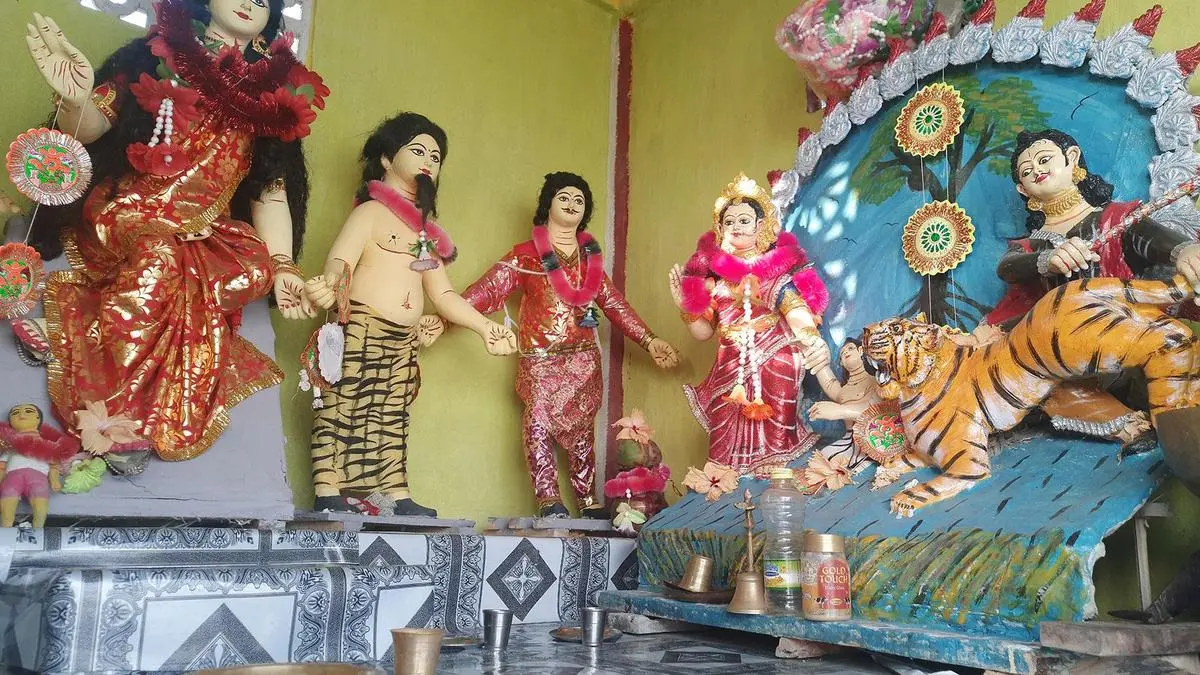
Imagine, too, the existence of a forest goddess who, local people insist, is Muslim. In imagery and form, Bonbibi resembles the several Shakti figures worshipped in West Bengal. But in the Sundarban, a vast tract of forest and swamp land, the largest mangrove forest in the world, people insist she is a Muslim who protects local communities from man-eating tigers. It is one of the most fascinating aspects of this land, with its shifting islands and seas, tigers, muddy embankments, mysterious forests, Muslim goddesses, and Hindu worshippers.
Much has been written about Muslims in West Bengal in the run-up to the Assembly election, many of them disenfranchised through the Special Intensive Revision (SIR) of electoral rolls. They are the profiled group against whom, it is believed, there was a decided Hindu consolidation. We have also been told of the many Muslim henchmen in the structures of the defeated party and heard the speeches of BJP campaigners and raving television anchors who define Bengali Muslims as either infiltrators or criminals. Post-election, we see protests in Kolkata against the ban on namaz said on roads when the mosques spill over, against the entry of the bulldozer, and the Kafkaesque new rules (take multiple permissions or face jail and fines) on animal qurbani (ritual animal sacrifice).
All these narratives present a certain stereotype of Bengali Muslims. But who are they? Most of them are cultivators and peasants who labour in the fields, and like the poor everywhere, many migrate out of the State in search of better wages. They are less urbanised than the Muslims in, say, Uttar Pradesh. In his seminal work on Bengal’s Muslims, the historian Richard M. Eaton wrote that the rise of the cultivator class of Bengali Muslims can be traced to their clearing of forests for agriculture. The Bengali Muslim identity is therefore built around a different local history than that in, say, southern India where they are prosperous trading communities. In the wonderful book The Islamic Syncretistic Tradition in Bengal, the historian Asim Roy examined the local beliefs of Bengal’s Muslims, originating from their lived realities in the Bengal delta and their pre-Islamic lore.
So, what will happen now to this 27 per cent of the population? The victorious BJP has more or less said that it does not intend to serve them and, in fact, will be actively hostile to them. “Detect and deport” are the words that BJP leaders used to describe what they would wish to do to Muslims here, one of their larger population clusters in South Asia.
There could possibly be a two-pronged strategy: an electoral one that involves cutting the population’s influence that arises from sheer numbers, and a cultural one to keep the community as an active hate object. The election that culminated in the BJP’s win in Bengal has been flagged as the most questionable in the country’s recent history, and some methods employed by the Election Commission of India are being legally challenged. The ruling party is anxious to put down roots in this non-traditional area where a large Muslim population always presented a numerical challenge.
Therefore, now that the SIR is over, we can also expect delimitation of constituencies to be done in the manner it was managed in Assam: to reduce the electoral clout of targeted sections of the population. Police cases and bulldozer action are also part of the playbook, apart from the constant push to disenfranchise and terrorise. The BJP got 45.84 per cent of the vote share, which means that over 50 per cent of the population did not vote for it in Bengal, and Muslims would form about half of those people. There will be upcoming election cycles that will reveal whether there is potential for opposition parties—the Trinamool Congress, the Congress, and the CPI(M)—to come together.
Police detain protesters during a rally organised by Muslim organisations to protest against the Special Intensive Revision of electoral rolls and harassment of Bengali migrant labourers in other States, in Kolkata in August 2025.
| Photo Credit:
ANI
The corporation and municipal elections will take place in 2027, the panchayat elections in 2028, and the next Lok Sabha election will be held in 2029. In a State known for political retribution, who will occupy the opposition space? The national leadership of the Congress believes it should join forces with the Trinamool. The Left position is more complicated, with one school in the CPI(M) believing that the Left will be the eventual beneficiary of the demolition of Mamata Banerjee (even if the BJP is used for that). Will the Left (now embedded in the Right) become glued to power or will there remain a small left-leaning Left within the Right? Or are these all just deranged ideas and propositions?
The self-image of the Bengali “bhadralok”
Then there is the self-image of the Bengali “bhadralok”. They are mostly drawn from the powerful castes, as most loyal voters of the BJP in the Gangetic belt have been, so will Hindutva feel like a natural fit? Or will doubts and discomfort resurface among these people who have been at the vanguard of intellectual exploration? After all, much before the Hindutva brand of nationalism, before communism, and the subnationalism of Mamata, Bengal is the land where Raja Ram Mohan Roy founded and edited two newspapers to promote reform and awareness in society: a Bengali weekly, Sambad Kaumudi, and a Persian one, Mirat-ul-Akhbar. It is the land of the poet Rabindranath Tagore, who wished to break down “narrow domestic walls”, and the revolutionary Subhas Chandra Bose, who believed in the idea of a strong central state but was explicitly anti-communal.
The BJP victory in Bengal is the biggest escalatory event for the ideology of the Hindu Right after it won Uttar Pradesh in 2017. After the Gujarat model of Narendra Modi, one saw the Uttar Pradesh model. Will there now be a Bengal Hindutva laboratory or are the chemicals in the mix too volatile?
Will the political consciousness and unique cultural pluralism of Bengal be able to withstand the homogenising force of a northern Hindutva project? And how will the BJP target, suppress, control Bengal’s large Muslim population, a community woven into the very fabric of the State? Will they hunt them in the fields and farms and forests?
It is also moot to ask how this will pan out in the context of relations with Bangladesh. What we have today are partitions within partitions: a Bangladesh that allegedly mistreats Hindus (according to narratives of the BJP/RSS) on one side of the border and a West Bengal that is preparing to mistreat Muslims on the other side.
Saba Naqvi is a Delhi-based journalist and author of four books who writes on politics and identity issues.
Also Read | The vanishing Muslim MLA
Also Read | Why the BJP’s big win in West Bengal is not a surprise