









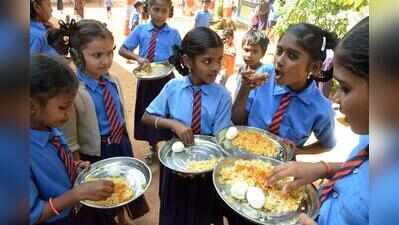
Bengaluru: Which came first: Egg or banana? Karnataka’s flagship midday meal scheme, which ensures nearly two-thirds of the total 47 lakh students in govt and aided schools of the state get six eggs a week as part of nutrition drive, is back to its familiar dilemma. This time, the either-or debate is triggered by prices of eggs touching a high. For perspective, the state govt provides Rs 5 for an egg and Re 1 for logistics. Schools have to procure eggs from a local vendor. With the price of egg crossing Rs 8 across the state, schools are finding it difficult to buy and distribute eggs among students from within the budgetary allocation.Under the Pradhan Mantri Poshan Shakti Nirman (midday meals, more popularly), many schools are requesting children to take bananas instead, while a few are rationing it on alternate days. Some schools in Mysuru have temporarily stopped giving eggs as part of meals.While the department of school education (midday meals) denied any fall in the number of students taking eggs, the ground situation paints a different picture. “Two weeks ago, we sent a proposal to the finance department seeking Rs 8 per egg. A review meeting is expected on Thursday,” said Prakash Nittali, director, midday meals.
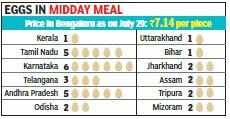
Egg in midday meal
In Mysuru region, egg price hovers between Rs 8.50 and Rs 9. Banana prices, too, are similarly going up. “We replaced eggs with pocket-friendly elakki bananas. With this variety hitting Rs 80 a kg, we are giving Robusta bananas,” said a headmaster in Mysuru.From 450 last year, the number of students opting for eggs increased to 750 in an east Bengaluru school following an awareness campaign by Azim Premji Foundation. “On the flip side, our vendors couldn’t meet the demands. Since they are providing around 300 eggs a day at the current price, we have resorted to alternate-day distribution, having divided students into two equal batches. For instance, we received 190 eggs on Wednesday; yet, only 30% of students received eggs,” said a teacher from the school.In Dakshina Kannada which sees large school enrolments, a mix of bananas and eggs is served to manage costs. A school with over 1,000 students follows a 70:30 formula in favour of eggs.Not ready to undercut the importance of the programme, some teachers are opening their purse strings and paying the difference. A headmaster in Mysuru is said to have paid Rs 15,000 from his pocket. Similarly, teachers, School Development and Monitoring Committees and old students’ associations have stepped in, while the govt is yet to come up with an inflation-proof egg-pricing formula. “Headmasters have been urged to raise funds,” said Jnanesh MP, education officer, PM Poshan Scheme, Dakshina Kannada.At the same time, school authorities feel their egg programme is constantly under watch. Joint teams from the education department and Azim Premji Foundation, who have been monitoring distribution since September 2024, conduct surprise checks on the egg programme. “Vigilance teams from APF directly ask students if they were served eggs. If the answer is no, they issue a notice to the teacher on the spot,” said an SDMC member.In Dharwad, 1.9 lakh children receive mid-day meals, and 80% opt for eggs (and bananas during festivals). School heads and SDMC members are forced to contribute up to Rs 2 per egg from personal funds.“Govt fixes egg prices based on the wholesale rates in Hospet. Prices go up substantially because of transportation. An egg that costs Rs 6.40 in Hospet is Rs 7.30 in Mangaluru. If damage exceeds 2% in a consignment, it substantially impacts our earnings. And our margins are thin,” said Alwyn Pinto, president, Dakshina Kannada Egg Suppliers Association.“Despite the squeeze, schools continue to serve eggs, helped largely by SDMC. We have received requests from teachers to increase allocation,” added Hanumanthappa Fadneshi, Hubballi City Block Education Officer.“We pay Rs 7,500 every month. The government gives Rs 6 per egg against the market rate of Rs 8,” said Nityananda, SDMC President at KPS Honnethalu, Shivamogga district.“Of the ₹6 allocated per egg, ₹5 goes to buy egg, ₹0.50 to boil it, ₹0.30 for peeling the shell, ₹0.20 for local transportation. Market prices range from ₹8 to ₹8.50; ₹9 in remote areas,” said Sadananda, Block Education Officer (BEO), Sagara, Shivamogga district.“Many seemingly good schemes fail because of lack of political will. Either the govt should procure eggs or have an inflation-proof pricing system. It’s a shame the state govt depends on a private entity, which can introduce conditions at any time or, worse, withdraw. Govt does not have the bandwidth to absorb price variations. This confirms a lack of commitment,” added Dr Sylvia Karpagam, public health doctor.(With inputs from Sruthy Susan Ullas in Bengaluru; Shrinivasa M, Uday Sagar & Ranjith Kandya in Mysuru; Deepthi Sanjiv in Mangaluru and Akshaykumar Doddamani in Dharwad)