
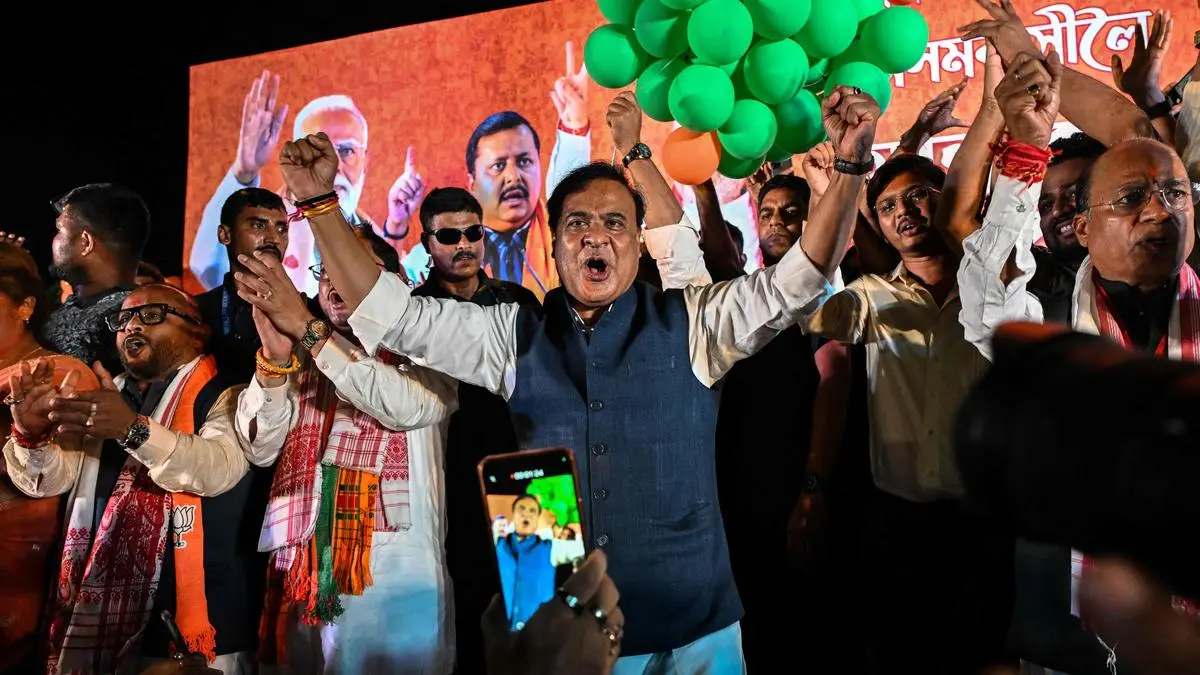
The National Democratic Alliance (NDA), led by the BJP, swept the Assembly election in Assam to retain power for a third term. The NDA won 102 of the State’s 126 seats. Unlike in 2016 and 2021, the BJP secured a majority on its own by winning 82 of the 90 seats it contested.
Political scientists have attributed the saffron sweep to a sharp religious polarisation of the electorate and the creation of a strong support base for the ruling party through cash payouts and social welfare schemes, especially among women beneficiaries..
The two regional allies of the BJP, the Asom Gana Parishad (AGP) and the Bodoland Peoples Front (BPF), won 10 seats each. Both parties performed better than they did in the 2021 election: the AGP increased its tally by 1 and the BPF by 6. Yet, with the BJP notching up a tally that is 18 more seats than the requirement for a simple majority, their importance in government formation will be reduced this time.
The NDA won 86 seats in 2016, when the BJP came to power in the State for the first time, but its tally was reduced to 75 in the 2021 Assembly election. In both elections, the BJP’s tally was limited to 60 seats, 4 less than the magic number, making it dependent on the support of its regional allies for government formation.
The opposition strength in the newly elected Assembly has been reduced to 24 seats. Of these, the Congress managed to win only 19, marking the party’s worst ever electoral performance in Assam, while its pre-election alliance partner the Raijor Dal won 2 seats. Four other constituents of the Congress-led opposition alliance—Assam Jatiya Parishad (AJP), All Party Hill Leaders’ Conference (APHLC), CPI(M), and Communist Party of India (Marxist-Leninist) Liberation—drew a blank.
The All India United Democratic Front (AIUDF) won two seats and the Trinamool Congress won one seat. Both parties had contested alone (the Congress-led alliance had rejected the AIUDF’s proposal for induction into the front). The AIUDF’s decimation to just 2 seats from the 16 it won in 2021 is attributed to the shifting of its support base of Muslims of East Bengal origin to the Congress.ts from the 16 it won in 2021 is attributed to the shifting of its support base of Muslims of East Bengal origin to the Congress.

There is not a single Muslim among the 102 elected representatives of the NDA. On the other hand, 18 of the 19 Congress winners are Muslims. So, the principal opposition party will have just 1 Hindu representative in the new Assembly. Of the 24 newly elected opposition MLAs, only 2 are Hindus.
Record turnout
The State registered a record turnout of 85.38 per cent, breaking the 2016 record of 84.72 per cent. Women voters recorded a higher turnout percentage (85.96) than men (84.8). In 2016, the turnout of women voters (84.81 per cent) was only marginally higher than that of men (84.64).
Chief Minister Himanta Biswa Sarma’s election campaign had hinged on his government’s welfare schemes for women. The higher turnout of women voters is attributed to the cash payout of Rs.9,000 to each of 40 lakh women beneficiaries of the Orunudoi scheme, which was distributed barely a month ahead of polling. Sarma’s government transferred the money—cumulatively amounting to Rs.3,600 crore—into the bank accounts of the beneficiaries on March 10.
The NDA parties secured a combined vote share of 48.01 per cent, with the BJP getting 37.81 of the votes; the AGP, 6.47 per cent; and the BPF, 3.73 per cent. In 2021, the NDA’s combined vote share was 44.51 per cent: the BJP got 33.21 per cent of the votes; the AGP, 7.91; and the United People’s Party Liberal (UPPL), 3.39 per cent.

Among the prominent winners were Sarma and most of his Cabinet colleagues, including two from the AGP (Atul Bora and Keshab Mahanta) and one from the BPF (Charan Boro). Others were the Speaker, Biswajit Daimary; AIUDF chief Badruddin Ajmal; and Raijor Dal leader Akhil Gogoi.
Among the prominent losers was Assam Pradesh Congress Committee president Gaurav Gogoi, who was the Congress-led opposition’s declared chief ministerial face. He lost in the Jorhat constituency, one of the Assembly segments of the Jorhat parliamentary constituency that he represents in the Lok Sabha. He was trounced by the sitting BJP legislator and former Assembly Speaker Hitendra Nath Goswami by a margin of 23,182 votes.
Other major losers were AJP chief Lurinjyoti Gogoi; UPPL chief and Rajya Sabha member Pramod Boro; the CPI(M)’s lone legislator in the outgoing Assembly, Manoranjan Talukdar; and APHLC chief J.I. Kathar.
Assam Congress chief and candidate from Jorhat constituency Gaurav Gogoi (centre) and Assam Jatiya Parishad leader Lurinjyoti Gogoi (right) at a roadshow in Guwahati in support of the Congress candidate from New Guwahati constituency, Santanu Bora. All three lost.
| Photo Credit:
PTI
The vote share of the Congress increased marginally to 29.84 per cent against 29.67 per cent in 2021. But it was overwhelmingly the Muslim-majority constituencies that elected Congress candidates. The party has lost Hindu-majority seats by huge margins, showing that its vote share remains concentrated in the Muslim population.
Delimitation factors
The mandate was clearly a sharply polarised one. This was the first State election held after the redrawing of geographical boundaries of Assembly constituencies. The election mandate mirrors the delimitation exercise of 2023, which created 104 Hindu-majority seats and 22 Muslim-majority ones. In the process, the number of seats where Muslim voters could play a decisive role was reduced from 29 to 22.
The BJP did not field a single Muslim candidate. However, its ally the AGP, which contested 26 seats, fielded 13 Muslim candidates, mostly in Muslim-majority areas. All 13 lost. The lone Muslim candidate fielded by the BPF, which contested 11 seats, lost too.
In the parliamentary election of 2024, held a year after the delimitation exercise, the NDA led in 94 Assembly segments. This made it confident of retaining power for a third consecutive term. Sarma and his party showcased the delimitation exercise as one that would “protect” the political rights of “indigenous communities” in 104 constituencies..

The opposition parties, on the other hand, accused the Election Commission of India of redrawing constituencies in a way that would benefit the BJP and its allies. The opposition also objected to the use of 2001 Census figures for the exercise and pointed out that Assam’s population had increased from 2.66 crore in 2001 to 3.12 crore in the 2011 Census.
Vikas Tripathi, associate professor in Gauhati University’s political science department, spoke of how religious polarisation, the ruling party’s campaign on the issue of evictions, and welfare schemes impacted the election. “The mandate shows a clear religious divide in Assam,” he told Frontline. “The delimitation of constituencies went in favour of the BJP and increased polarisation on religious lines. The polarisation reached its peak in 2021, and this election sharpened it. There are deep religious fault lines in Assam, but prior to the BJP coming to power, religious issues were not discussed much in public. Now, however, the entire electoral politics and public discourse is anchored on religion.”
Tripathi pointed out that the BJP’s campaign also focussed on the evictions, carried out by the State government, of Bengali-speaking Muslim “encroachers” from forest land, government land, and Satra (Vaishnavite monasteries) land. This helped consolidate the party’s support base among Hindu voters. Tripathi also pointed out that several of the BJP candidates who won were fairly new faces, proving that the party and symbol, rather than the candidates themselves, influenced electoral choices.
The Congress campaign, meanwhile, appears to have also been hampered by weak organisational support. And, as Tripathi told Frontline, the Congress and its allies also faced internal competition over seat distribution, with multiple claimants for the party ticket in the same constituency.
A Muslim voter after casting her vote in Guwahati on April 9. While the BJP mopped up Assam’s Hindu votes in this election, Muslim voters have largely favoured the Congress. All but one of the party’s MLAs in the new Assembly are Muslims.
| Photo Credit:
ANI
The psephologist Rajan Pandey, who has been studying elections in Assam for the past two decades, listed four factors that impacted the mandate. The first, he told Frontline, was delimitation, which reduced the impact of Muslim votes. Welfare schemes with direct cash transfers constituted the second. The third, he said, was the BJP’s nurturing of leaders from various communities: Bodos, Karbis, Misings, Bengali Hindus, and the tea-garden tribes. The opposition parties had nothing to counter this strategy. The Congress, for instance, does not have strong young leaders from these communities. The older generation of leaders it had cultivated are all either dead or ineffective, and some have crossed over to the BJP. And finally, perhaps most importantly, the opposition lacked a cohesive narrative to counter the BJP’s campaign, Pandey said.
Impact of women voters
Women voted for the BJP in this election in overwhelming numbers. The acting director of the OKD Institute of Social Change and Development, Saswati Choudhury, said that Sarma projects himself as the common man’s ally. He delivers quick solutions and communicates with women with ease, at times like a son of an older woman, a brother of a young voter, and the iconic mama, or maternal uncle, of all. This has boosted his acceptability among women, while schemes such as Orunodoi, Mukhyamantri Mahila Udyamita Abhiyaan, Kanaklata Mahila Sabalikara Yojana, Swanirbhar Nari-Atmanirbhar Asom, Majoni (offering financial assistance for girl children), and Mukhyamantri Atmanirbhar Asom Yojan have bolstered the effect.
“The schemes cannot be interpreted as mere cash transfers,” said Choudhury. “Their appeal and impact are threefold. One, they convey a message of dignity, self-reliance, and self-worth for women, who identify themselves as part of development within a patriarchal society. Second, given the competitive market economy and slowdown in employment, women beneficiaries have emerged as the fulcrum in the running of their households. Third, instead of perceiving the schemes as benefits given by the state, people are now grateful to the party in power for making women a part of the welfare regime. This is reinforced by Sarma’s unassuming and rustic style of communication, which finds resonance in the common woman’s imagination of a rising Assam where she is an active participant in the growth process and has an impact at the household level.”
Union Minister for Rural Development, Agriculture and Farmers’ Welfare Shivraj Singh Chouhan (left) on an election campaign in a tea garden in Assam’s Golaghat district on April 5. He was canvassing for Atul Bora, AGP candidate for Bokakhat constituency, who is standing next to him. The BJP has consolidated its position in the tea garden areas by initiating the distribution of land pattas to tea garden workers.
| Photo Credit:
PTI
The UPPL, backed by the All Bodo Students Union (ABSU), failed to win a single seat. The delimitation exercise led to an increase in the number of seats in the Bodoland Territorial Region (BTR) from 12 to 15. The UPPL, dumped as an alliance partner by the BJP ahead of the election, contested all 15 seats in the BTR and 3 more seats outside the BTR. It lost in all of them.
The UPPL’s poor performance reflects the declining influence of the ABSU. For the first time since the Bodoland statehood movement began in 1986, the State Assembly will not have any representative backed by the student body that spearheaded the six-year movement.
In 2021, the UPPL was a constituent of the BJP-led ruling coalition and won six seats. In fact, the BJP depended on the support of the UPPL and the AGP during its second term in office, while during its first term it had relied on the support of the AGP and the BPF. Ahead of this election, however, the BJP shook off the UPPL and forged a pre-election seat-sharing arrangement with the BPF.
The BPF contested in 11 seats in the BTR and left 4 for the BJP; it won in 10 seats while the BJP won the 4 seats it contested. The one remaining seat went to the Congress.
The Jharkhand Mukti Morcha, which made its debut in Assam this time, got 1.16 per cent of the votes and came second in two constituencies, polling over 15,000 votes in 7 of the 16 seats it contested. This indicates the rise of a new political force in the State’s Adivasi-dominated areas, including the tea garden areas. The BJP, incidentally, has consolidated its position in the tea garden areas by initiating the distribution of land pattas to tea garden workers.
Gaurav Gogoi, in his first post-results press conference, said the Congress would undertake a comprehensive analysis at the State and district levels and hold discussions with cross sections of society to understand why it failed. He acknowledged moral responsibility for the party’s defeat but raised questions on the fairness of the election process, pointing out that the BJP and its allies won by huge margins even in constituencies where a close contest was expected.
In his press conference, Sarma reiterated the BJP’s commitment to carrying on with evictions against “Bangladeshi” encroachers. His campaign promise had been to “reclaim” five lakh bighas of land from “Bangladeshi encroachers” and roll out bulldozers against “Bangladeshis” occupying even one katha (267 square metres) of land. “India has always been a Hindu rashtra and will forever remain a Hindu rashtra,” he had said during the campaign, indicating that the saffron party would intensify its religious polarisation drive in the coming days..
Sushanta Talukdar is a senior independent journalist based in Guwahati who has extensively covered the north-eastern region. Formerly a writer with The Hindu, he currently edits a bilingual online magazine called nezine.com.
Also Read | Will the bulldozer return to power?
Also Read | Hate wears a crown in Assam