




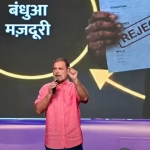



Aga Syed Ruhullah Mehdi, Member of Parliament from Central Kashmir’s Srinagar constituency, drew cheers from supporters for speaking about Kashmir and Kashmiris on the seventh anniversary of the abrogation of Article 370, in the heart of New Delhi at the Constitution Club.
Considered a “rebel” within the Jammu and Kashmir National Conference (JKNC) camp for openly criticising the government led by Chief Minister Omar Abdullah, Mehdi organised and hosted a programme titled “Listening to Jammu and Kashmir: Dialogue, Dignity and Democratic Futurity” on August 5 at the Constitution Club of India.
Several guest speakers and panellists representing different ideological positions said that what was done to Jammu and Kashmir on August 5, 2019, was “illegal, unconstitutional, and immoral”, and that the decision affecting the people of Kashmir was made without their consent and executed arbitrarily. In one of the panel discussions, a former judge said that the abrogation of Article 370 was akin to a “constitutional fraud”.
After introductory remarks by Mehdi, five panel discussions covering diverse themes were held from afternoon till late evening. Several speakers said the BJP had been “subverting democracy and the spirit of federalism by capturing institutions, and using the very tools of democracy to disempower people”.
Manoj Kumar Jha, Member of the Rajya Sabha from the Rashtriya Janata Dal (RJD), said the people of Kashmir were “not asking for the moon”. “Constitutional commitments made to the people of Jammu and Kashmir can be restored. What will they do with a disfigured statehood?” Jha asked. He argued it made no sense for a nation-state to invoke constitutional principles, fraternity, freedom and justice during the day, and bulldoze everything in the dark of night.
“The current regime in Delhi has demonised and caricatured two entities since 2014: one, the people of Kashmir; two, Jawaharlal Nehru,” Jha said, adding, “you’d be surprised to know that during this period most books have been written on these two subjects. A significant portion of my library is filled with books on Kashmir.”
He reiterated that India is a coalition of States and a coalition of people, but accused the BJP of attacking the very idea of India. The special status granted to Jammu and Kashmir, he said, was not a gift but the foundation of the relationship between Kashmir and Delhi.
“They [Jammu and Kashmir] should be granted what they possessed. Stop looking at Kashmir from a territorial prism. It is not just a piece of beautiful valleys. This filmy idea of Kashmir has to be replaced with a humanistic perspective that sees the people of Kashmir, Ladakh and Jammu as human beings. By not embracing the people, you are hurting the foundation of India,” Jha concluded.
‘Delhi’s ego versus Kashmir’s self-respect’
Pawan Khera, senior Congress leader and Member of the Rajya Sabha, praised Mehdi for organising an event about Kashmir in Delhi. Khera said the restoration of statehood alone would not matter to the people of Kashmir, because “the people of Jammu and Kashmir were stripped of their dignity, their rights, and their special status”.
He said what happened on August 5, 2019, was a clash between ego and humility. “Delhi wanted to humble Kashmir and Kashmiris. It was Delhi’s ego and Kashmir’s self-respect. Delhi assaulted Kashmir’s self-esteem. Statehood will be restored one day, but Kashmir deserves more than that,” he said.

JKNC MP Aga Syed Ruhullah Mehdi speaks during the ‘Let’s Talk Kashmir’ discussion at the Constitutional Club of India in New Delhi on August 5, 2026.
| Photo Credit:
ANI
Khera argued it was the first time in India’s political history that a full-fledged State was downgraded into a federally administered territory, and accused the BJP of pursuing divisive politics. “The people of Jammu and Kashmir witnessed a prolonged internet suspension [for more than six months], incarcerations and other sufferings. Therefore, what Kashmiris collectively suffered is more important to know here,” he said, drawing applause from the packed hall.
He concluded: “Kashmir has a distinct culture and unique identity. Special guarantees—statehood plus plus—have to be given. What happened on this day was a dark chapter. Set politics aside for a moment and think about the people of Kashmir and what they have gone through. Kashmiris must be granted statehood, but beyond that, their constitutional rights relating to land, jobs, opportunities, and resources must be fully restored. This is our demand, and it is the demand of the united opposition.”
Other speakers said it was important to build alliances across India to challenge the “climate of fear”.
Criminalising opinions
The third panel discussion, on the theme “Banning the Bibliography”, included Bharat Bhushan, senior journalist and former editor of Mail Today; O.P. Shah, author and peace activist; Muzaffar Shah, vice president of the J&K Awami National Conference (JKANC); and Professor V.K. Tripathi. A senior author and broadcast journalist moderated the session.
Bhushan said Kashmir functions as a laboratory for experiments, with the same template applied, in milder form, elsewhere in India. “Journalists and authors have to form broader coalitions to fight erasure of memory,” he said.
O.P. Shah, a regular visitor to Kashmir, said New Delhi should immediately restore statehood and initiate dialogue with the people of Jammu and Kashmir, and engage “with our neighbour”. Without naming Pakistan, Shah made the case for an India-Pakistan composite dialogue and broader engagement.
Muzaffar Shah of the JKANC said only weak states ban books, and that such bans enhance curiosity and drive rigorous research. “Without the concurrence of the erstwhile Constituent Assembly, no party could have withdrawn Article 370 unilaterally. Someone like a Governor cannot be a substitute for either the Constituent Assembly or Legislative Assembly. At the time, the J&K Assembly was not in session. So, how can a Governor take decisions on our behalf?” he asked.
Other speakers said civilised societies and mature democracies do not ban academic, legal, or journalistic works, and allow citizens to ask why and how. “Look at the quality of books they have banned. They have banned scholarly works of Victoria Schofield, Christopher Snedden, Sumantra Bose, Arundhati Roy, Abdul Ghafoor Noorani, Hafsa Kanjwal, Anuradha Bhasin, among others. This is state-sponsored censorship to criminalise scholarship,” said one speaker, adding: “when censorship is normalised, people indulge in self-censorship. This imposed silence is not good. Apathy has dangerous consequences.”
Kashmir interlocutors
Former Kashmir interlocutor Radha Kumar said she was pleased to see the hall packed with young political and student activists. “Such events are important to create memories. The BJP has been critical of our efforts for peace and interlocution. In the past, their people have burned copies of our report while flexing their muscle power. From the 1980s and 1990s, they would disrupt parliamentary proceedings,” she said.
Kumar was also critical of previous Congress governments, saying the party “never summoned the courage” to make Article 370 a permanent feature of the Indian Constitution.
She said one of the recommendations made by the interlocutors was to make Article 370 permanent, followed by the formation of a panel of constitutional experts to examine whether the eroded parts of Article 370 could be restored.

Former IIT Delhi professor Vipin Kumar Tripathi, journalist Gowhar Geelani, Om Prakash Shah and others during the ‘Let’s Talk Kashmir’ discussion in New Delhi on August 5, 2026.
| Photo Credit:
By special arrangement
A specialist in ethnic conflict and peace studies, Kumar has served as director of the Nelson Mandela Centre for Peace and Conflict Resolution at south Delhi’s Jamia Millia Islamia. In October 2010, she was appointed one of three interlocutors for Kashmir. At the time, the Government of India’s Cabinet Committee on Security made Dileep Padgaonkar, former editor of The Times of India, the head of the interlocutor panel. M.M. Ansari, then a Central Information Commissioner, was the third member.
Kumar is presently associated with the Forum for Human Rights in Jammu and Kashmir. Her group released a report titled Jammu and Kashmir: Seven Years Under Union Rule. Its members were not allowed to release the report at Srinagar’s Sher-e-Kashmir International Convention Centre (SKICC) on August 7. Former Chief Minister and National Conference president Farooq Abdullah was to have released the report.
Spymaster’s take
In the last panel discussion, India’s former spymaster Amarjit Singh Dulat said Article 370 had been hollowed out well before 2019. “Like the leaders of Kashmir, I was also taken by surprise when Article 370 was abrogated in August 2019. I wrote against it. I spoke against it. I’m of the view that there was nothing left in Article 370. The reality is that when Sheikh Mohammad Abdullah made a pact with Indira Gandhi in 1975 [the Indira-Sheikh Accord], in which he acknowledged that accession was irrevocable, Article 370 ended there only,” Dulat said.
He said former Union Home Minister P. Chidambaram had delivered the most passionate speech against the abrogation, calling the decision a “monumental disaster”.
“Time will tell, history will tell. I keep watching Kashmir from day to day. I saw a post from my friend, Mirwaiz Umar Farooq, saying ‘today is a very painful day for Kashmir’. Kashmir, in many ways, is such a sad story that its sadness runs all the time. The abrogation of Article 370 didn’t sadden me as much as the day-to-day living of Kashmiris,” Dulat said.
He also praised Farooq Abdullah’s leadership: “Aga Ruhullah Mehdi would have won from any constituency because of his stance on Article 370…. If you understand Kashmir, Farooq Abdullah is the only leader from there, whether you accept it or not!”
Hosted by Mehdi, the event drew public figures including Pawan Khera (Congress), Manoj Jha (RJD), Salman Khurshid (India’s former external affairs minister), Syeeda Hameed, Radha Kumar, Wajahat Habibullah, Amarjit Singh Dulat, Justice (retired) Iqbal Ansari, Sanjay Singh (AAP), Najeeb Jung (former Lieutenant Governor of Delhi), Mohammad Adeeb (former MP), O.P. Shah, student leaders associated with the All India Students’ Association (AISA), Zafarul-Islam Khan (president, Jamaat-e-Islami Hind), Bharat Bhushan, Professor Siddiq Wahid, Thamizhachi Thangapandian (MP, DMK), Professor V.K. Tripathi, Rajkumar Rawat, Raja Ram Singh (CPI-ML), and Mohibullah Nadvi (SP), among many others.
Mehdi told Frontline it was satisfying to see cross-party voices “unanimously favouring the restoration of Jammu and Kashmir’s constitutional status”.
“Speakers representing different political formations and backgrounds were united in describing the manner of Article 370’s abrogation as a departure from democratic norms, arguing that the decision was pushed through without the consent of the people of Jammu and Kashmir. Participants reaffirmed that the fight for J&K’s future cannot stop at the restoration of statehood alone—that the special status and constitutional protections guaranteed to the region under the Constitution of India must also be restored,” Mehdi’s office said in a press release after the event.
Disclaimer: The reporter moderated one of the panel discussions.
Gowhar Geelani is a senior journalist and author of Kashmir: Rage and Reason.
Also Read | JKNC is committed to getting back what Jammu and Kashmir lost in 2019: Salman Sagar
Also Read | Kashmir’s paradox: Popularly elected government without powers of governance


