









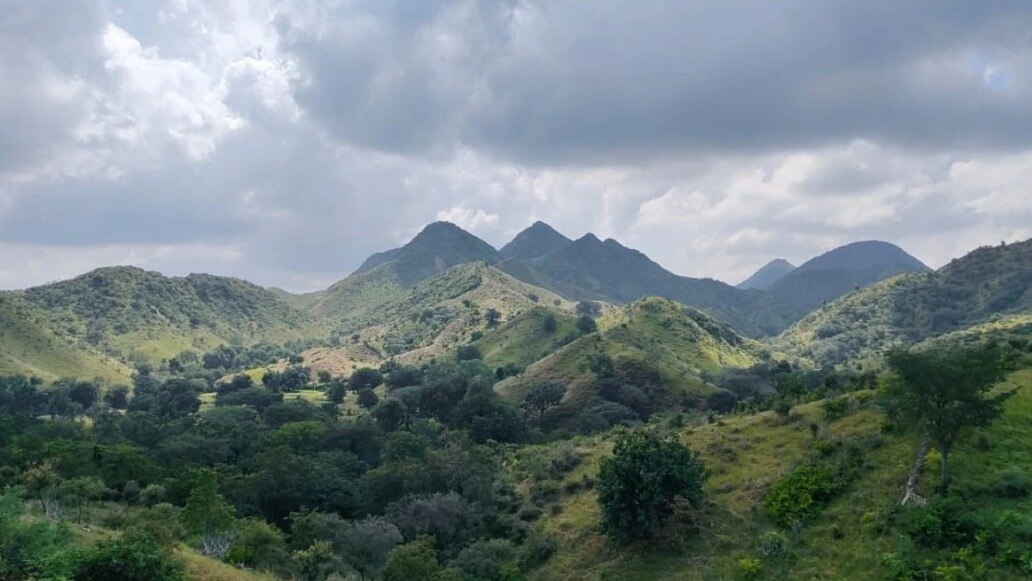
As Delhi prepares for the monsoon, a new study has found that the Aravalli Biodiversity Park helps retain nearly three million litres of rainwater every year, reducing surface runoff that can add to waterlogging and urban flooding. The 692-acre restored forest, the study said, is doing far more than serving as a green space in the middle of urban expansion.
Researchers said the park’s roughly 2.02 lakh trees also improve air quality, store carbon and help recharge groundwater. The findings also trace the park’s transformation from a heavily degraded mining site into a biodiverse landscape of forests, grasslands and wetlands.
The study, titled “Structure, ecosystem services and economic evaluation of native tree diversity: a case study of the restored Aravalli Biodiversity Park, Delhi, India”, was carried out by researchers from the Centre for Environmental Management of Degraded Ecosystems, Biodiversity Parks Programme, Department of Finance and Business Economics and Satyawati College, all affiliated with the University of Delhi.
It said the park sits in an important groundwater aquifer recharge zone and plays a key role in replenishing underground water reserves. By slowing the movement of rainwater across the ground, the forest allows more water to seep into the soil instead of flowing quickly over paved surfaces.
“Delhi has a dry-winter humid subtropical climate bordering on a hot semi-arid climate and receives an average annual rainfall of 774.4 mm, most of it during the monsoon months between July and September,” the study said.
Researchers added that such ecosystem services are becoming increasingly important in fast-urbanising cities, where shrinking green spaces and expanding built-up areas often worsen flooding and waterlogging during heavy rain.
Besides regulating water, the park was found to play a major role in cleaning the air. The study estimated that its trees remove around 126.89 tonnes of air pollutants every year, with environmental benefits valued at nearly Rs 1.89 crore.
The researchers said the trees help remove particulate matter and other harmful pollutants from the atmosphere, and noted that structurally diverse urban forests are particularly effective in trapping airborne pollutants and improving environmental quality.
The park was also found to be a growing carbon sink. Researchers estimated that its trees currently store around 8,360 tonnes of carbon, valued at nearly Rs 11.34 crore, while absorbing another 1,236 tonnes of carbon every year as they grow. The study explained that carbon storage refers to the amount of carbon locked in tree biomass at a given time, while carbon sequestration refers to the annual build-up of carbon by growing trees.
For economic valuation, the carbon estimates were converted into carbon dioxide equivalents using a standard molecular conversion factor. The researchers also found that bigger trees generally store and absorb more carbon, with trees that have thicker trunks, greater height and wider canopies proving more effective at capturing carbon from the atmosphere.
The study said the importance of these findings becomes clearer in light of the site’s past. Located on Delhi’s southern ridge, the area was once a heavily degraded mining site. Nearly 80 per cent of the land was covered by abandoned pits created during the extraction of morrum, a reddish gravelly soil used in construction, along with mounds of waste left behind by mining operations. Much of the land was barren and supported only scattered vegetation.
The area was largely covered by invasive species such as vilayati kikar and lantana, along with a few native species such as white-barked acacia, babul and adulsa, the researchers said.
Over the years, restoration work changed the damaged landscape into a mosaic of forests, grasslands and wetlands. According to the study, the park now supports around 700 plant species across 20 ecological communities and provides habitat for a wide range of wildlife. During field surveys, researchers recorded 80 native tree species and found high biodiversity. The study said this wide variety of plant species has helped create a healthy, stable and resilient ecosystem.
According to the study, the dominant tree species in the park include palash, Indian elm, white-barked acacia and kadamb. Researchers said the park’s uneven terrain, shaped by years of mining, has created different kinds of habitats that support a range of plants and animals.
This diversity also helps the park deliver ecosystem services such as carbon storage, air pollution removal and groundwater recharge. The study added that forests with a greater variety of native species are usually more resilient and better able to withstand environmental stress, while also supporting nutrient cycling, pollination, habitat creation and climate regulation.
For the study, researchers carried out vegetation surveys across about 500 acres of the park in 2023. They laid 83 quadrats measuring 10×10 metres and recorded 829 trees belonging to 80 species. Using the i-Tree Eco model along with local meteorological and air quality data, the team assessed ecosystem services including carbon storage, carbon sequestration, air pollution removal and avoided surface runoff.
The researchers said the findings show how degraded land can be restored with native vegetation to create urban green spaces that support biodiversity while also providing cleaner air, carbon capture, groundwater recharge and lower flood risk.
– Ends