







For years, environmental awards, we heard, largely went to scientists, startups and conservation projects. This year, however, one of the world’s biggest sustainability honours went to an army of small farmers from Andhra Pradesh.
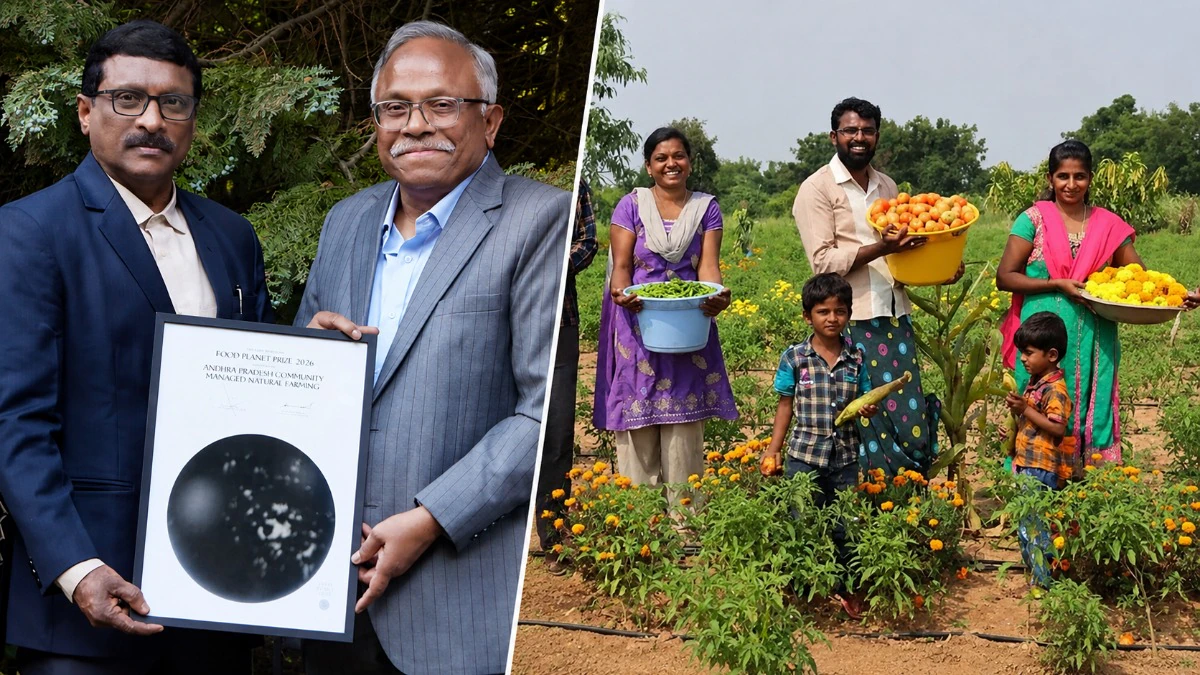
The Andhra Pradesh Community Managed Natural Farming (APCNF) programme, which now works with around 18 lakh farmers of the state, won the 2026 Food Planet Prize, often described as the world’s largest environmental award focused on transforming food systems.
The $1.5 million prize was presented to APCNF by the Curt Bergfors Foundation in Bastad, Sweden, on June 2.
The moment of glory comes at a time when farming and food security are increasingly threatened by climate-driven weather anomalies. Droughts, floods, rising input costs, and dependence on chemical fertilisers, many of which are cancerous and banned in dozens of countries, have been the norm. Against this backdrop, Andhra Pradesh’s 18 lakh farmers demonstrated that natural farming can make agriculture more resilient while reducing dependence on chemical fertilisers. According to APCNF, the approach is already being replicated in 22 Indian states as well as Sri Lanka and Zambia.
The award aligns with Andhra Pradesh Chief Minister N Chandrababu Naidu’s ambition of making Andhra Pradesh a “100% natural farming state” by 2047. It’s part of Naidu’s Swarna Andhra@2047 or Viksit Andhra Pradesh-2047 roadmap and was launched in 2016 during his last term.
The jury in the Swedish summer resort town of Bastad said the programme of Andhra Pradesh had demonstrated how farming can become more climate-resilient while reducing dependence on synthetic inputs. An integral part of the model are women-led self-help groups, more than 10,000 farmer trainers and a community-driven approach to agricultural transformation, according to a statement from the APCNF.
The CNF of the APCNF is Community-Managed Natural Farming. It’s a farming model in which farmers, using community networks, grow crops using natural fertiliser and pesticides.
WHAT IS THE FOOD PLANET PRIZE THAT APCNF WON?
The Food Planet Prize is awarded annually by the Swedish Curt Bergfors Foundation to initiatives capable of transforming the global food system while reducing environmental damage. The 2026 edition attracted over 1,000 nominations from across the world. The APCNF emerged as the winner ahead of finalists from the United States and the Netherlands.
The award carries a prize purse of $1.5 million.
The jury called APCNF one of the most ambitious agroecology transitions undertaken anywhere in the world.
Zimbabwean professor, Lindiwe Majele Sibanda, co-chair of the jury, said APCNF provides “a scalable pathway for millions of farmers” while improving livelihoods, resilience and environmental outcomes. She added that the programme showed how “the future of agriculture can be built by working with nature rather than against it,” the APCNF said in a statement.
WHAT EXACTLY IS APCNF DOING?
Launched by the Andhra Pradesh government, APCNF promotes natural farming practices that reduce dependence on synthetic fertilisers and pesticides. The programme operates through women’s collectives and a network of more than 10,000 community resource persons and farmer trainers.
According to APCNF, around 18 lakh farmers across more than 8,000 villages have joined the transition.
Farmers are encouraged to adopt practices such as year-round cover cropping, pre-monsoon dry sowing and soil-regeneration techniques based on local knowledge and ecological principles.
The programme says these methods help reduce cultivation costs, improve soil health and make farms more resilient to droughts, floods, cyclones and pest attacks.
HOW ANDHRA WOMEN BECAME THE STAR OF NATURAL FARMING?
“The magic is in the women,” said T Vijay Kumar, the Executive Vice Chairman of Rythu Sadhikara Samstha (RySS), the Andhra Pradesh government-backed body that implements the APCNF programme.
“This journey did not begin with agriculture. It began with organising women, strengthening communities, and creating the foundation for change,” he said. He credited women farmers, self-help groups and rural communities for making natural farming possible at scale.
The APCNF said the movement is supported by around 3.4 lakh women’s self-help groups and thousands of women community resource persons who drive farmer-to-farmer learning across villages.
WHY IS THE AWARD A BIG DEAL FOR INDIA?
The recognition for APCNF places an Indian farming model at the centre of a global debate on climate-resilient agriculture. It’s also an ideal farming option as demand for chemical-free food is growing.
Andhra Pradesh Chief Minister Chandrababu Naidu described it as a “First for India” and said the state now aims to become “100% natural Andhra Pradesh by 2047”.
Agriculture Minister Kinjarapu Atchannaidu said the model had helped farmers reduce input costs and improve net incomes while creating a large network of community-based trainers. The approach is already being replicated in 22 Indian states as well as Sri Lanka and Zambia.
The prize money would be used to expand demonstration farms, create implementation toolkits, support new research partnerships, train future natural-farming leaders and strengthen a network of “farmer scientists” who conduct field experiments and document results. For APCNF, the award is not just an international recognition.
It is also an appreciation that a model built around small farmers, women’s collectives and community institutions can compete with, and beat, some of the world’s most celebrated sustainability initiatives. And for Andhra Pradesh’s 18 lakh farmers, it is perhaps the closest agriculture comes to winning an Oscar.
– Ends