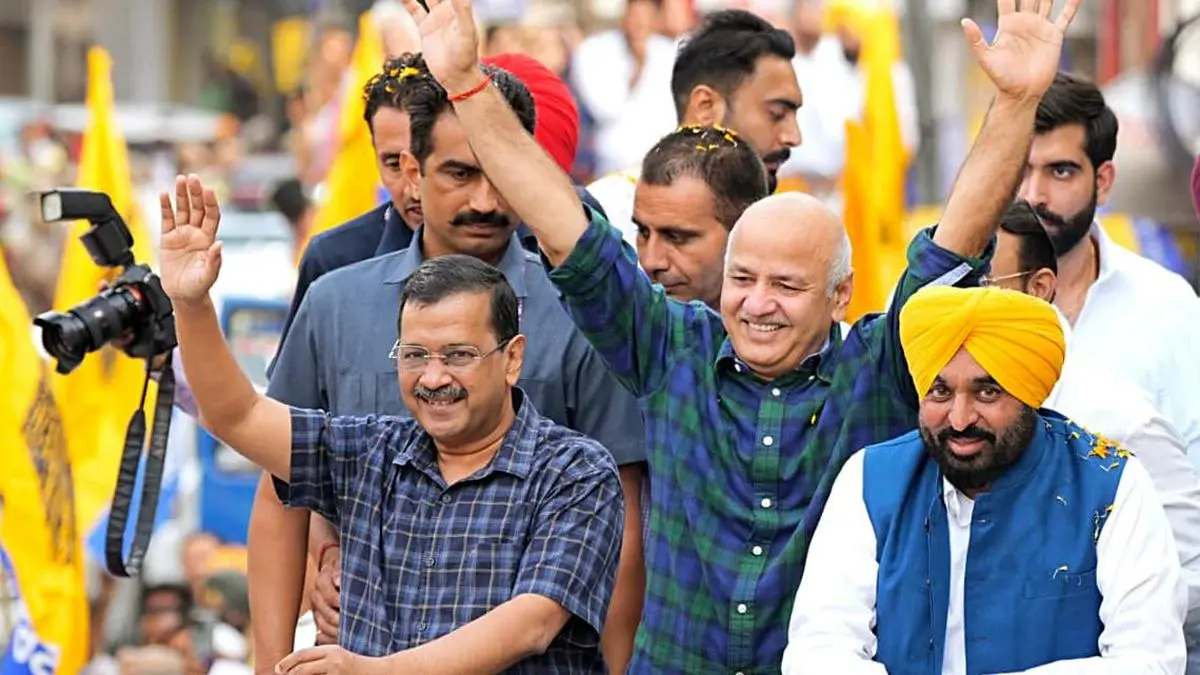
The moment seemed just right for the Aam Aadmi Party to get into top gear for the Assembly election in Punjab due early next year. As the ruling party, the AAP had done well in the recently concluded municipal corporation elections. At a roadshow held in Bathinda on June 12 to celebrate this performance, Arvind Kejriwal, the party’s national convenor, appealed to the people to elect Bhagwant Mann for another term as Chief Minister.
Kejriwal made a forceful endorsement of Mann’s candidature as the party’s chief ministerial face, his speech clearly indicating the party’s keenness to focus on the work it has done in the last four years in the State as it entered campaign mode. The slogan “Vadhiya lange panj saal, saara Punjab Mann naal” (The last five years were excellent, entire Punjab is with Mann) featured prominently in the party’s publicity material.
Kejriwal said at the roadshow: “I was looking at people during the roadshow and I could clearly see the happiness on their faces. They are happy with our government’s performance. Mann has, for the first time in the history of the State, provided an honest government, which has not indulged in corruption but has spent money on the people. Our government provides free electricity and free medical treatment of up to Rs.10 lakh. And from July 1, every mother and sister in the State will get Rs.1,000 [general category] or Rs.1,500 [Scheduled Castes] in their bank accounts.”
However, a dramatic turn of events has forced the party to shift its focus to resolving its disputes with the Sikh priesthood. Ironically, Mann is at the centre of the controversy. His party, which only recently began projecting him as its chief ministerial face, is suddenly left with the difficult task of defending him.
Mann in trouble with Akal Takht
On June 15, just three days after the Bathinda roadshow, the Akal Takht, the highest temporal seat of Sikhs, declared that a video in which Mann was allegedly seen indulging in acts that amounted to insulting the Sikh gurus had been run through forensic tests and found to be genuine. The acting Akal Takht jathedar, Giani Kuldeep Singh Gargajj, read out from the Takht podium the edict containing the unanimous decision of the five Sikh high priests. In an unprecedented decree against a Chief Minister, Gargajj also declared that Mann is “Guru dokhi” (anti-Guru) and “Khalsa Panth virodhi” (opposed to the Khalsa Panth), and asked the Sikh community to boycott him socially and religiously.
Mann insists that the person in the video is not him but an impersonator. In a video message posted on X on June 19, he said the video was the product of a well-planned conspiracy against him. His party stated that the video was examined by two government-recognised laboratories outside Punjab and both had concluded that a person resembling Mann was the one in the footage. Later, police in neighbouring Haryana arrested two men for their alleged involvement in a conspiracy to prepare manipulated forensic reports of the video.
On June 20, the Akal Takht released a video of Mann appearing before it on January 15. The video shows a stern-faced Gargajj and an earnest-looking Mann engaged in a discussion over the video in question. Both are heard agreeing on the need for an investigation to decide on its authenticity. Mann was also questioned on statements he had allegedly made about certain Sikh practices.
All this, however, is just one aspect of the problem the AAP in Punjab is facing in its interaction with the Sikh religious establishment. A significant issue on which they are at odds with each other is the anti-sacrilege law passed by the Punjab Assembly in April. The Mann government had hoped that this would be seen as fulfilment of the AAP’s election promise to ensure justice is delivered in cases involving alleged sacrilege against Sikh holy scriptures.
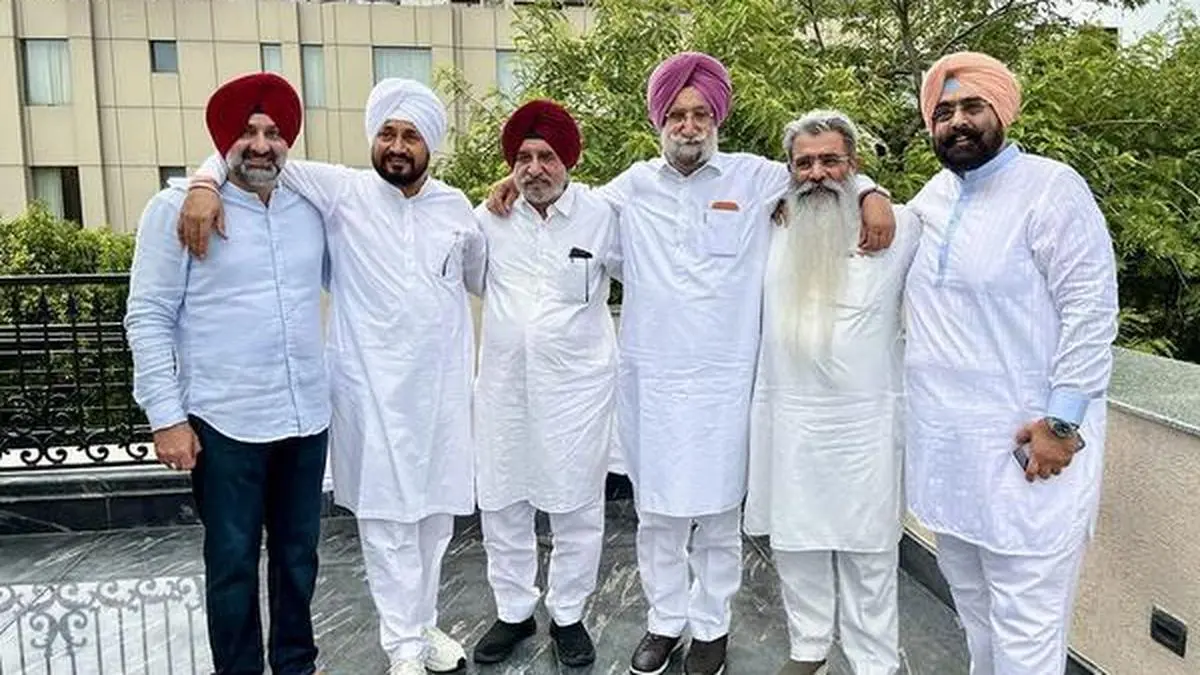
Akal Takht members address a meeting with Sikh MLAs and Punjab Cabinet Ministers at the Akal Takht Sahib Secretariat on June 29. The MLAs and Ministers were summoned by it over the new anti-sacrilege law.
| Photo Credit:
ANI
On June 29, all Sikh MLAs and Ministers in the State appeared before the Akal Takht in response to its directive to clear their stance on the contentious Jaagat Jot Sri Guru Granth Sahib Satkar (Amendment) Act, 2026, or the anti-sacrilege law. Live telecast of the meeting showed the Akal Takht posing some tough questions to the legislators about the law, with many MLAs on the ruling side admitting they had not read the Bill properly before its passage. The Akal Takht has expressed strong displeasure over the law being passed without any consultation with Sikh religious authorities. Following the meeting, the Akal Takht gave the Mann government a month’s time to amend the Act.
AAP on the back foot
“Not too long ago, the AAP looked like it had a good momentum in the election run-up. The opposition was disorganised and riddled with factionalism. The Mann government was on the verge of rolling out the much-touted regular income scheme for women. However, the current controversy has put the AAP on the back foot,” said the political commentator Harjeshwar Pal Singh.
He said the Mann government’s handling of the video controversy ended up compounding the problem. “There is massive damage to the public image of Mann and his government. They made contradictory statements about the video. The biggest blunder was to involve the police in getting a forensic report to give Mann a clean chit. The focus shifted from the authenticity of the video to the Mann government’s alleged manipulation of the verification process. It has actually given rise to doubts in the minds of the people that the video could actually be genuine.”
Political observers believe the government has ended up displeasing everybody with what they describe as a hastily enacted anti-sacrilege law. Views range from complete agreement with the reservations expressed by the Akal Takht about the law to criticism of the law’s “narrow-minded” focus on just one religion.
The Akal Takht objects to the way the new law has replaced traditional terms used in the religious context with non-traditional words and the assigning of a unique identification number to each copy of the holy book, which it believes undermines its sanctity. It opposes online records pertaining to custodians being made available; the Akal Takht believes the presence of these records in the public domain constitutes a breach of privacy and can be misused. The Akal Takht has also demanded that it should be consulted when rules to implement the law are made, a power that currently rests with the government. The Akal Takht has demanded a clause making it mandatory for a case to be registered against the head of a dera, or sect, if a follower of that sect commits sacrilege.
Key objection
A key objection by the Akal Takht pertains to how the new law defines “custodian” of the holy book. It contends that the definition, which includes devotees, committees, Granthis, and Sewadars, would result in putting the onus of protecting the holy book in cases of sacrilege on ordinary Sikhs.
“In my opinion, the Akal Takht jathedar dealt with the issue in a very meticulous and genteel manner, and with a lot of grace. Mann and the AAP MLAs and Ministers who appeared before the Takht behaved in a very disappointing manner. They were asked whether they had read the Bill, and a majority of them said no. The situation is a massive tragedy beyond words for Punjab,” said Gurdarshan Singh Dhillon, a former professor and head of the department of history at Panjab University, Chandigarh.
“These are issues that carry a huge emotional value. Mann and his government have lost all respect in the eyes of the people because of the manner in which they first passed the anti-sacrilege law and then dealt with the questions that were raised about it,” he said.
Pramod Kumar, chairperson of the Institute for Development and Communication, Chandigarh, pointed out that the 2026 law marks a significant departure from the 2025 Bill on sacrilege, which sought to protect the Guru Granth Sahib, the Bhagavad Gita, the Quran, and the Bible. The 2026 legislation confines itself to the Guru Granth Sahib.
“Whatever one’s position on the desirability of such a law, it represents a fundamental policy shift—from equal statutory protection for multiple religious texts to protection of only one. It is surprising that this aspect has attracted so little public debate. Equally striking is that the Governor assented to the Bill without publicly flagging any constitutional or legal concerns arising from this departure,” he said.
The Golden Temple in Amritsar. Around 58 per cent of Punjab’s population is Sikh.
| Photo Credit:
ANI
Panthic issues have always been integral to Punjab’s politics. The Sikh religious identity was closely intertwined with the demand for a separate State of Punjab for Punjabi-speaking people in the 1950s and 1960s. Around 58 per cent of the State’s population is Sikh.
The Shiromani Akali Dal (SAD) has historically represented Sikh religious interests in the political sphere. However, the SAD paid a heavy price for its perceived inaction when it was in government against several incidents of sacrilege reported in 2015, and the police firing that year on those protesting against the sacrilege at Behbal Kalan and Kotkapura.
The Akali Dal-BJP government was voted out in 2017, and the SAD was reduced to just 17 seats in the 117-member Assembly. The party has since failed to recover lost ground. The Congress government under Amarinder Singh, which took over in 2017, also faced immense political heat within and outside the party over demands for justice in the sacrilege cases.
AAP’s recalibrated approach
The AAP has, over the last decade, recalibrated its approach to Sikh religious issues. Its debut in the 2017 Assembly election was believed to have been restricted to 20 seats owing to the perception that it had the backing of radical Sikh elements. In the 2022 election, it built a campaign focussing on the Delhi model of governance and consciously steered clear of any move that would expose it to accusations of proximity to pro-Khalistani elements. Kejriwal, nevertheless, could not avoid charges of sympathising with separatist forces. He countered it by saying he was the “sweetest terrorist” who built schools and hospitals.
According to a senior AAP leader in Punjab, the recent developments reflect a desperate move on the part of the SAD to make a comeback. The leader said there was no public outrage against Mann or the government with regard to religious issues, in contrast to what the Akali Dal had faced when in power. Mann, he said, has maintained a balance between being completely respectful of the Akal Takht as an institution while raising questions about the objectivity of some of its functionaries. The leader said that it pointed to the possibility that the Akali Dal was using its influence over the Shiromani Gurdwara Parbandhak Committee, and thereby the Akal Takht, to corner the Mann government.
Harjeshwar Pal Singh agreed with the view that the recent developments can be seen in the context of the Akali Dal’s struggle to get back in the reckoning. “Questions have been raised about the manner in which the Takht jathedar was appointed. Many people believe he is influenced by the Akali Dal,” he said.
Intellectuals uneasy
Intellectuals in Punjab are uneasy about the summoning of elected legislators by the clergy. Pramod Kumar said this is institutionally problematic: “Today it may be the Sikh clergy. Tomorrow, similar calls could come from the Jama Masjid, the Shankaracharyas, church bodies, or any religious authority. Such a precedent would gradually shift the locus of democratic accountability from the Constitution and the electorate to competing religious institutions.”
He said that in a secular constitutional democracy, legislators may consult religious leaders as citizens, but their legislative accountability must be to the Constitution, the Assembly, and the people who elected them.
“The larger issue is not sacrilege alone, it is the health of our democratic institutions. A mature democracy requires that legislation be debated, read, scrutinised and enacted through constitutional processes. Once these institutional norms begin to erode, the consequences extend far beyond any single Bill or any single community,” he said.
The Mann government’s run-in with the Sikh religious establishment has a lot to do with the evolving political dynamics in the State. The situation, however, also gives rise to some crucial questions about the correlation between religion and politics in India today.
Also Read | The sacrilege trap