




We are now in the eighth year after the disassembling of the former Indian State of Jammu and Kashmir on August 5, 2019. The effects of that action have been far-reaching for regional geopolitics and domestic policymaking. Regionally, it can be reasonably argued—albeit with qualifications—that Islamabad has been alternately snubbed and ignored by New Delhi. In an almost symmetrical reaction, Beijing has done the same to New Delhi, although China’s growing confidence in its global presence allows it to be more nuanced, with a continued wooing of India for the RIC (Russia-India-China) civilisational coalition even as India’s ineffectiveness in the BRICS consortium surfaces in the emerging new bipolar world, with Chinese characteristics. All this, even while Beijing never leaves the world in doubt about its territorial claims from Arunachal Pradesh to Bhutan’s Doklam to the sweeps of the Changthang in Ladakh. It may be added that China’s open support for Pakistan on the issue of the erstwhile Dogra state of Jammu and Kashmir is a special irritant. This is the larger picture.
It is vital to understand this backdrop if we are to recognise the full implications of the latest announcement in The Ladakh Gazette, disaggregating Ladakh into seven districts, after its original two was divided into five (without implementing the implications of this move) less than two years ago, when an “in principle” five districts were announced on August 26, 2024.
It is crucial to grasp that the latest “Gazette” of April 27, 2026, has been “published by authority” of an unelected government that is in place and conducting the delimiting, or redistricting, exercise in this vast and doubly vulnerable to foreign encroachment borderland, without its citizens being either transparently consulted or their objections being heard; this is especially so in the last almost five years ago since August 1, 2021, when the then two districts of Leh and Kargil united regionally and as religious communities to form a united front and framed a collective leadership structure that has endured until the present.
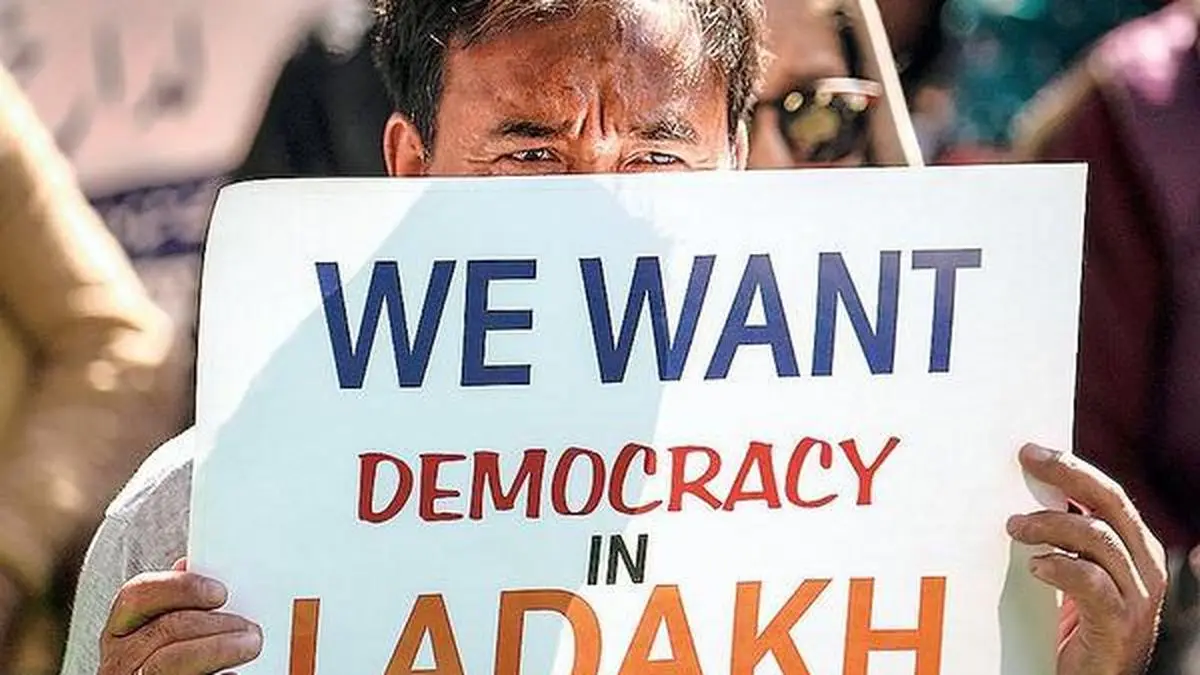
Since 2021, this united front has seen protest marches and rallies with increasing intensity but has always remained peaceful. The asks of the Ladakhis have been simple. To reverse the removal and denial of Ladakh’s democratic rights concerning youth employment, land policies, and expanded representation. To be fair to the government, there has been some hearing of Ladakhi voices. Broad-based meetings were held, several non-statutory committees—such as the Leh Apex Body (LAB), the Kargil Democratic Alliance (KDA), and a High-Powered Committee—were formed and talks have been ongoing. However, they were, precisely speaking, “talks”. They were not “negotiations”, which is the need of the hour. The difference between the two is not mere semantics.
Another feature of these talks with the government has been that they were held with significant time gaps, decisions were made incrementally, and changes were instituted amidst opaque consultations with Ladakh’s BJP unit. Most of these, it may be added, without germane consideration of consensus submissions agreed to between Leh’s LAB and Kargil’s KDA.
What are these submissions? That Ladakh’s burgeoning youth unemployment be addressed; that, given the minuscule percentage of arable land available in Ladakh, there be a consideration of ecological factors, for which land rights be reverted to enable discretionary local intervention; and that Ladakh’s representational structure be increased. However, while youth employment has been addressed to some extent, albeit with minimal implementation, the two complex issues of fairer representation and land rights have been ignored by the government.
Rather, the Ministry of Home Affairs has pushed ahead, making decisions in incremental doses, without revealing its endgame, and with orders that have the consequence of undoing the formidable collective leadership that Leh and Kargil as also Buddhist and Muslim communities have welded.
But perhaps we are getting ahead of ourselves here.
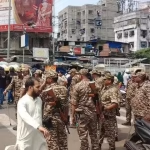
It was a year ago that Ladakhis began to notice that their objections were not being heard. Thus began an intensification of the protests, fuelled in part by youth restlessness. Large rallies were called in both Leh and Kargil in August 2025. Amongst them was one scheduled in Leh for September 24, 2025. This came after a couple of months of a steady build-up of CRPF troops in Ladakh, causing street speculation that something may be in the offing. Then, after four years of peaceful protests that invariably ended with cries of “Jai Hind” and “Bharat Mata ki Jai” in front of the national flag, the protest of September 24 turned violent, with a burst of fire that left four dead and one young person ending his own life in despondent solidarity.
People of Leh gather outside the BJP office building, which was set ablaze by protesters on September 24, 2025, during a demonstration demanding statehood for Ladakh.
| Photo Credit:
Mohd Arhaan/PTI
It was an unprecedented—and wholly unexpected—occurrence for Ladakhis, who have been proud of their patriotism for 75 years and made sacrifices themselves in several wars. This event was well after the disassembling of Ladakh’s two large districts into five new districts, mentioned above, which was received with benign recognition of some forward movement but was not enough to satisfy either Leh or Kargil.
In the face of this, how are we to view the local unelected government’s claim, implicit in The Ladakh Gazette, to be a devolution of power within Ladakh, and its latest incremental declaration that Ladakh, with a population of three lakh, will now have seven districts? To be sure, it has been met with some enthusiasm, as was the severance of Ladakh from the former Jammu and Kashmir State. But a close look at the announcement, the dismantling of the former State of Jammu and Kashmir, and the current trends do not bode well for Ladakh.
*****
To begin with, let us examine the possible reasons for the incremental disclosure typical of the current administration. There has been no indication of the overall structure that will govern the relationship between districts and the general functioning of the government in Ladakh. Reportedly, the leading option is to bestow more empowered “Territorial Councils” to the seven districts. It is a bestowal roundly opposed by an overwhelming majority.
The reason for the opposition is simple.
It is the implication that the delimitation exercise will decentralise decision-making, hand over power, and in the face of scarce resources, get direct funding from New Delhi. However, in a Union Territory, resources and funding are controlled by the Centre. Real political power, in other words, is concentrated in New Delhi.
L.K Advani initiates the Sindhu Darshan Abhiyan by pouring waters from different rivers with that of the Indus in June 1997.
| Photo Credit:
PTI
What such a structure achieves, precisely, is the very opposite of decentralisation. The short-term impact of this delimitation exercise is particularly worrying. It undoes the regional political unity within Leh and the emotional unity between Buddhists and Muslims. It is less known that Kargil’s population consists of 15 per cent Buddhists; Leh has a similar percentage of Muslims. These “nested communities”, who have coexisted for centuries, cannot be ignored or, worse, made to feel vulnerable.
Moreover, an informed reading of the BJP government’s delimiting/redistricting exercise in Ladakh shows the Muslims of Ladakh being reduced to a minority. The current announcement actualises this—in five of the seven new districts, Muslims have been reduced to a minority. Thus, depending on how the overall structure for governance in Ladakh shapes up, it reduces Muslim representation to less than two-thirds of Ladakh’s voice. This is a palpably undemocratic arrangement, as the population of Buddhists and Muslims in Ladakh is all but equal, with Muslims, in point of fact, constituting a fractional majority.
Uniquely vulnerable
How did this happen, one could ask, in the face of the resolute unity between Ladakh’s two largest regions and communities (let us not forget the tiny but equally important Christian community) and the nuanced collective leadership in place for almost five years now?
There is no gainsaying that it must be attributed to the BJP’s meticulous attention to electioneering tactics—always to win; timing of any important announcement, always deliberately incremental; the party’s core political agenda, a majoritarian Hindu Rashtra. In addition to these political and ideological ambitions for India as a whole, one senses perhaps also a special agenda in the case of Ladakh—to secure a foothold in the trans-Himalaya area for Akhand Bharat, for the first time in known history, beginning perhaps with ex-Home Minister L.K. Advani’s institutionalisation of Sindhu darshan during ex-Prime Minister A.B. Vajpayee’s years. Indeed, this has now grown to grander proportions with the announcement of a Maha Kumbh in Leh later this year.
Tailpiece: It is worth noting that this assault on Ladakh’s historical sense of autonomy is not unique. The results of the just concluded State Assembly elections in West Bengal, Kerala, Tamil Nadu as well as in Assam in the eastern Himalaya all point to the BJP-led minority Union government’s strategic and tactical outreach throughout India. Call it gerrymandering, Special Intensive Revision, delimitation, redistricting, bullying, or money power. In a sense, that is what realpolitik has been for a long time now.
However, Ladakh is also uniquely vulnerable. Its tiny population of three lakh is pitted against a government responsible for 1.4 billion. It is fighting for an almost “natural” autonomy that is centuries old. One preserved, in part, by Ladakh’s tiny population, its geographic distance from the centres of empires, and its role as a pivot for trade between Central Asia and South Asia.
But those advantages have been fading for 150 years now. In part because of technological advances—road building, air traffic, and media proliferation. In part because these same facilities ensure governmental control. And in part because it is once again becoming a small playground for new empires looking for rare earth mining, potential access as a lookout for corridors of energy transfer, and sheer old-fashioned territorial acquisitiveness.
For protection against all of the above, Ladakh is dependent on how New Delhi treats its vast populations, beginning with the smallest segments such as in Ladakh. On the face of it, it seems a hopeless wish. But does that mean Ladakhis will allow themselves to be manipulated into accepting an unjust fate? That they will give up and agree to be silenced?
From what one senses on the ground, the answer seems to be a loud no. The Ladakhis tend to describe themselves as citizens who have caught up with the 21st century and, as someone once said, are true “patriots who know when they have been used”.
Siddiq Wahid, from Ladakh, is Distinguished Professor at the School of Humanities & Social Sciences at Shiv Nadar University (Institute of Excellence), where he teaches Central Eurasian history in the Department of International and Governance Studies. He is Adjunct Fellow at the Institute of Chinese Studies in New Delhi.
Also Read | Ladakh’s new district map deepens a Buddhist–Muslim divide
Also Read | I was labelled anti-national for supporting the nation: Sonam Wangchuk