





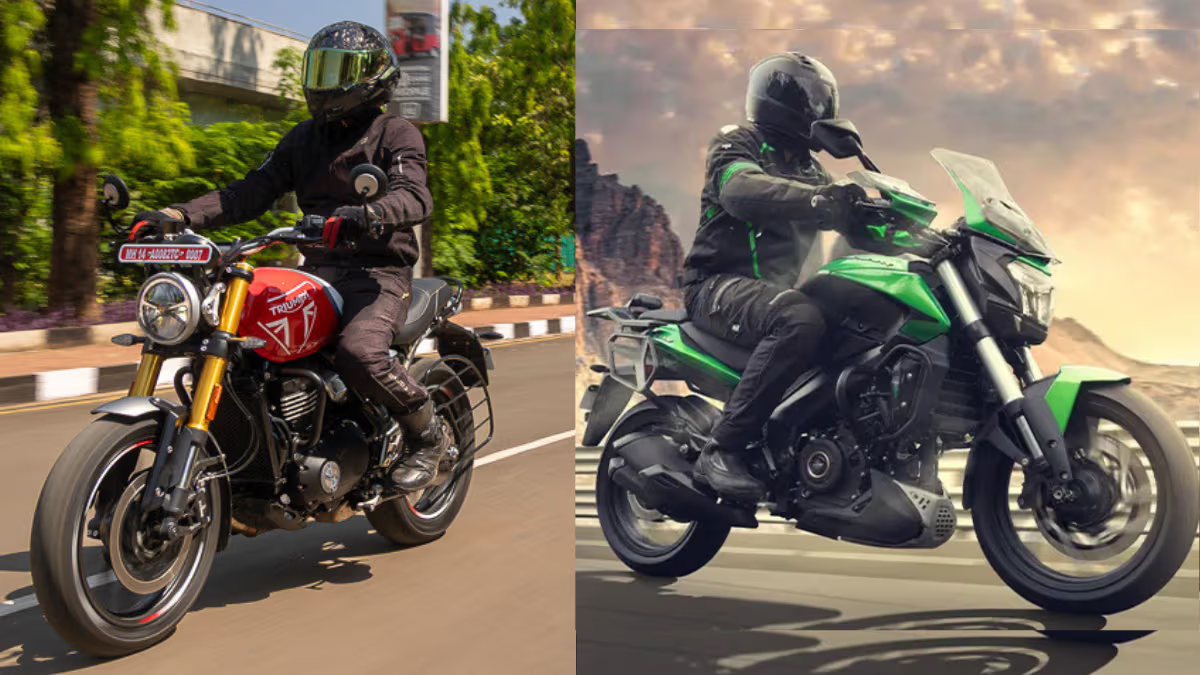
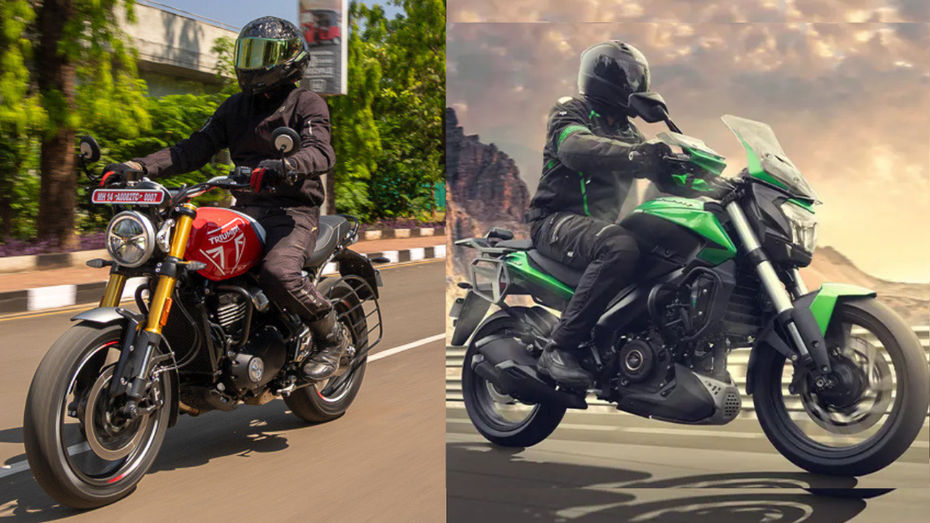
Comparing the Bajaj Dominar 400 and the Triumph Speed 400 is possibly the simplest way to describe how different two 350cc motorcycles could be. One looks immensely dominant, is performance-focused, and built to make long highway runs feel super easy. Meanwhile, the other feels approachable, more polished, and is pretty sharp for a modern classic roadster. Both motorcycles are engineered for different kinds of riders, but still, if you are confused between the two, this detailed comparison will help you find the right ride companion:
Price & Variants
|
Price |
Bajaj Dominar 400 |
Triumph Speed 400 |
|
Ex-showroom (Delhi) |
Rs 2,03,214 |
Rs 2,34,140 |
|
Warranty |
5 years / 75,000km |
2 years / Unlimited km |
- Both motorcycles are available in single variant, that comes fully loaded, and both offer optional accessories for personalisation.
-
The Bajaj Dominar 400 undercuts the Triumph Speed 400 by a noticeable margin of Rs 30,926.
-
The Dominar’s 5-year / 75,000km warranty looks more lucrative than the Triumph’s 2-year / unlimited kilometres cover. The Speed 400, however, counters it with an impressive 16,000km service interval.
Dimensions & Design
|
Specification |
Bajaj Dominar 400 |
Triumph Speed 400 |
|
Wheelbase |
1,452mm |
1,386mm |
|
Ground Clearance |
157mm |
164mm |
|
Seat Height |
800mm |
803mm |
|
Kerb Weight |
190kg |
179kg |
|
Fuel Tank Capacity |
13 litres |
13 litres |
|
Body Style |
Sports Cruiser |
Modern Classic Roadster |
|
Colour Options |
Aurora Green, Charcoal Black |
Racing Yellow + Pearl Metallic White, Phantom Black + Pewter Grey, Pearl Metallic White + Pewter Grey, Racing Red + Pearl Metallic White |
-
The Dominar 400 looks a bit larger and bulkier than the Speed 400. That, with a significantly larger wheelbase, makes the Dominar more surefooted and offers better straight-line stability at highway speeds.
-
The Compact Speed 400, meanwhile, feels more agile and offers more responsive handling, thanks to its sharper rake, shorter wheelbase and about 11kg less kerb weight.
-
Both motorcycles have almost similar seat heights, which is quite accessible for most riders. A slightly higher ground clearance, however, gives the Triumph an edge over speed breakers and broken patches.
-
Styling is one of the aspects where you can clearly make out that they are polar opposites.
-
The Dominar 400 is unmistakably aggressive with its muscular tank, sculpted bodywork, chunky twin-pod exhaust, a tall visor, and low-slung LED headlamp.
-
The Speed 400, meanwhile, looks clean with its retro-inspired silhouette, minimalistic styling, and polished detailing. Such as brushed aluminium inserts and premium paint finish. One looks built for munching miles, while the other looks built to be admired.
Ride & Handling
|
Specification |
Bajaj Dominar 400 |
Triumph Speed 400 |
|
Frame Type |
Beam-type, Perimeter |
Hybrid Spine/Perimeter, Tubular Steel |
|
Front Suspension |
43mm USD (Upside Down) Forks, 135mm travel |
43mm USD Forks, 130mm travel |
|
Rear Suspension |
Nitrox Monoshock with preload adjustment, 110mm travel |
Monoshock with preload adjustment, 120mm travel |
|
Front Brake |
320mm Disc |
300mm Disc |
|
Rear Brake |
230mm Disc |
230mm Disc |
|
Front Tyre |
110/70-R17 |
110/70-R17 |
|
Rear Tyre |
150/60-R17 |
150/60-R17 |
|
Wheels |
17-inch Alloy Wheels |
17-inch Alloy Wheels |
- Both motorcycles use perimeter-type frames for superb torsional rigidity. The Triumph’s hybrid frame, however, balances it with comfort, while its cast aluminium swingarm improves agility.
-
The suspension setup on the two is also of a similar type, but offers different wheel travel and tuning.
-
Both get 17-inch alloys with similarly tyres sizes, but the Triumph comes equipped with Vredestein Centauro ST tyres, which are far more superior than the MRF Revs which the Dominar gets.
-
The Dominar offers a larger front brake disc; however, the Speed 400’s setup may actually feel more confidence-inspiring in real-world conditions, as it comes equipped with high-performance sintered brake pads.
Features & Technology
|
Feature |
Bajaj Dominar 400 |
Triumph Speed 400 |
|
Lighting |
All-LED |
All-LED |
|
Instrument Cluster |
Digital LCD |
Analogue Speedo with Digital LCD |
|
Connectivity |
Bluetooth |
— |
|
Connected Features |
Turn-by-turn Navigation, Call/SMS alerts |
— |
|
USB Charging Port |
Type-C |
Type-C |
|
Riding Modes |
4 (Road, Sport, Rain, Off-Road) |
— |
|
Traction Control |
Switchable |
Switchable |
|
ABS |
Dual-Channel |
Dual-Channel |
- Both motorcycles feature all-LED lighting and a type-C USB charging port, but the Bajaj Dominar 400 takes a leap in tech with its fully digital instrument cluster and connected features.
-
The ride-by-wire tech, dual-channel ABS and traction control are featured on both the motorcycles.
-
The Dominar takes a lead again by offering four riding modes to suit the power delivery and ABS interventions to various riding conditions.
Engine & Performance
|
Specification |
Bajaj Dominar 400 |
Triumph Speed 400 |
|
Engine Type |
4-stroke, Single-cylinder, DOHC |
4-valve, Single-cylinder, DOHC |
|
Displacement |
349.13cc |
349cc |
|
Maximum Power |
40.6PS at 9,000rpm |
37PS at 8,500rpm |
|
Maximum Torque |
33.2Nm at 7,500rpm |
32Nm at 7,000rpm |
|
Fuel Supply |
Electronic Fuel Injection (EFI) |
Electronic Fuel Injection (EFI) |
|
Throttle Control |
Ride-by-wire (Electronic) |
Bosch Ride-by-wire (Electronic) |
|
Gearbox |
6-speed |
6-speed |
|
Clutch |
Wet Sump Multiplate, with Assist & Slipper Tech |
Wet Sump Multiplate, with Assist & Slipper Tech |
- Having the same engine capacity and a more or less similar architecture, both motorcycles have a sporty, rev-happy character.
-
The Bajaj Dominar 400 delivers slightly more power (about 3.6PS) and a pinch of extra torque (1.2Nm), but the Triumph Speed 400 makes up for it with its lightweight.
-
While the Bajaj is outright performance-focused and likes to be revved high, the Triumph delivers its peak torque a bit earlier and feels more refined. Both respond quite well to the throttle input, thanks to the ride-by-wire electronic throttle control.
-
The two motorcycles come equipped with a slipper clutch for smooth shifting and to avoid rear wheel lock during gear transitions.
BikeDekho Says
The Bajaj Dominar 400 is arguably one of the best cruising machines you can get under Rs 2.5 lakh (on-road). It brings a very potent engine with ride-by-wire throttle, four riding modes, and traction control. Then the equipment it has is focused on high-speed stability, and its factory-fitted touring accessories complete the package to roll out on a long ride straight from the showroom.
The Triumph Speed 400, meanwhile, is compact, lighter and pretty precise in terms of control. The built quality is best-in-class, and its super-refined engine doesn’t feel short on performance, too. It misses a few tech features compared to the Dominar, but whatever it offers is top-notch, such as switchable traction control and electronic throttle control by Bosch. It also gets a premium set of equipment, but is more focused on agility and sharper handling response. It actually feels like a true sports bike under the classic disguise.
Clearly, both motorcycles have a day-night different character. Those looking for a long-distance touring machine with maximum features and power per rupee should go with the Dominar 400. Those who have a thing for classy motorcycles, prefer quality over quantity, want precise handling, and can spend a few extra grands, will choose the Speed 400.
Other Rivals
If you are looking for something less intimidating and retro styled, the Meteor 350 could be a good option over the Dominar 400.
The Royal Enfield Classic 350 owns the nostalgia and heritage space, while the Dominar 400 is a more capable all-rounder.
Along with a more premium badge, the Harley-Davidson X440 also offers a stronger low-end torque than the Dominar.
The Yezdi Roadster offers a more expressive design than the Dominar 400, but lacks performance and electronics.