









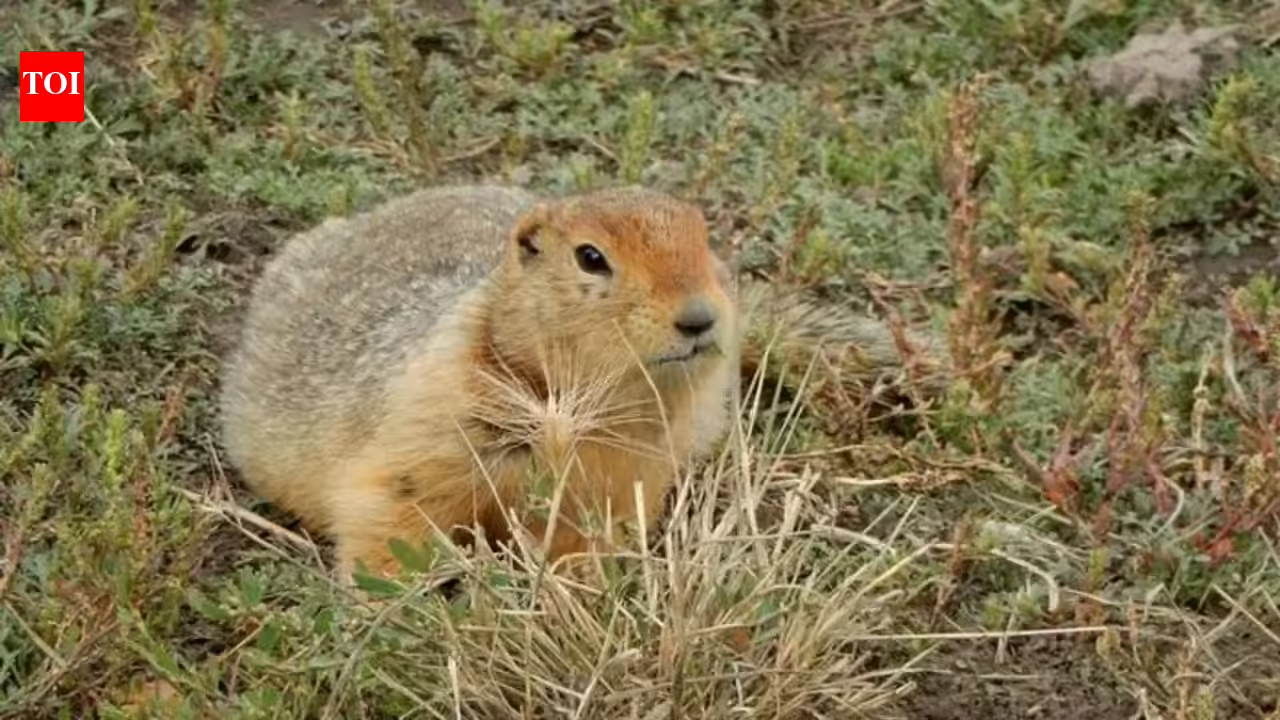
A sealed vial of sediment pulled from Yukon permafrost does not look like a breakthrough. It looks like dirt until the sequencing results arrive. Inside it, scientists from institutions including McMaster University and the University of Alberta found genetic traces of mammoths, horses, and predators that have not roamed the Arctic for tens of thousands of years. The material was not bone or tooth enamel. It was fossilised Arctic ground squirrel droppings preserved in ice for up to 700,000 years.The study, published in Nature Communications, titled ‘Ground squirrel coprolites preserve complex archives of ancient environmental DNA over 700,000 years’, is forcing a rethink of what counts as a viable fossil record. In practice, it represents a technical shift in paleogenomics: using ancient environmental DNA trapped in coprolites to reconstruct entire food webs that once existed in Beringia.
How squirrel poop preserved DNA from mammoths, wolves and hundreds of ancient plants
The Arctic ground squirrel (Arctic ground squirrel) does not just leave droppings behind. It leaves behind a compressed snapshot of its environment. These squirrels forage widely, including plants, fungi, insects, and occasionally carrion, and they also cache material inside burrows that remain sealed in permafrost for millennia. In modern sequencing laboratories, researchers recovered over 18 mitochondrial genomes from the samples, including woolly mammoth, steppe bison, and horse lineages. They also identified DNA signatures from wolves, large cats, including cougar or cheetah-like predators, and more than 200 plant groups spanning multiple glacial periods dated between roughly 30,000 and 700,000 years ago.What makes this possible is not just cold preservation but accumulation. Each pellet contains environmental DNA from everything the animal interacted with, whether ingested, inhaled or collected in its burrow. It turns a single biological sample into a multiplexed ecosystem record.
What 700,000-year-old coprolites tell us about predator, prey and plant relationships
Bones preserve anatomy, teeth preserve diet, coprolites, fossilised faeces, preserve interaction. That distinction is why this work is drawing attention across paleogenomics. A bone confirms that a mammoth existed in a region. A squirrel dropping can show what that mammoth coexisted with, what it ate indirectly through plant chains, and which predators moved through the same landscape.Tyler Murchie of the Hakai Institute, a lead author on the study, described the squirrels as natural collectors. The analogy is useful because the burrow functions like a low-temperature archive with stable humidity, minimal microbial activity, and rapid entombment in permafrost layers that slow DNA decay.At a molecular level, preservation relies on mitochondrial DNA resilience and the protective effect of frozen, low-oxygen conditions. Over time, enzymatic breakdown slows significantly, allowing fragments to remain recoverable long after most organic material disappears.
What ancient DNA is rewriting about Arctic species continuity over 700,000 years
One of the most important findings is not the list of species but the mismatch between assumed continuity and genetic turnover.For years, Arctic paleontology assumed that fossil ground squirrel remains represented a single long-lived lineage in the Yukon. The genetic data complicates this picture. Researchers identified previously unknown diversity, including a lineage dating back roughly 700,000 years with closer modern relatives in western Siberia. Evolutionary geneticist Hendrik Poinar, director of the McMaster Ancient DNA Centre, noted that genomic regions under selection during past climate transitions may help inform models of how modern species respond to present warming trends. The main constraint in ancient DNA research is fragmentation over time. Most usable sequences degrade beyond around 100,000 years under typical conditions. These samples extend far beyond that limit.