







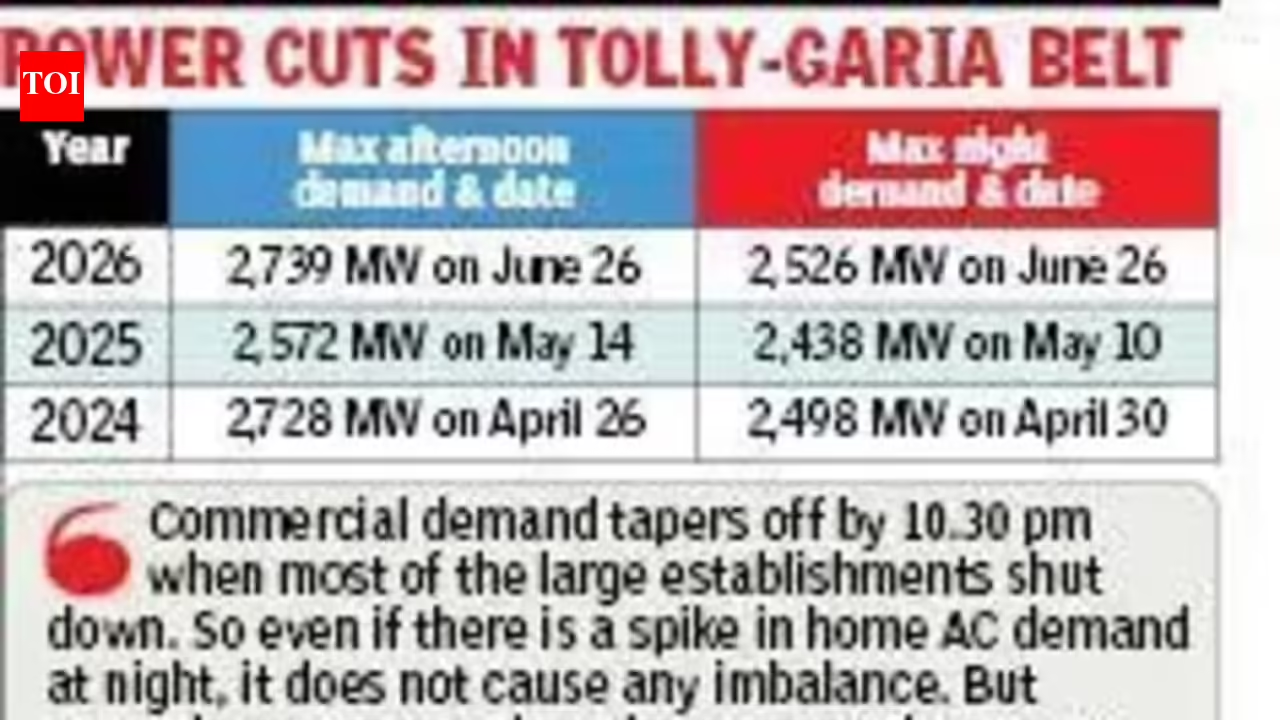
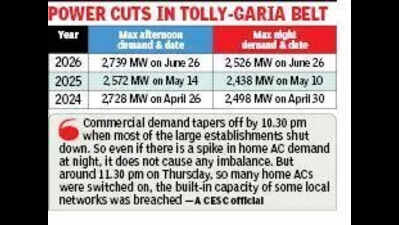
Kolkata: Several neighbourhoods in the Tollygunge-Garia belt experienced power cuts between midnight and 3 am on Friday as circuits in CESC distribution boxes tripped following a sharp surge in load. The utility said its demand hit a record peak, both during the day and night on Thursday, as the city witnessed unprecedented use of home ACs.Residents of Netaji Nagar, Bijoygarh and other localities in the region said the power went off around midnight, leaving them sleepless in the sweltering heat and humidity. While the power returned in some places after an hour, some localities recorded outages for nearly three hours.CESC said the outages were owing to a sudden spike in demand that had outstripped the local network capacity. “Commercial demand tapers off by 10.30 pm when most of the large establishments shut down. So even if there is a spike in home AC demand at night, it does not cause any imbalance. But around 11.30 pm on Thursday night, so many home ACs were switched on, the built-in capacity of some local networks was breached, causing the outages,” the official said.The power demand at 11.45 pm peaked at 2,526 MW, well over the previous night-time peak of 2,498 MW in May 2025. Earlier in the afternoon at 3.45 pm, the daytime record peak also was breached. At 2,739 MW, it was 10 MW higher than the previous peak of 2,728 MW recorded in April 2024.While CESC insisted it had maintained stable supply, officials said the problem of not reporting ACs being added to homes that caused major disruptions a couple of years ago resurfaced on Thursday.“The meter installed in a household may be capable of taking the load of up to three air-conditioners. But if the ACs are installed without informing the utility, it is considered unauthorised load and can contribute to the tripping of supply and a blackout in the neighbourhood. That is what happened in some localities on Thursday. We urge consumers to let us know when they are adding an AC so that we can accordingly augment the network,” a CESC official said.The utility said the overall network had been strengthened with the installation of 500 new distribution transformers and two distribution stations. “The situation is a lot better than what we experienced in 2023-24. This is a continuous process and we are at it but we need the cooperation from consumers, who have to just inform us of additional load,” the official added.

