







Last Updated:
While Mamata Banerjee continues to be viewed by a section of voters as a leader above the organisation, Abhishek is increasingly seen as the face of the organisation itself




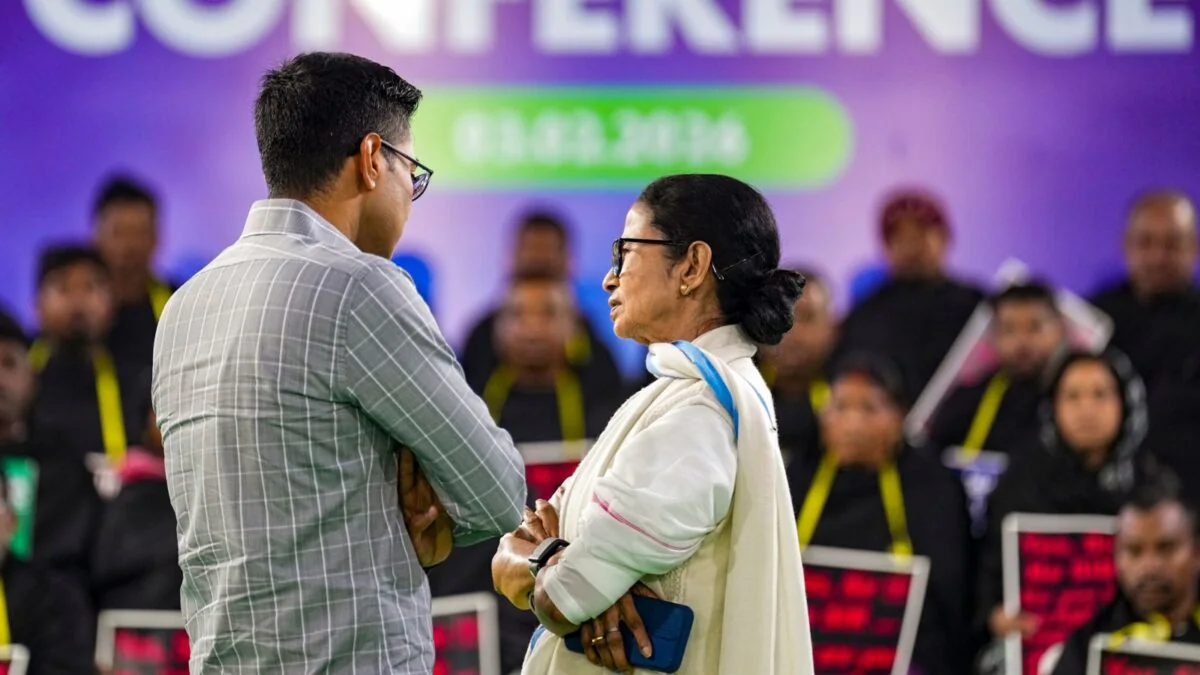
Abhishek Banerjee with Mamata Banerjee. (File pic)
A decade ago, during Mamata Banerjee’s 2016 swearing-in ceremony on Kolkata’s most prominent street—Red Road—one absence generated almost as much discussion and controversy as the event itself. Abhishek Banerjee was missing.
The speculation was immediately amplified because, in the days leading up to the ceremony, large stretches of the city had been lined with posters carrying photographs of mostly the chief minister’s nephew, who had become a member of Parliament just two years earlier. Several of those posters were quietly removed after questions began to be raised. The episode marked one of the earliest public glimpses into a debate that would continue to shadow the Trinamool Congress for years: the rise of the “Bhaipo” (nephew) and the party’s evolving power structure. The senior leaders started flocking around him as he was seen as the political heir of their Didi, and they fondly started calling him “Yuvaraj”.
In 2026, post the first defeat, the same “Yuvaraj” is at the centre of localised anger over corruption, cadre disintegration, factional feud, probable division, central agency scanner, and also the alleged prime accused of the forged signature scandal. In connection with the signature forgery case, which is a serious one, the state CID summoned him twice, and he did not appear, citing health reasons. However, evading a third summons for appearance, which is likely to be issued soon, may be detrimental for him, News18 has learnt from sources in the police.
Didi’s Legacy, Bhaipo’s Burden
For over a decade, Mamata Banerjee has remained Trinamool Congress’s ultimate vote-catcher, crisis manager, and political shield. Yet, as public anger over corruption, the syndicate system, local strongmen, and central agency investigations intensifies across Bengal, it is increasingly Abhishek Banerjee, and not Mamata, who finds himself in the line of fire.
The reason is simple. Mamata Banerjee continues to be viewed by a section of voters as a leader above the organisation, while Abhishek is increasingly seen as the face of the organisation itself. Over the years, Trinamool evolved from a movement-driven party centred on Mamata’s street politics into a highly structured electoral machine.
That transition coincided with Abhishek’s rise. From candidate selection and organisational appointments to election management and campaign strategy, the Diamond Harbour MP became synonymous with the party’s functioning. The successes were credited to him. Now the failures are finding their way back to him as well.
Why The Anger Stops At Abhishek:
Having entered Parliament in 2014, Abhishek’s political ascent was rapid. Supporters projected him as the future face of the organisation. The formation and expansion of the youth wing—Yuva Trinamool—under his leadership added a new power centre within the party. Over time, differences between sections of the traditional organisation and the younger leadership became increasingly visible. The seed was already sown by him.
The fault lines continued to resurface before elections; the speculations over an alleged rift became loud, but none publicly acknowledged it, except for some stray comments coming from some leaders. The reason was the party’s winning trajectory.
However, friction within the Trinamool was never entirely absent. Senior leaders occasionally complained of shrinking influence. Veterans who had been part of Mamata Banerjee’s anti-Left, anti-land acquisition movement often found themselves sharing space with a newer generation whose rise coincided with the party’s years in power rather than its years in opposition. For years, electoral success papered over these differences.
At the grassroots level, public resentment is rarely directed at an abstract institution. It seeks a face. In Bengal today, anger over recruitment scams, allegations of cut money, the syndicate network, local corruption, and the growing disconnect between leaders and cadres increasingly converges on Abhishek. He is now perceived as the custodian of the system that emerged during Trinamool’s years in power. A senior Trinamool leader and former minister told News18, “We are sad and disappointed that we are now seeing this day too. We warned Didi time and again. But she always chose her bloodline over the party. She was not ignorant or oblivious of such a situation. She never accepted the erosion in her support base.”
The central agency investigations have only reinforced that perception. Even when cases involve multiple leaders, the political narrative often circles back to Abhishek. The irony is that Abhishek has often attempted to project himself as a reformer within the party. His calls for internal accountability, performance-based politics, and organisational restructuring were aimed at distancing himself from precisely the problems now haunting Trinamool.
About the Author

Madhuparna Das, Associate Editor (policy) at CNN News 18, has been in journalism for nearly 14 years. She has extensively been covering politics, policy, crime and internal security issues. She has co…Read More
Read More