




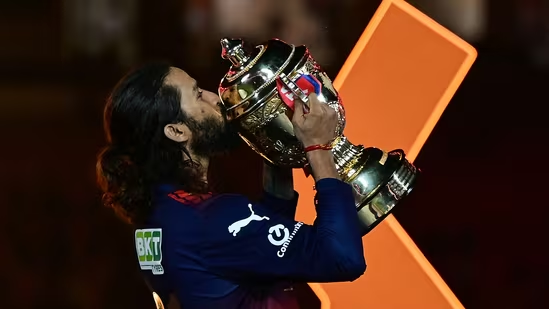
Rajat Patidar’s IPL 2026 was not simply a batting season. It was a franchise-control season.

Royal Challengers Bengaluru did not merely extract 501 runs from their captain. They extracted middle-order acceleration, tactical authority, playoff composure, and one of the most efficient auction returns the tournament produced. At a season cost of ₹11 crore, Patidar generated a modelled value of ₹49.34 crore, resulting in a total profit of ₹38.34 crore. No player in the tournament’s monetary profit-loss ledger finished above him.
What makes that number arresting is the structure beneath it. His player-performance value stood at ₹21.28 crore, yielding a profit of ₹13.03 crore. His captaincy value surpassed even that: ₹28.06 crore, with a leadership profit of ₹25.31 crore. That is the real architecture of his season. The batting generated the headlines. The captaincy generated the hidden surplus.
The batter who changed phases
Rajat Patidar‘s 501 runs arrived at a strike rate of 192.69. His 30 fours and 42 sixes make clear that this was not a season built on soft accumulation; it was built on phase-breaking force.
His Powerplay numbers were measured: 37 off 43 balls at 86.05. That was never where he intended to win matches. Patidar’s real value ignited after the field spread. Between overs 7 and 11, he made 152 off 80 at 190.00. Between overs 12 and 16, he went harder still – 234 off 108 at 216.67. At the death, 78 off 28 at 278.57.
That pattern carries weight. Most middle-order batters either consolidate or finish. Patidar did both, but with a ferocity that kept RCB moving through the innings’ most dangerous passages. He did not wait for the final two overs to justify his place in the order. Overs 12 to 16 were his launchpad, and he treated them accordingly.
His wagon wheel told the same story. Mid-wicket was his most productive zone – 136 runs off 52 balls at 261.54. Long-off returned 81 off 35 at 231.43. Cover yielded 65 off 31 at 209.68. That breadth made him exceptionally difficult to contain. Bowlers could not simply drag it wider and hope for the best. Full on off-stump, he drove. Into the body, he cleared mid-wicket. The margin for error was forensically thin.
Outside-off good length and outside-off short-of-length deliveries remained his more controllable zones. But full-pitched deliveries, full tosses, hittable bouncers, and anything drawn straight through the line became damage deliveries regardless of the plan.
The captaincy layer that changed everything
Patidar’s leadership was the difference between a profitable individual season and a tournament-defining one.
He finished as the top-ranked captain in our impact model, with a captaincy score of 798.3 and an average captaincy rating of 7.13 across 15 matches. The season had its stress fractures – Match 26, Match 42, Match 50, and Match 67 pulled the leadership graph down. But that is precisely what lends the final reading its credibility. This was not a pristine, frictionless campaign. It was a captaincy season with identifiable pressure points, followed by a decisive surge when the stakes demanded it most.
Match 39 crystallised the argument. Patidar did not bat, yet RCB won by nine wickets, and his captaincy rating was 10. The monetary model credited him with a value of ₹3.60 crore and a profit of ₹2.81 crore. That single match separates captaincy value from batting value with unusual clarity. Patidar was not only useful when he scored. He was useful when RCB controlled a match without needing him at the crease at all.
The playoffs sharpened that argument to a point.
In Qualifier 1, he delivered the complete captain-batter performance: 93 not out off 33 balls, no dots, 14 boundaries, a strike rate of 281.82. The model valued the match at ₹11.75 crore, with ₹11.01 crore in profit. His player-performance worth was ₹5.27 crore. His captaincy worth was higher still – ₹6.48 crore.
That innings was not merely acceleration. It was command. Patidar did not play a high-impact knock and then watch the outcome resolve. He controlled the match’s emotional temperature from the first ball he faced. By the end, RCB’s efforts no longer resembled a pursuit. It resembled paperwork.
The final offered a different kind of proof. Patidar made only 15 off 13, yet his captaincy rating was 10. The model credited him with ₹4.01 crore of total worth and ₹3.27 crore in profit. That is the other face of genuine leadership value: in the most consequential match of the season, he did not need to be the main batting act to remain central to the outcome.
Also Read: INR 83.53 crore profit, one trophy, 9 heroes: How RCB built their most complete IPL season
The ₹38.34 crore verdict
Patidar’s season resolves into three distinct layers.
As a batter, he delivered 501 runs at 192.69 – 42 sixes, elite middle-over destruction, and a scoring pattern built to break innings phases rather than simply fill them. As a captain, he finished first in the model’s leadership table and produced his most significant tactical returns precisely when the tournament’s pressure was highest. As a market asset, he converted an ₹11 crore investment into ₹49.34 crore of modelled value.
That is the complete story. Patidar was not merely RCB’s captain. He was their batting accelerator, their tactical anchor, their playoff force, and their single largest profit centre.
RCB did not purchase one role for ₹11 crore. They got four.
Method note
This analysis is based on a performance valuation model designed exclusively by the author. The model converts batting, fielding, captaincy, and match-impact layers into a monetary ledger, measuring modelled match value against season cost.
The monetary figures are analytical estimates, not official IPL valuations, salary revisions, or franchise accounting numbers. They are intended to measure cricketing impact through a structured model.