







NEW DELHI: India’s major cities continue to show alarming signs of mental health strain and socio-economic distress, according to the National Crime Records Bureau (NCRB) 2024 data. The report highlights rising suicides, high crime rates, and growing emotional pressures across urban centres, with Delhi, Bengaluru, and Mumbai emerging as the most affected cities.Delhi recorded the highest number of suicides among 53 Indian cities, while Bengaluru showed the highest suicide rate, and Mumbai remained among the top three cities despite a slight decline.
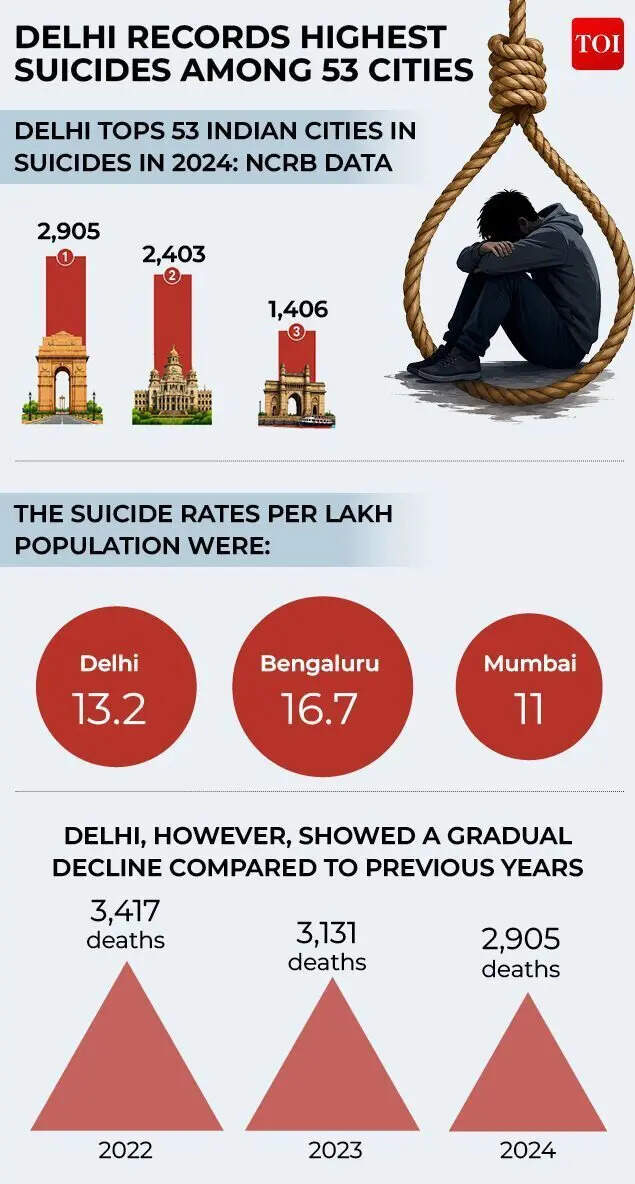
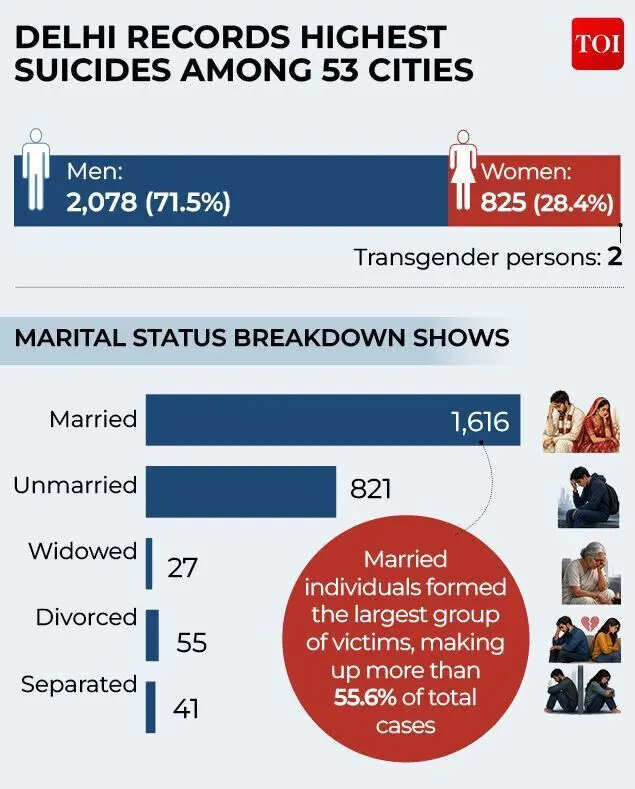
Delhi records highest suicides among 53 citiesDelhi reported 2,905 suicides in 2024, the highest among 53 Indian cities, according to NCRB data. Bengaluru followed with 2,403 suicides, while Mumbai recorded 1,406 cases. According to the NCRB report, Delhi recorded 2,905 suicides in 2024. Bengaluru followed with 2,403 suicides, while Mumbai reported 1,406 cases. In terms of suicide rate per lakh population, Bengaluru stood highest at 16.7, followed by Delhi at 13.2 and Mumbai at 11.Although Delhi continued to top the list in absolute numbers, the city showed a gradual decline over the last three years. The capital recorded 3,417 suicide deaths in 2022, 3,131 in 2023 and 2,905 in 2024. Despite the slight drop, the numbers remained significantly high, reflecting persistent emotional and socio-economic distress among residents. The suicide rates per lakh population were 13.2 in Delhi, 16.7 in Bengaluru and 11 in Mumbai.Delhi, however, showed a gradual decline compared to previous years, recording 3,417 deaths in 2022, 3,131 deaths in 2023 and 2,905 deaths in 2024.Who is most affected? Strong demographic patterns emergeThe NCRB data revealed clear demographic patterns in Delhi’s suicide cases. Out of the total 2,905 suicides, 2,078 victims were men, accounting for 71.5 per cent of all cases. Women accounted for 825 deaths, while two transgender persons were also among the victims.The marital status data indicated that married individuals formed the largest category of suicide victims. A total of 1,616 married persons died by suicide, compared to 821 unmarried individuals. The report also recorded 27 widowed victims, 55 divorced persons and 41 separated individuals.The figures showed that more than 55.6 per cent of the total victims in Delhi were married, suggesting a strong connection between domestic responsibilities, family stress and emotional pressure. Out of Delhi’s total suicides, 2,078 victims were men, 825 were women and two were transgender persons. The marital status breakdown showed 1,616 married victims, 821 unmarried victims, 27 widowed persons, 55 divorced persons and 41 separated individuals.
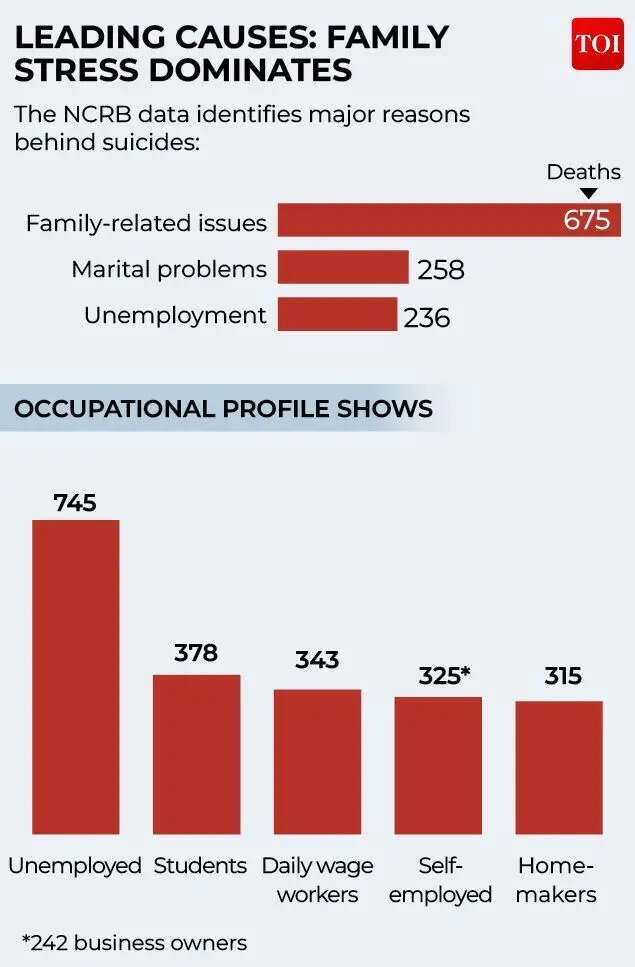
Leading causes: Family stress dominatesThe NCRB report identified family-related issues as the leading cause behind suicides in Delhi, accounting for 675 deaths. Marital problems were linked to 258 cases, while unemployment contributed to 236 deaths. The occupational profile of the victims reflected the widespread socio-economic pressures faced by different sections of society. The report showed that 745 victims were unemployed. Students accounted for 378 cases, daily wage workers for 343 cases, while 325 victims were self-employed, including 242 business owners. Homemakers accounted for 315 cases. The findings pointed towards emotional stress, academic burden, financial instability and livelihood insecurity as major contributing factors behind suicides.Family-related issues accounted for 675 deaths, marital problems for 258 cases and unemployment for 236 deaths. The occupational profile showed 745 unemployed victims, 378 students, 343 daily wage workers, 325 self-employed individuals, including 242 business owners, and 315 homemakers.These figures highlighted a combination of emotional, academic and financial pressures as major triggers.Income and education trends show economic vulnerabilityThe income profile of the victims further highlighted economic vulnerability. A total of 1,362 victims earned less than Rs 1 lakh annually, while 1,258 victims belonged to the income group earning between Rs 1 lakh and Rs 5 lakh per year. Only 28 victims had annual incomes above Rs 10 lakh. Educational background data showed that suicides cut across all education levels. Among the victims, 537 had studied up to Class XII, 525 up to Class X and 383 up to Class VIII. The report also recorded 319 graduate victims and 310 individuals with no formal education. The income profile showed that 1,362 victims earned below Rs 1 lakh annually, while 1,258 earned between Rs 1 lakh and Rs 5 lakh annually. Only 28 victims earned above Rs 10 lakh annually. In terms of education, 537 victims had studied up to Class XII, 525 up to Class X and 383 up to Class VIII. The report also recorded 319 graduates and 310 persons with no formal education. This suggested that suicides were more concentrated among lower-income groups, though they cut across all education levels. Crimes against women and children remain high in delhiApart from suicides, the NCRB report also highlighted serious concerns related to women’s and children’s safety in Delhi.The capital recorded 7,827 crimes against women involving 7,904 victims in 2024. Among these were 1,058 rape cases. Crimes against children also remained alarmingly high, with Delhi recording 7,662 such cases, compared to 3,374 in Mumbai and 2,026 in Bengaluru. In kidnapping and abduction cases, Delhi again topped the list with 5,404 cases. Mumbai reported 1,831 cases, while Bengaluru recorded 1,136 incidents.Under the Protection of Children from Sexual Offences (POCSO) Act, Delhi registered 1,553 cases in 2024. Mumbai followed closely with 1,416 cases, while Bengaluru recorded 594 cases. The data reflected continuing concerns regarding the safety of women and children in urban areas, especially in the national capital. Women-related crimes in Delhi stood at 7,827 cases involving 7,904 victims, including 1,058 rape cases. Delhi also recorded 7,662 crimes against children, while Mumbai reported 3,374 cases and Bengaluru 2,026. In kidnapping and abduction cases, Delhi recorded 5,404 cases, Mumbai 1,831 and Bengaluru 1,136. Under POCSO, Delhi registered 1,553 cases, Mumbai 1,416 and Bengaluru 594.Property crimes and road safety challenges in DelhiProperty-related crimes also remained high in Delhi. The city reported 39,976 vehicle theft cases, 10,690 household thefts, 8,968 burglary cases, 1,510 robberies and 228 extortion cases. Road safety emerged as another area of concern. Delhi recorded 1,521 road accidents in 2024, resulting in 1,658 deaths. The figures underlined the growing burden on policing systems, civic infrastructure and urban safety management.Delhi continued to report high levels of property-related crime, including 39,976 vehicle thefts, 10,690 household thefts, 8,968 burglary cases, 1,510 robberies and 228 extortion cases. Road safety data showed 1,521 road accidents and 1,658 deaths linked to road accidents.
Bengaluru suicide trend: Steady rise over yearsBengaluru continued to witness a steady rise in suicides over the years. The city recorded 2,313 suicides in 2022, 2,370 in 2023 and 2,403 in 2024. Trend data for 2025 showed 2,364 cases. Between 2022 and November 2025, Bengaluru reported a total of 9,450 suicides, averaging nearly seven deaths every day. The NCRB data showed that hanging remained the most common method used in Bengaluru, accounting for 8,148 cases. Poison consumption was reported in 740 cases, while 204 people died after jumping from heights. The city recorded 2,313 suicides in 2022, 2,370 in 2023, 2,403 in 2024 and 2,364 cases in 2025, according to trend data. Methods used included hanging in 8,148 cases, poison consumption in 740 cases and jumping from heights in 204 cases.Experts call it a psycho-social crisisMental health experts said suicides are being driven by emotional distress, lack of coping skills and increasing social pressure.Dr Raveesh BN, professor and head of psychiatry at Mysuru Medical College and Research Institute, said: “It is a psycho-social problem,”He further added: “Access to means is also an issue in deaths by suicide. Earlier, fans were fitted at a height that can’t be reached easily. Earlier, pesticides and other materials were not easily available, unlike now,”He also stated: “Various forms of stress continue to be the major reason for suicides. If individuals don’t learn problem-solving skills, they are more vulnerable to taking extreme steps,”Dr Kiran R, senior resident at Tele MANAS, NIMHANS, said: “Family and relationship, academic, financial and adolescent issues are the major reasons for individuals taking such extreme steps,”He further advised: “If one develops suicidal thoughts, they must call a helpline number immediately and seek professional help. They need to talk to close ones and move to a safer place immediately,”Archana Kartik added: “Most of the phone calls received are from people between the ages of 18 and 45, due to issues like sleep, sadness, phobias, anxiety, marriage-related issues, financial difficulties, exam stress, grief, and suicidal ideation,”She also noted: “When needed, the audio calls can be converted to video consultation through mental health professionals.”
Mumbai and Maharashtra context (city-level focus)Mumbai recorded 1,406 suicides in 2024 and ranked third among 53 Indian cities. The suicide rate in Mumbai stood at 11 per lakh population.In 2022 has recorded 1,501 suicides case, indicating a marginal decline by 2024. However, despite the drop, the city remained among the top three urban centres with the highest suicide burden in India. At the state level, Maharashtra continued to contribute significantly to the country’s suicide numbers, driven by urban stress in Mumbai and wider socio-economic pressures across the state. Mumbai recorded 1,406 suicides in 2024, ranking third among 53 Indian cities, with a suicide rate of 11 per lakh population. The city had reported 1,501 suicides in 2022, showing a slight decline by 2024.Telangana shows rising mental health-linked suicidesTelangana also reported rising suicides linked to mental illness. In 2024, the state recorded 951 such suicides and a suicide rate of 28.6 per cent, making it the fifth highest in the country. Among states, Karnataka recorded 2,465 suicides linked to mental illness, followed by Madhya Pradesh with 1,598, Tamil Nadu with 1,276, Maharashtra with 1,092 and Telangana with 951.
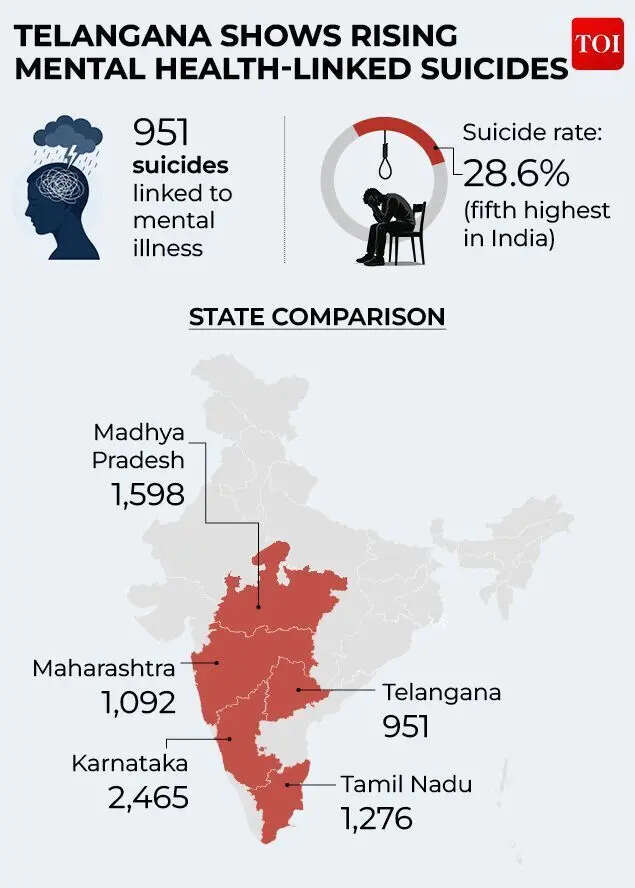
Experts pointed to unemployment, loneliness, academic pressure, financial instability and relationship issues as major triggers behind the growing crisis.Dr Jawaharlal Nehru P said: “Many hesitate to discuss their emotions openly because of fear of judgment, which gradually pushes them into loneliness,”Telangana recorded 951 suicides linked to mental illness and a suicide rate of 28.6 per cent, the fifth highest in India. Among states, Karnataka recorded 2,465 such cases, Madhya Pradesh 1,598, Tamil Nadu 1,276, Maharashtra 1,092 and Telangana 951.A growing need for mental health supportNCRB data highlights urgent need for stronger intervention systemsThe NCRB 2024 findings present a deeply concerning picture of India’s urban mental health and safety landscape. While Delhi continues to report the highest number of suicides, Bengaluru records the 2nd highest suicide rate and Mumbai remains among the top three cities despite a slight decline in cases. Across regions, family conflicts, financial stress, unemployment, academic pressure and emotional isolation continue to emerge as the most common triggers behind suicides. The data highlights the urgent need for stronger mental health infrastructure, accessible counselling systems, early intervention mechanisms and sustained public awareness efforts to address the growing psychological burden across India’s cities and states.