The world’s loneliest tree had no other tree within 400 km across the Sahara Desert and roots over 30 metres deep to reach hidden groundwater, then one drunk truck driver knocked it down after 300 years of survival | World News

Deep in Niger’s Ténéré Desert once stood what was widely regarded as the world’s loneliest tree, an umbrella thorn acacia that survived for around 300 years despite having no other tree within roughly 400 kilometres. Hidden beneath the scorching Sahara, its roots stretched more than 30 metres underground to reach precious groundwater, allowing it to…

Read More

Japan’s 2011 megaquake sent a seismic wave nearly 2,900 km to Earth’s core, which returned 13 minutes later and shifted the entire country eastward |

A seismic wave generated by Japan’s devastating 2011 magnitude 9.0 Tohoku-Oki earthquake travelled nearly 2,900 kilometres to the boundary of Earth’s core, reflected back about 13 minutes later and shifted the entire country eastward by roughly six millimetres, according to a study published in the journal Science. The movement was far too small for anyone…

Read More

Antarctic: Scientists find nanoplastics in Antarctic soil for the first time, including tyre-wear particles, raising concerns that tiny plastic pollution can travel through the atmosphere to Earth’s most remote places

Nanoplastics found in Antarctic soils for first time, suggesting long-range atmospheric transport Scientists have detected nanoplastics in Antarctic soil for the first time. This provides fresh evidence that tiny plastic particles can travel through the atmosphere and reach some of the most remote places on Earth. But how is it even possible?The study was published…

Read More

Mysterious ‘space balls’ twice the size of basketballs wash ashore on Australian beach, scientists say the discovery is more common than many people think

Strange Spheres Washed Ashore on an Australian Beach. Authorities Say They’re Probably ‘Space Balls’ What began as an ordinary day in a small Australian beach town turned into an unusual investigation after six large metallic spheres washed ashore. The discovery forced residents to evacuate and raised fears that the objects could be dangerous.The shiny objects…

Read More

A new island rose from the sea in Iceland in 1963, but everyone except scientists is banned from setting foot on it: Here’s why |

A barren stretch of volcanic rock rising from the Atlantic Ocean may not sound like one of the world’s most protected places, yet almost nobody is allowed to set foot on Iceland’s Surtsey island. There are no permanent residents, hotels or tourist attractions, and even scientists need special permission to visit. The reason lies in…

Read More

Less than 30% of Earth’s ocean floor has been mapped while scientists still have clearer high-resolution data of Mars than most of the seabed covering our own planet

Scientists say we have only explored a fraction of Earth’s Seas and Oceans Less than 30% of the world’s ocean floor has been mapped to modern standards, meaning scientists still have a clearer view of the Space, Moon and Mars than of the seabed that covers most of Earth.The global effort known as the Seabed…

Read More

Antarctica froze 25 million years before the Arctic, and scientists now think the answer was hidden beneath the continent |

For a long time, the story seemed straightforward. As atmospheric carbon dioxide levels fell and the planet cooled, large ice sheets began spreading across the polar regions. Yet there was an awkward detail that never quite fitted. Antarctica became locked beneath vast quantities of ice around 34 million years ago, while the Arctic remained largely…

Read More

Arctic alarm: Earth’s frozen carbon stores in the Arctic may stop absorbing CO2 and start releasing it by the 2050s |

The Arctic is warming far faster than the rest of the planet, and a new study published in Science Advances suggests that this warming could transform one of Earth’s biggest natural carbon stores sooner than scientists once thought. Researchers say northern soils above 30°N, including vast areas of permafrost, may switch from absorbing carbon to…

Read More

‘Real-life Project Hail Mary’: Scientists discover a hidden fungal network beneath Earth stretching 110 quadrillion kilometres |

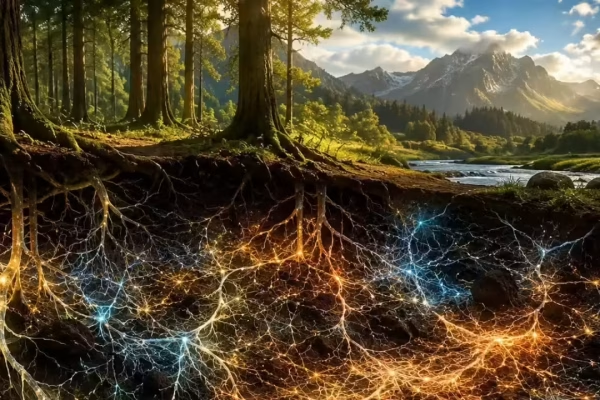
Beneath forests, grasslands and even the soil in our gardens lies an extraordinary hidden world that most people never see. Scientists have now mapped a vast underground network of microscopic fungi stretching an estimated 110 quadrillion kilometres across Earth’s topsoil, a distance so immense that it could reach the Sun nearly a billion times. The…

Read More