


Have you heard of Bhamashah, the epitome of financial renunciation for a cause? He was the treasurer (finance minister) of Mewar in 1578, when Maharana Pratap was living in the jungle after losing to the Mughals. Bhamashah gave all of his family wealth to the Maharana who used the funds to raise a new army and reclaim most parts of his kingdom that he had lost to the Mughals. This gripping, fairytale-like turnaround story holds an important lesson. If the State and the people join hands, they can make the impossible happen.

The lesson has become extremely relevant in the present context as our world deals with a decade of crisis. It began with the Covid-19 pandemic, followed by the Ukraine-Russia war and the Israel-Gaza conflict; now, the war in West Asia has blown to smithereens all the established norms and networks that built the edifice of global village over the last three decades.
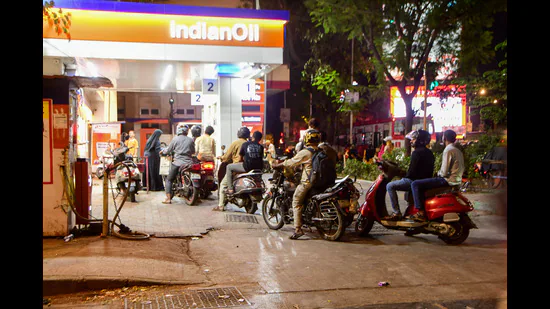
A few examples are enough to understand the gravity of the situation. After three months of restraint, the prices of petrol, gas and diesel are rising. The Wholesale Price Index (WPI) inflation is at 8.30%. Despite what the government data says about retail inflation, grocery, dairy, and vegetable bills are rising. Many industries are complaining about increased input costs and decreasing profit margins. Daily-wagers are feeling the pinch.
For a reality check, let me take you to Firozabad. There are 200 glass bangle manufacturing units in the city. Three lakh labourers work in these units. The bangle business is worth close to ₹17,000 crore. Due to the war in West Asia, their exports have dried up and a reduction in the piped natural gas (PNG) quota is affecting their production. Thanks to this double whammy, the manufacturers threatened to stop production from May 22. But, after the district administration’s intervention, they postponed their decision till May 30. There are thousands of such units across the country that are suffering from a similar crisis.
This is the reason Prime Minister (PM) Narendra Modi asked the people to exercise restraint.
Modi wants Indians to desist from buying gold and travelling abroad for a year. Due to the Strait of Hormuz shutting down, the spectre of shortage in petroleum products and urea has raised its ugly head. Some YouTubers are busy peddling canards that a shortfall in rains and urea supply will create famine-like conditions in India. Be assured nothing like this will happen. Since the Covid-19 pandemic, the Modi government is providing monthly rations to 80 crore people. We have enough food grains to continue the scheme.
The PM has also advised Indians not to buy gold to save foreign currency. We can meet our needs by stopping the import of gold. Government data is testimony that close to 25,000 tonnes of gold is “lying idle” with Indian citizens. Apart from this, religious institutions have huge amounts of gold, silver and other ornaments. Taking inspiration from Bhamashah, we can utilise this dormant wealth.
In 1997, the government led by HD Deve Gowda brought a Special Import Licence and, in 2015, the Modi government introduced the Gold Monetisation Scheme. These schemes filled the government coffers, but were bitterly criticised. Their shortcomings can be addressed and a fresh time-bound scheme can be introduced.
India’s prominent jeweller guilds and gems and ornament export processing councils have advised the government to establish a “bullion bank” with people’s participation. It will reduce the dependence on gold imports and save foreign exchange. Our gold requirements will not be hampered.
Crisis in petroleum products and related issues have plagued the economy earlier too. The only long-term solution is to decrease our dependence on oil. To counter the threat, the idea of “gasification of coal” was discussed in the 1950s. India doesn’t have enough oil and gas but it has abundant reserves of coal. We can make gas from it and use it to bring down the use of oil. Later, as the years passed by there were talks of solar and biogas energy. Some work was done in this direction but no strong push was made to meet the ever-growing demand of the Indian consumers. We need superhuman efforts to meet our burgeoning needs.
We are told to use public transport to save fuel and energy, but the condition of public transport is abysmal. City bus services are dead in almost every city in the Hindi heartland. Polluting three-wheelers and e-rickshaws have replaced them. Some big cities have metro services but they are inadequate considering the expanse of the city.
A few days ago, one of my senior editorial colleagues in Noida was hit by a vehicle while he was returning home on a two-wheeler. He sustained serious injuries. He had to drive a two-wheeler because there’s no credible round-the-clock transport option for him in the 30-kilometre stretch that lies between his residence and the office. This is the situation in Delhi and the National Capital Region. The situation in smaller towns and those just assuming metropolitan status is worse.
I am astonished at the charade perpetuated by people in positions of power, about using public transport. We should do away with such optics and start working on long-term solutions to problems on a war-footing. Remember such conversations were initiated during Covid too, but in the heady “hockey-stick recovery” period we lost track of them. We can turn this aapda (crisis) into an avsar (opportunity). The country and society need to maintain focus and direct efforts to achieve targets, sailing through the present crisis into a glorious future.
Shashi Shekhar is editor-in-chief, Hindustan. The views expressed are personal