




The media is, rightly, reporting at length on the murder of Chandranath Rath, personal assistant to BJP leader Suvendu Adhikari, one of the principal contenders for Chief Minister in a Bengal that now belongs to the BJP. The party’s leadership lost no time in holding the All India Trinamool Congress (TMC) responsible, and a Special Investigation Team has been constituted.
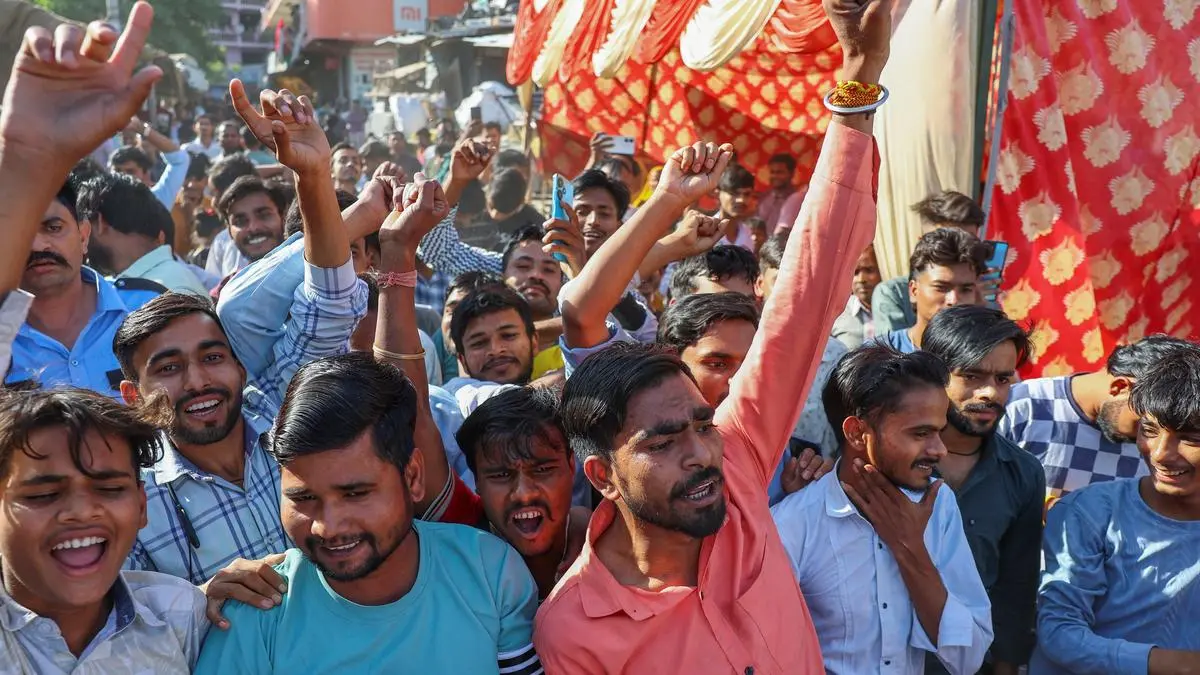
But this degree of attention was not extended to the violence that unfolded immediately after the Assembly election results. Is the media indifferent because it is the BJP that has been unleashing violence after capturing the State? Four people have been killed. Scores of photographs and videos show mobs carrying BJP flags attacking people, dragging them from their homes, and beating them. The fate of the man thrown from the first floor of his house remains unknown.
Mobs have vandalised, looted, and burned shops and homes, smashed statues. “Jai Shri Ram” has become the war cry. Near Kolkata’s New Market, a bulldozer appeared during BJP victory celebrations and demolished structures in the area—the TMC and witnesses allege that Muslim-owned establishments were among those targeted, though the police and some local accounts dispute this characterisation. In Barasat, North 24 Parganas, the name of Masjid Bari Road was reportedly altered. A Hindutva mob in Darjeeling’s Jore Pokhari climbed atop a mosque and planted a saffron flag. This is only the beginning.
The central security forces, deployed in unprecedented numbers to maintain peace during polling, are now standing by as BJP supporters move through the streets. These are the same forces that acted with considerable zeal against TMC workers and supporters while voting was underway.
The Prime Minister, who appeared at his party office in Delhi, draped in a Bangla dhuti and panjabi, instructed his workers that their motto should be “badlav, not badla”—transformation, not revenge. Other leaders offered similarly noble sentiments. The workers and supporters of what the party describes as the world’s most disciplined organisation appear to have understood something rather different—or, perhaps, understood perfectly and proceeded accordingly.
The commentariat and political analysts are, for the most part, unmoved. They invoke Prakash Karat, who once remarked that violence was embedded in West Bengal’s political culture even as CPI(M) cadres were creating mayhem in Singur and Nandigram. Brinda Karat’s instruction to party workers to administer “Dam Dam Dawai” to the Left Front’s opponents also survives in public memory.
The Left and the BJP regularly remind us of the violence the TMC once perpetrated—violence that, in their telling, secular intellectuals never adequately condemned. I remember the post-poll violence of 2011, when the TMC decisively defeated the Left Front. As results came in, CPI(M) offices were attacked and burned. Some of us in Delhi, who had opposed the Left and sympathised with the Nandigram land movement, drafted a statement condemning the violence. I called a writer of considerable reputation who had stood at the forefront of the Nandigram movement, seeking support. What I received was an angry rebuke: the violence, I was told, was a natural response to what the Left Front had long done to its opponents. I remember the shock of hearing a writer who had spent a lifetime speaking against violence inflicted on ordinary people now offering precisely that justification.
Political violence has been so thoroughly internalised within West Bengal’s public life that the current brutality appears almost normal—expected, even desirable. What else, one is implicitly asked, could have happened?
How is it that the TMC, which only yesterday seemed to possess a near-monopoly on street power, now appears incapable of resistance? As the Left Front was before it? The explanation is simple: they were never powerful on their own. They exercised violence because there would be no consequences. Once the protection of the State was withdrawn, they became powerless. Yesterday’s perpetrators are today’s victims.
Why are ordinary people not reacting? Is it because they have come to regard this as normal—as another transfer of territorial control, another resetting of local power? Have people grown so accustomed to living under the patronage of whichever party rules that they no longer imagine citizenship outside such dependence? Democracy as practised in West Bengal has, over decades, converted people into powerless voters who, once elections are over, surrender themselves to whichever party holds the State.
A communal dimension
This time, the violence carries an additional quality. It is not merely the replacement of one power by another, not simply a territorial contest between competing parties. Muslims and Muslimness have become a specific target. Mosques have been attacked. Muslim-sounding names are being replaced with Hindu-sounding ones. Muslim-owned establishments have been threatened and, in some instances, demolished. Suvendu Adhikari, now among the most powerful leaders in West Bengal, has publicly told Muslims they must abandon Islam if they wish to deserve their rights as citizens.
Dilip Ghosh, the former State BJP president who built the party’s base in Bengal, has promised a final “hisab” and a bulldozer for “infiltrators”.
The fear that targeted violence against Muslims will increase is not imaginary. The BJP sought a mandate to push “infiltrators” out of Bengal. Every significant BJP leader deployed anti-Muslim symbolism during the campaign. The campaign was structured around the mobilisation of Hindu votes to advance a political vision aimed at the incremental disenfranchisement of Muslims. This victory, therefore, carries an unmistakable anti-Muslim mandate. It would be naive to imagine that the rhetoric of the campaign will remain confined to speeches.
In the weeks, months, and years ahead, this anti-Muslim politics will seek implementation through law as well as through physical force. The question is whether the political class will once again leave Muslims to defend their citizenship alone, with whatever limited resources they possess, or whether the defence of their rights will finally be understood as a democratic responsibility shared by all parties.
Apoorvanand teaches Hindi at Delhi University and writes literary and cultural criticism.
Also Read | Bengal is not just another election
Also Read | Where, indeed, is ‘khair’?