

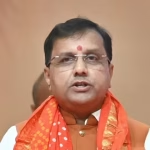




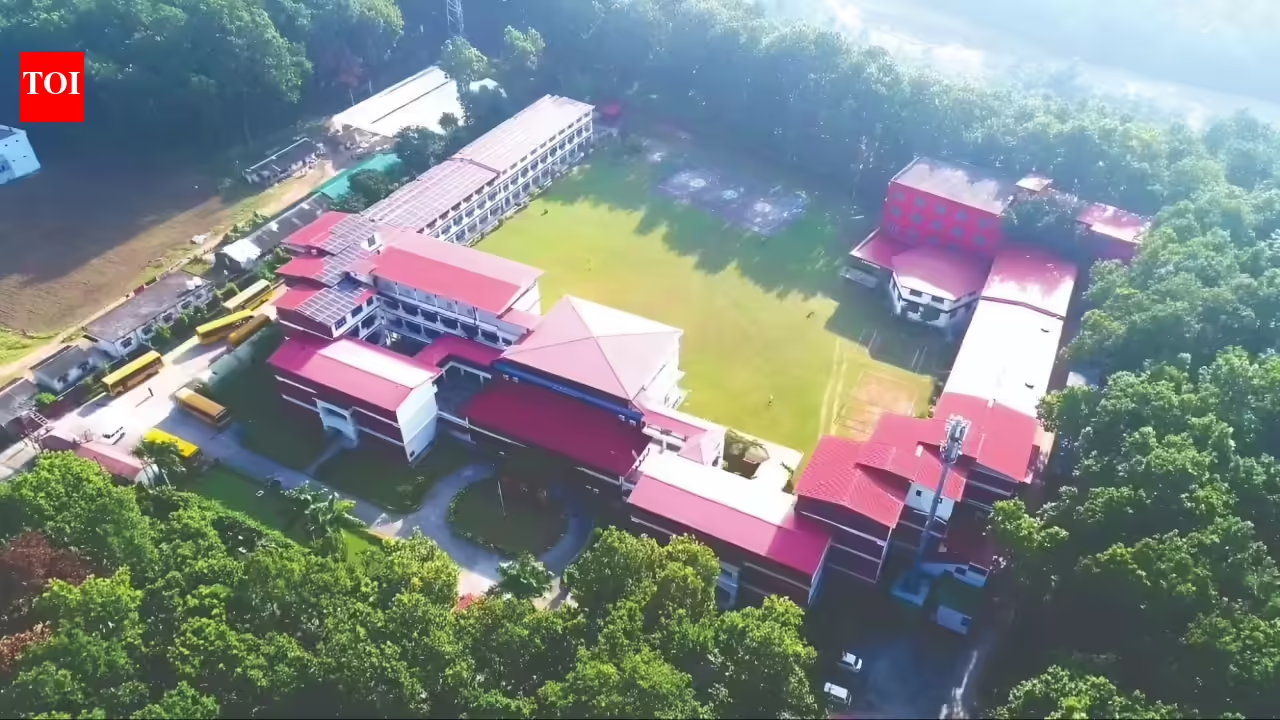

Every year, Indian families face the challenging question of where to send their child to college when they want more than just a certificate. It is the question at the heart of any real search for the best higher education institution, where families seek clarity on what that “more” actually looks like.While many top colleges still run on rigid, affiliated university curricula, a quiet structural shift is happening in the landscape of Indian higher education. Institutions that manage to secure autonomous status and the highest tiers of national accreditation are fundamentally changing how education is delivered, stepping away from outdated systems to meet the demands of tomorrow.These credentials allow a college to offer the curriculum agility of a modern, private institution while still grounding students with the weight and credibility of a central university degree.In an interview, CA Arvind Gupta, the founder of Dolphin (PG) Institute of Biomedical and Natural Sciences, shares what the institution actually stands for as Uttarakhand’s first self-financed autonomous college1 affiliated to HNB Garhwal Central University, holding NAAC A+ accreditation2 and AICTE approved3.Q1. Dolphin Institute holds NAAC A+ accreditation and is Uttarakhand‘s first autonomous college. What do those two distinctions actually mean for a student choosing a college in Dehradun?What autonomy gives us is the ability to design our own curriculum, revise it the moment an industry shifts, and integrate learning structures that a conventional university affiliation would take years to approve. In high-growth domains like Biotechnology, Data Science, or B.Tech AI and ML, where the practice evolves every eighteen months, that speed matters enormously.Despite that private-university agility, our degrees are awarded by HNB Garhwal Central University, which is a rare combination. A regular private college cannot award you a central university degree, and a conventional government college cannot match this speed of curriculum reform. At Dolphin, a student gets both. A contemporary skill set the industry actually demands, and a degree with the institutional weight of a central university behind it. NAAC A+ then completes the picture. It is a formal declaration, after rigorous external examination, that our academic processes, faculty standards, infrastructure, and student outcomes meet the highest benchmarks in the national framework.Q2. Dolphin now offers programmes across B.Tech AI and ML, Computer Science, ECE, MBA, BBA and BCA, alongside its original science disciplines. Is this diversification, or something more structural?It is structural. The word “diversification” implies we are spreading across unrelated areas to hedge our bets, but that is not what is happening. We are building an ecosystem. The flagship disciplines like Physiotherapy, Radiology, Biomedical Sciences, Agriculture, Microbiology, and Biotechnology remain the backbone of who we are and are not being diluted. What we are adding around them is the technology and management layer that every scientific domain is now inseparable from.A Biotechnology graduate who understands data analytics is a different kind of professional from one who does not. A B.Sc. Agriculture student who can model a supply chain are in a different league from a peer who cannot. When a Computer Science student, an Agriculture student, and a Business Analytics student work on the same problem, that intersection is where the interesting things happen. That is the India that Viksit Bharat 2047 needs to be built by.Q3. You have spoken about the “Mini Campus Factory” as a learning model. Can you describe what a student actually experiences in it?The traditional internship gives a student a corner of an operation, where they observe a fragment without ever understanding the whole cycle. In our Mini Campus Factory, the student steps into something that functions as a real business unit within the campus.A Commerce or BBA student might begin by identifying a genuine market gap, such as a healthy food product for which there is real local demand. That student then collaborates with peers from Agriculture, Microbiology, or Biotechnology to research, test, and determine how it can be safely produced. A BCA or B.Tech Computer Science student is brought in to build a product tracking system or a simple commerce interface. The same student who started with market identification may end up managing inventory, assessing financial viability, and presenting to a panel that plays the role of investors. The only thing that carries a student through is their own capacity to think, adapt when something fails, and work with people whose expertise is entirely different from theirs.Q4. What does life beyond academics look like at Dolphin, and why does it matter?A student coming to Dehradun, or from any smaller city or town in this region, arrives carrying more than academic ambition. They come needing to find their footing in the world, and that footing is built in the moments when a student takes responsibility for something larger than themselves, fails at something in front of others, and decides to try again.At Dolphin, we have active, experiential programmes woven into student life, including NCC, NSS, Youth Red Cross, alongside sports, student-run clubs and community engagement drives. NCC builds a level of discipline and national purpose that classrooms simply cannot replicate. NSS takes students straight into rural communities and health camps, where the problems are real and the solutions are written in no textbook. Add to that our Women’s Empowerment initiatives and cultural activities, and students gain a platform to lead and speak. For a student who has never had to chair a meeting or present in front of a crowd, that is transformative. These are structural pillars for building genuine confidence.

Q5. Indian higher education is intensely focused on placement statistics, salary figures, and offer letters. Dolphin seems to measure something different. What is it?I do not dismiss placement data; it is real, it matters to families, and we track it. But we believe placement is an incomplete metric for what a college is actually producing. The real question we ask is about economic absorption. Can this student generate lasting economic value? Not just whether they got an entry-level job, but can they solve a problem an organisation or a community is willing to pay for, or can they create their own economic contribution if the right role does not appear immediately?India’s ambition as a nation will not be served by graduating students who occupy a role, but by graduates who expand the role, improve the organisations they join, and eventually build organisations of their own. With over 11,000 alumni network now working across healthcare, research, banking, corporate enterprises, and entrepreneurial ventures globally, we are really watching whether our graduates generate value that lasts.Q6. The AI disruption is the defining question for every college right now. How is Dolphin preparing students for a world where many tasks their syllabus prepared them for may be automated?The institutions that will produce graduates who matter in the AI era are not necessarily the ones teaching the most AI tools, because tools change every six months. They are the institutions producing students who understand their domain deeply, and who know how to reason, question, and learn. A student who genuinely understands biochemistry will use AI to accelerate their research, but a student who has only learned to operate a piece of software becomes vulnerable the moment that software changes. This is why our model is anchored on genuine subject mastery alongside interdisciplinary practice. When AI evolves again in three years, they will evolve with it. The Mini Campus Factory reinforces exactly this, as there is no textbook answer inside it. Q7. What would you say to a family in Uttarakhand, or anywhere in India, that is weighing Dolphin Institute against better-known names in other cities?I would say, do not choose a college for the name on its gate. Choose it for what it will make your son or daughter capable of. Examine whether the institution has the academic credibility to stand behind its claims; NAAC A+ and autonomous status are external verifications, not self-assessment. Look closely at whether the curriculum is genuinely current, ask what kind of problems students are solving before they graduate, and ask where the alumni actually are.If, after that honest look, Dolphin Institute is the right answer, we would be glad to have that student. References:1. https://www.dolphininstitute.ac.in/wp-content/uploads/2024/04/Conferment-of-autonomous-status-by-UGC-13-11-23.pdf2.
3.
Disclaimer: This article has been produced on behalf of Dolphin Institute by Times Internet’s Spotlight team.