





NOTE: This is Part III of an ongoing series on the history of India-US relations. In Part I, we looked at the historic ties between the two countries before formal diplomatic relations were established in 1947. The second part looked at bilateral ties under Jawaharlal Nehru. You can read them here and here.
The year 1966 was an inflection point for India in more ways than one. Lal Bahadur Shastri, who had succeeded the county first Prime Minister Jawaharlal Nehru, died midway through his term. Indira Gandhi, then widely dismissed as a political lightweight, took over as Prime Minister. The country was grappling with a severe food crisis and had begun looking for ways to become self-sufficient in food production. The economy was under strain, with a widening trade deficit and mounting financial pressures. Together, these challenges pushed India towards a more leftward economic and foreign policy – though without abandoning its commitment to non-alignment.
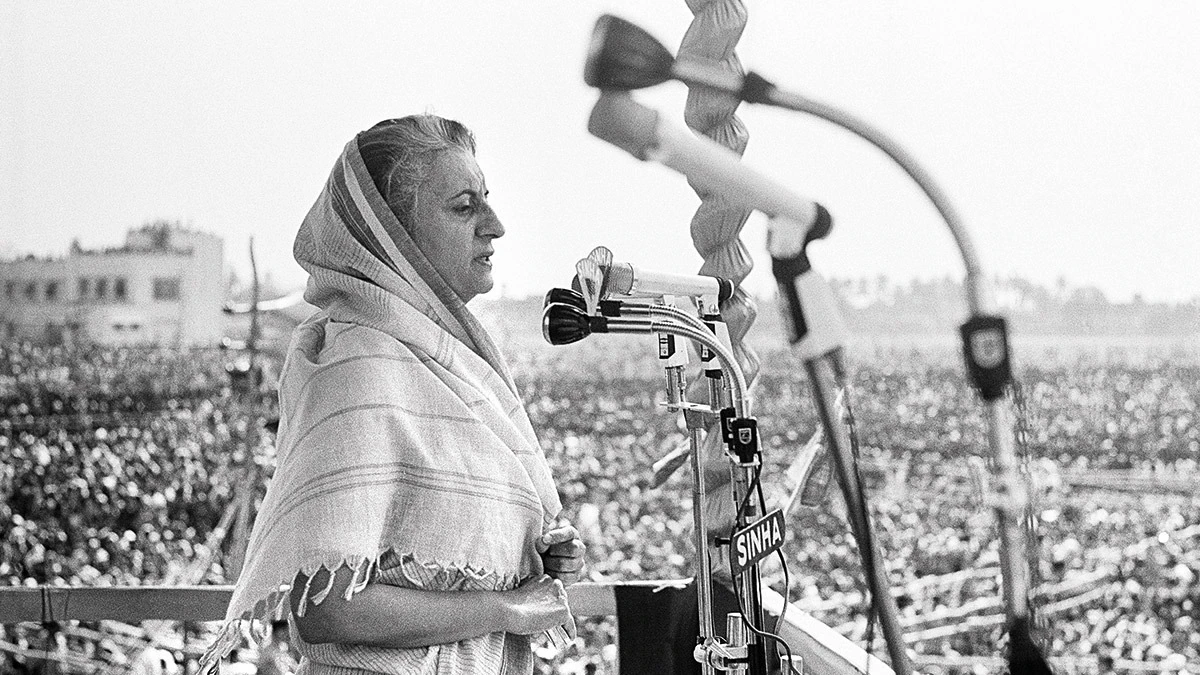
Just two months after taking office, Indira Gandhi travelled to the United States on her first foreign visit as Prime Minister. Accounts from back then suggest that then US President Lyndon B Johnson was personally charmed by the 48-year-old leader, reportedly telling his aides, “No harm comes to this girl.” But behind the diplomatic warmth lay a complicated reality. Johnson, popularly known as LBJ, sought to use America’s food aid programme as leverage to extract concessions from New Delhi and draw India closer to the US camp at the height of the Cold War.
A food-scarce India had little choice. In return for food aid, India was expected to accelerate economic reforms, devalue its “overvalued” currency and liberalise parts of its agriculture sector. India devalued the rupee by 57 per cent on June 6, 1966. The move turned out to be politically unpopular and economically damaging.
The whole experience, for Indira Gandhi, was deeply humbling and furthered the resolve to make India self-sufficient in food. “I don’t ever want us to have to beg for food again,” Gandhi is reported to have told her press adviser, Sharada Prasad.
THE LEFTWARD TURN
India launched the Green Revolution to boost agricultural production, with significant support from the United States. By the end of the 1970s, the programme had helped transform India into a net exporter of foodgrains.
Even as Washington backed the Green Revolution, New Delhi remained critical of US actions in Vietnam. Just weeks after the devaluation, India condemned the US Air Force’s bombing campaign.
Gandhi’s leftward turn became even more visible at home with the nationalisation of banks and the abolition of privy purses for former princes.
The lowest point in India-US ties came in 1971. As millions of Bengali refugees poured into India, fleeing the genocide carried out by the Pakistani Army, New Delhi faced a humanitarian crisis it could no longer ignore.
When India decided to internationalise the issue, Gandhi embarked on a global tour to highlight the crisis in then East Pakistan. She received a cold reception in Washington, which tacitly backed Islamabad. Pakistan, at the time, was serving as America’s conduit for opening ties with China.
Ahead of the war, India signed the Indo-Soviet Treaty of Peace, Friendship and Cooperation in August 1971. The agreement marked a significant shift from India’s traditional non-alignment and brought New Delhi considerably closer to the Soviet Union. It also helped India withstand US pressure during the December war.
Weeks later, Gandhi extended an olive branch to Washington but questioned its intentions. “India would like to have a friendly relationship with the United States again, but I wonder whether the United States Administration wants friendship or not.”
Relations worsened further in 1974 when India conducted its first nuclear test at Pokhran under Operation Smiling Buddha. Though India described it as a Peaceful Nuclear Explosion, the test shocked Washington. The US was alarmed by India’s emergence as a nuclear-capable state.
It was in the aftermath of India’s nuclear test that the Nuclear Suppliers Group (NSG) was created to regulate global nuclear trade. India was kept out of the grouping.
THE JANATA PARTY THAW
Indira Gandhi’s defeat in March 1977 briefly improved India-US ties. Under Prime Minister Morarji Desai, the Janata Party pursued what it called “genuine non-alignment” – a policy that critics argued meant closer ties with the West and greater distance from the Soviet bloc.
In May 1977, US President Jimmy Carter wrote to Desai expressing hope for stronger ties.
“I know that Indians and Americans share many basic values and care deeply about fundamental human rights. Two countries as diverse as ours will not agree on all matters; our shared interests and values should, however, provide a sound framework within which we can work out specific differences.”
A year later, Carter and Desai paid official visits to each other’s countries. But the thaw proved short-lived.
INDIRA’S RETURN AND RAJIV ERA
In December 1979, the Soviet Union invaded Afghanistan, bringing the US and Pakistan closer as Washington sought to contain Soviet influence in South Asia. A month later, Indira Gandhi returned to power.
This time, however, the story was different. While India continued to express concern over growing US military assistance to Pakistan, bilateral ties did not deteriorate as they had in the 1970s.
In fact, Gandhi’s 1982 visit to the United States was widely seen as a success. The two countries expanded cooperation in science, technology and civilian nuclear energy, and agreed to celebrate 1985 as the “Year of India”.
The year 1985 proved to be another milestone in India-US ties. Rajiv Gandhi became the first Indian Prime Minister to address a joint session of the US Congress.
Long before IT became the cornerstone of India’s exports to the US, the young Prime Minister called on Congress to help India with high technology:
“The application of computerised control systems can help to optimise production and process planning in industry. The United States is an important source of technology in many of these areas. Our governments have recently reached an understanding on the export of high technology from the U.S. to India. We see this as the beginning of a substantial partnership to our mutual benefit.”
His visits to the United States in 1985 and 1987 also laid the foundation for closer defence cooperation between the two countries.
THE END OF THE COLD WAR AND BEYOND
By the late 1980s, bilateral ties had warmed considerably. The Cold War was drawing to a close as Mikhail Gorbachev’s reforms liberalised the Soviet Union to some extent. Those changes eventually led to the Soviet Union’s collapse in 1991, fundamentally reshaping the global order.
The post-Cold War era would, in turn, usher in a new chapter in India-US relations.
– Ends