






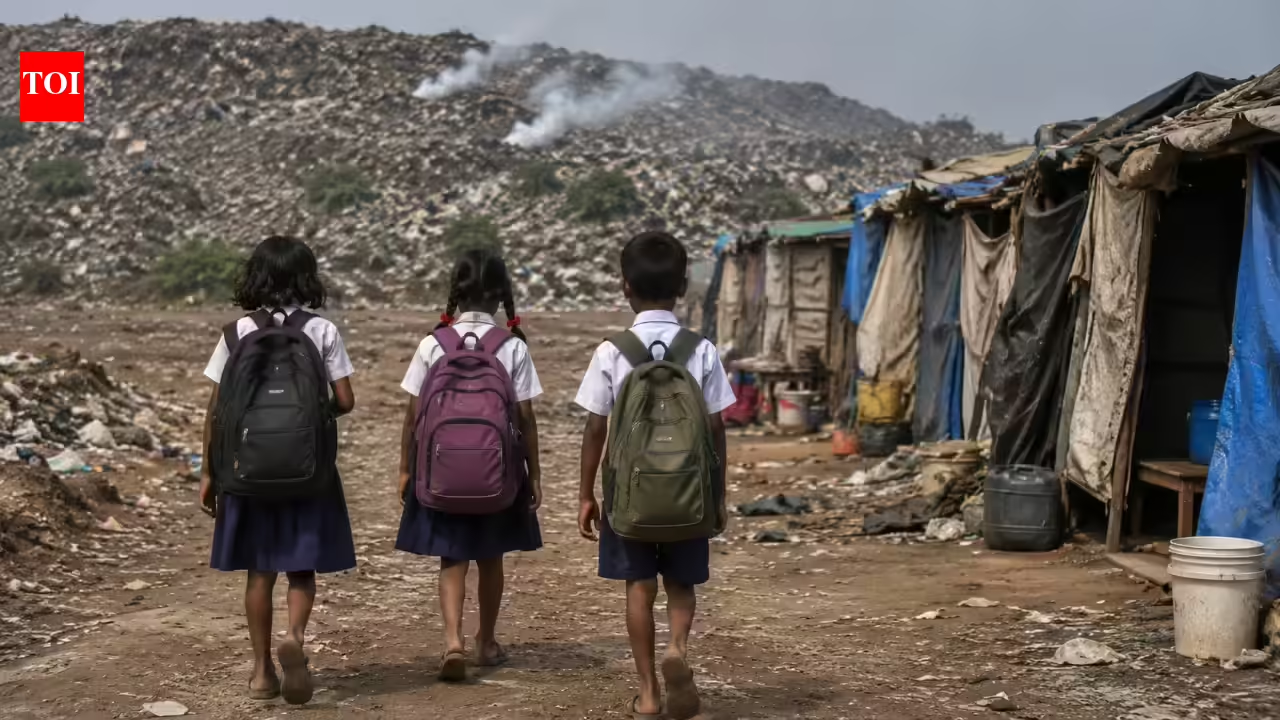
HYDERABAD: A disturbing picture has emerged from Jawahar Nagar, where children living beside the city’s massive landfill are being pushed out of classrooms by a mix of poverty, pollution, and institutional neglect.The dump yard, spread over 300 acres, is ranked as the world’s fourth largest source of methane emissions, and its impact on education is now starkly documented.A recent study titled ‘Educational Deprivation and Environmental Inequality in Peri-Urban Slums: Socio-Spatial and Institutional Barriers to Education – A Case Study of Jawahar Nagar, Hyderabad’ by M Kamraju, faculty of geography at Army Public School Golconda, has been published in Education, Sustainability & Society (ESS) journal.It highlights how government welfare schemes have failed to ensure equal access to schooling in this fast-growing peri-urban settlement.According to the study, 78% of households are located more than one kilometre from the nearest school, and nearly 30% are over three kilometres away. With private transport rare, children must navigate unsafe, poorly connected roads, leading to irregular attendance and dropouts.
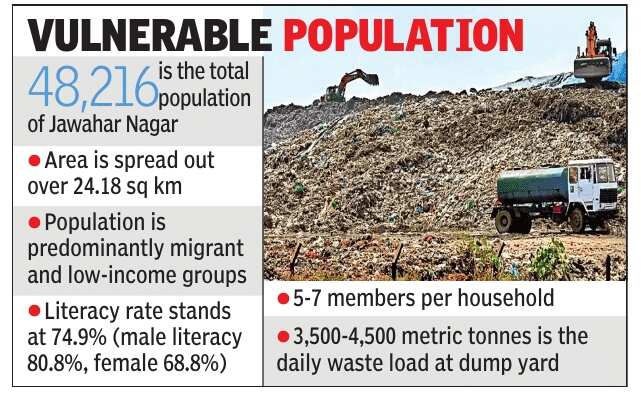
Vulnerable Population
Economic hardship compounds the problem. Nearly half of families earn under Rs 10,000 a month, forcing immediate survival needs to outweigh education. Financial pressures account for 34% of dropouts, while child labour, including waste picking and daily wage work, pushes another 21% out of classrooms.“In addition, 62% of residents are migrant families, and frequent movement disrupts learning and creates major documentation obstacles during admissions,” Kamraju noted.Environmental injustice is severe. About 41% of households live within one kilometre of the landfill, enduring foul smells, toxic smoke, and dust. As a result, 33% of children suffer respiratory illnesses, 27% face waterborne diseases, and 57% of households report frequent school absences due to poor health.Gender inequality is also evident: irregular attendance among girls stands at 46%, compared with 32% for boys, linked to domestic duties, safety concerns, and lack of separate sanitation facilities.“These problems are reinforced by institutional weaknesses, including shortages of teachers, high pupil–teacher ratios, inadequate infrastructure, and limited awareness of existing govt welfare schemes,” Kamraju pointed out.The study urges coordinated action, new government schools within settlements, qualified teachers, better classrooms, flexible learning options, bridge courses, and targeted scholarships.“The importance of genderresponsive planning—especially separate toilets and menstrual hygiene facilities for girls—along with school health programmes, environmental education, and simpler, barrier-free admission processes for migrant children,” Kamraju says, concluding that sustainable urban development cannot be achieved if marginalised children remain excluded, calling for aligned responsibilities across education authorities, municipal agencies, and urban planners.