










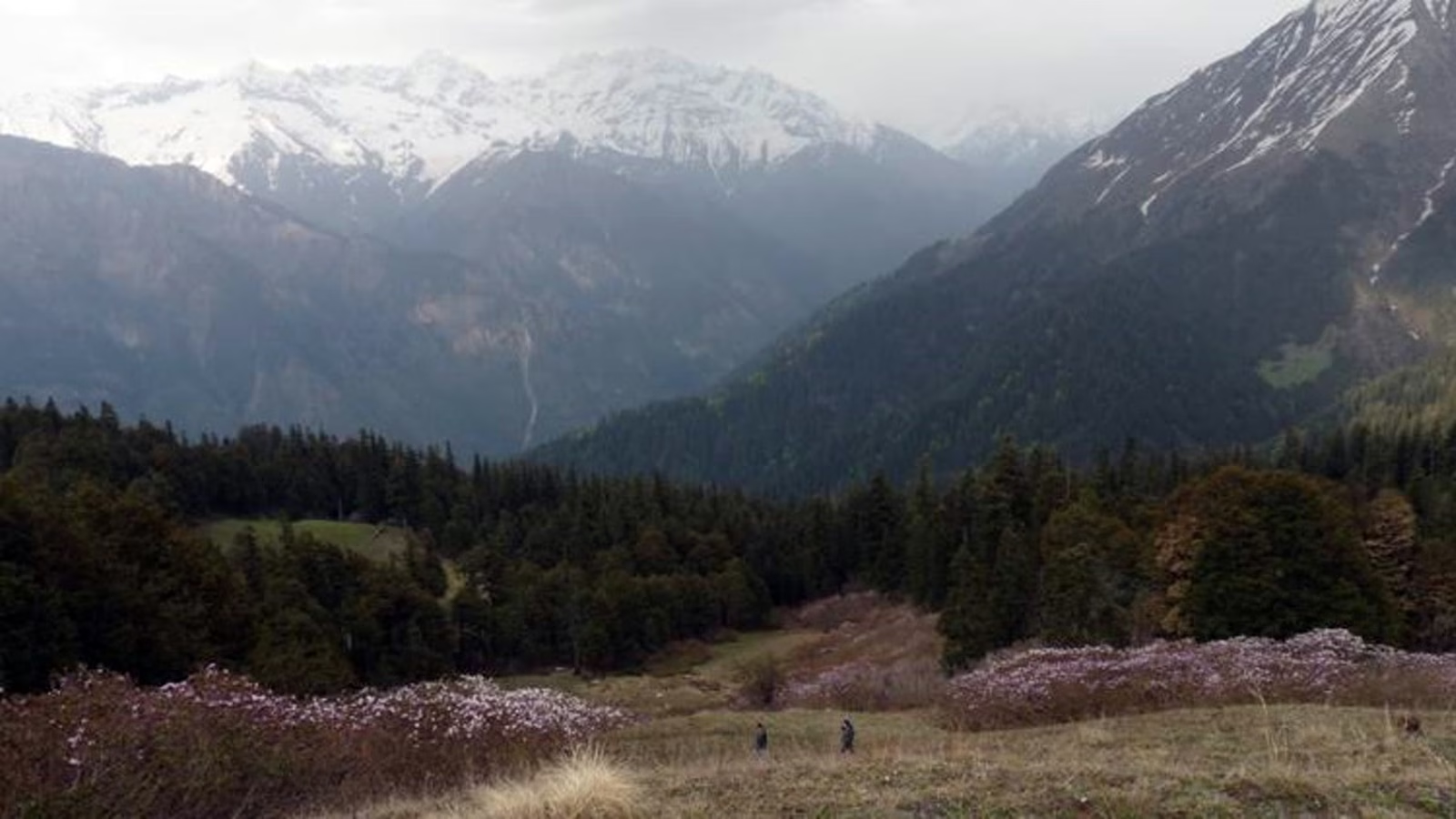
THE HINDU Kush Himalaya (HKH) region, the source of at least 10 large river basins in Asia, including Ganga, Indus and Brahmaputra in India, is likely to witness below-normal rainfall and above-normal temperatures in the upcoming monsoon, according to a new analysis.
The combination of below par rainfall, owing to the El Niño weather phenomenon, and rising temperatures is also expected to increase drought as well as hazard risks from floods, glacial lake outbursts, and landslides, said the findings of the HKH monsoon outlook published by the International Centre for Integrated Mountain Development (ICIMOD) and the Institute of Atmospheric Physics, Chinese Academy of Sciences.

The HKH region is a mountain arc stretching 3,500 km across Afghanistan, Pakistan, Nepal, India, China, Bangladesh, Myanmar and Bhutan. Home to thousands of glaciers and large river basins such as Ganga, Indus, Brahmaputra, Yangtze, Irrawady, Mekong and Amu Darya, they support the food and livelihood security of about two billion people in this region of Asia.
The HKH Monsoon Outlook 2026, warned that lower rainfall and warmer conditions will also likely intensify heat stress and reduce water availability. The outlook is also crucial for administrative management as winter snow persistence (the time snow remains on the ground) in the season that passed was below long-term average.
“Lower snow persistence means the region is entering the monsoon with a reduced seasonal water buffer,” said Sarthak Shrestha, co-author of the outlook.
This means that communities across the region will depend more on rainfall, groundwater and spring water availability. The monsoon outlook also highlighted that climate change has intensified the region’s vulnerability to climate-induced hazards such as extreme weather events.
“The outlook points to a drier monsoon overall, but that does not mean lower risk. Short, intense rainfall events can still trigger serious hazards,” Manish Shrestha, hydrologist at ICIMOD said.
Story continues below this ad
The Hindu Kush Himalaya region
The HKH region is a mountain arc stretching 3,500 km across Afghanistan, Pakistan, Nepal, India, China, Bangladesh, Myanmar and Bhutan. Home to thousands of glaciers and large river basins such as Ganga, Indus, Brahmaputra, Yangtze, Irrawady, Mekong and Amu Darya, they support the food and livelihood security of about two billion people in this region of Asia.
At the heart of this year’s bleak forecast is the anticipated return of El Niño. El Niño phenomenon is characterised by unusually warm sea surface temperatures in the central and eastern tropical Pacific ocean, which disrupts global weather patterns, including suppression of monsoon in the Indian sub-continent.
Multiple seasonal forecasting agencies — including the South Asian Climate Outlook Forum (SASCOF-34), the Asia-Pacific Economic Cooperation Climate Centre, Copernicus Climate Change Service, and the International Research Institute for Climate and Society, have all projected conditions in the Pacific Ocean transitioning from neutral to El Niño during the early monsoon period, with those conditions expected to persist through the season. During an El Nino event, waters in the western pacific equatorial ocean warm
The HKH region is described as “highly sensitive” to El Niño, as it strongly shapes the South Asian monsoon, which accounts for nearly 70-80% of the region’s annual rainfall. Historically, El Niño conditions have suppressed monsoon rainfall across South Asia.
Compounding the picture, Northern Hemisphere snow cover was recorded slightly below normal during January–March 2026 — a condition that is inversely linked to subsequent monsoon strength. Climate models also suggest the possible emergence of a positive Indian Ocean Dipole later in the season, which could partially offset El Niño’s drying effect, though uncertainty remains. The India Meteorological Department has already predicted below-par monsoon this year.
Story continues below this ad
Rising temperatures are also expected to accelerate glacier melt and snowmelt, driving short-term spikes in river discharge and heightening GLOF (glacial lake outburst flood) risk.