




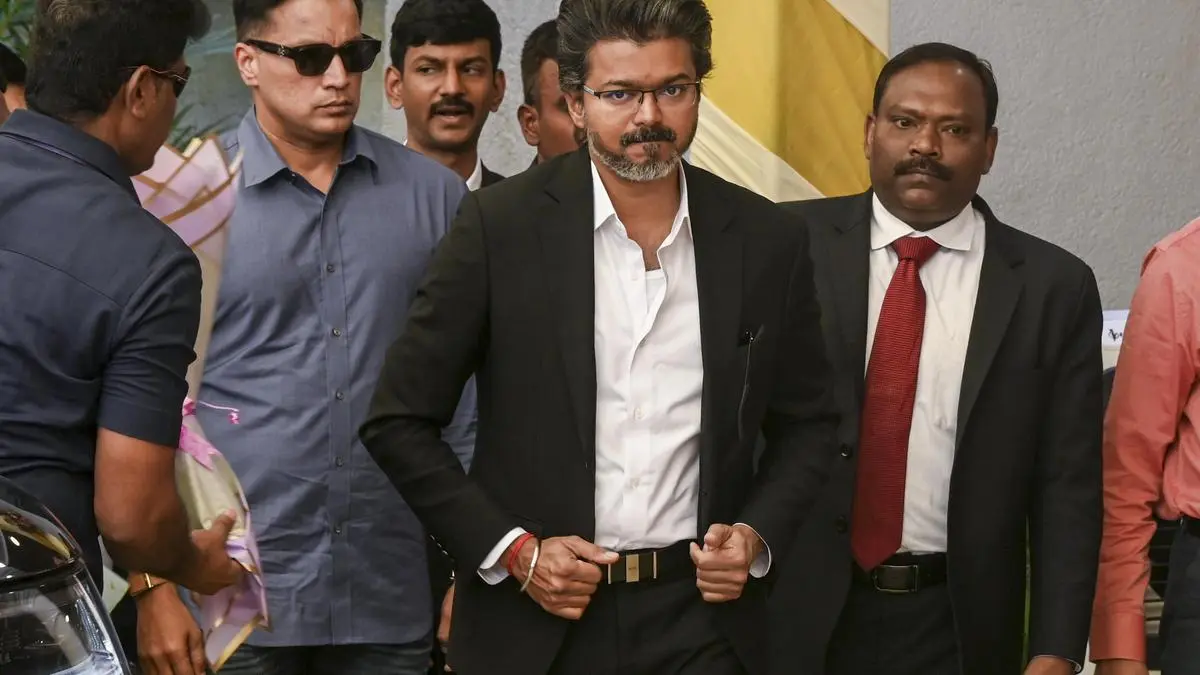
One month is too short a time to assess a government elected for a term of 60 months, but it provides broad pointers on the path a government has embarked on. The new Tamilaga Vettri Kazhagam (TVK) government in Tamil Nadu was sworn in on May 10 with great fanfare and an unconventional swearing-in staged by Chief Minister C. Joseph Vijay. Barring prepared speeches from platforms, Vijay has so far not made any off-the-cuff comments and has refused to interact with the media.
The past month has seen some encouraging signs on governance but also concerns over a few issues. Any government’s first move is to select a team of bureaucrats for administrative work. This government, unburdened by incumbency, was in a position to select officers based on performance and not their political or other affiliations. It retained the Chief Secretary, M. Sai Kumar, who was posted by the Election Commission of India, and many officials, including J. Radhakrishnan, Chairman and Managing Director of the Tamil Nadu Electricity Board. One department known for its corruption, the Tamil Nadu State Marketing Corporation (TASMAC), has been given to an officer known for his intolerance to corruption, K. Nantha Kumar.
In this first month, a pattern is becoming clear: the TVK government is conciliatory towards the ruling BJP at the Centre, but continues to attack the Dravida Munnetra Kazhagam (DMK) on all issues, including blaming it for an empty treasury and rampant drug consumption in the State. Also, on his Delhi trip, Vijay called on Prime Minister Narendra Modi, but did not meet Congress leaders. “Our leader wants to keep official engagements distinct from political meetings,” said a TVK spokesperson when asked why Vijay had skipped meeting Congress leader Rahul Gandhi.
The TVK has taken many steps to contain petty corruption on the ground, and has made it a point to publicise this as a failing of the former DMK government. “Petty corruption affects people directly,” said a former IAS officer who did not wish to be named. “When I was a Sub Collector, one of the first things I did was to ensure that the people who came to seek government help or certificates of various kinds were not exploited.”
Under Vijay, the Directorate of Vigilance and Anti-Corruption (DVAC) has raided several registrar offices on busy registration days to drive home the point. On June 3, the DVAC raided 60 Sub-Registrar Offices, leading to the seizure of nearly Rs.38 lakh in unaccounted cash.
The TVK has managed to create a conversation around the extra Rs.10 that Tamil Nadu’s retail liquor outlets charge per bottle. Employees of these shops have said that this amount goes towards establishment costs such as electricity, for which they had no separate budget or provision. The TVK government has stopped this charge. The decision has been hailed as a first step towards controlling corruption in the liquor trade, but some reports indicate that the amount continues to be charged at some outlets.
Soon after his swearing-in, Vijay broke with Tamil Nadu tradition and called on former Chief Minister M.K. Stalin and the leaders of most political parties. These visits were hailed as setting a new precedent in Tamil politics. But the move was clouded by Vijay’s decision to skip visiting the All India Anna Dravida Munnetra Kazhagam (AIADMK) general secretary Edappadi K.Palaniswami while meeting the rival AIADMK faction led by C.V. Shanmugham and S.P. Velumani. “The TVK leader’s controversial visit was uncalled for since he is already assured of the minimum support needed to prove his majority,” said DMK MP and spokesperson J. Constandine Ravindran.
The next controversy was the short-sighted decision to appoint Vijay’s astrologer Ricky Radhan Pandit as officer on special duty (OSD) in the Chief Minister’s Office. While it is the Chief Minister’s prerogative to appoint anyone as OSD, the move was widely panned as encouraging superstitious beliefs. Following the criticism, the government revoked the order.
The rebel MLAs and the AIADMK crisis
On May 13, the TVK government proved its majority on the floor of the Assembly, with 144 votes, including 25 rebel AIADMK votes from MLAs owing allegiance to Shanmugham and Velumani. While the government proved its majority, the support it got from these 25 AIADMK MLAs created a crisis in the AIADMK. The same day, Palaniswami demanded the disqualification of these MLAs and handed a letter to Speaker J.C.D. Prabhakar. As per Assembly rules, the Speaker has three months to decide on the case.
As it became clear that the AIADMK MLAs would not all be allowed to join the TVK, many of them have returned to the AIADMK fold. Following this, Palaniswami sent another letter stating that he condoned 21 MLAs and wanted action only against the four MLAs who had joined the TVK. On June 9, action was dropped against the 21 MLAs while the Speaker said that action had been initiated against the other four MLAs.
Three of these four MLAs, Maragatham Kumaravel (Maduranthakam), Sathyabhama (Dharapuram), and Jeyakumar (Perundurai), joined the TVK on May 25. They submitted their resignation letters to the Speaker and proceeded to Minister Aadhav Arjuna’s room, from where they addressed the media. The fourth MLA, Isakki Subbiah (Ambasamudram), joined the TVK the next day.
The TVK has both been commended for not taking “tainted” former Ministers from the AIADMK, and criticised for encouraging four AIADMK MLAs to resign and join the party. “Those who vociferously told the world they were political purists stand exposed now,” said DMK president M.K. Stalin. Seizing the chance to take a dig at the Congress, Stalin also said that the move made the Congress’s “anti-BJP stance ring hollow”. The Congress had joined the TVK government on the condition that parties from the National Democratic Alliance (NDA) would not be part of it. The AIADMK is part of the NDA in Tamil Nadu.
Politically, the TVK is in a good space right now—both the AIADMK and the BJP are in disarray, while the DMK has lost almost all its allies from the Secular Progressive Alliance. This situation, however, might not last. The AIADMK is likely to recoup sooner than later, the BJP is known for its organisational strength, and the DMK is already in the process of recalibrating itself at the State and national levels. Meanwhile, a new actor in the form of the former BJP State president K. Annamalai has also entered the fray.
While many of the DMK’s former allies are with the TVK now, they are not very comfortable with Vijay’s studied silence on important national issues. For instance, neither Vijay nor the TVK condemned the Enforcement Directorate raids on the former Kerala Chief Minister and CPI(M) leader Pinarayi Vijayan. The CPI(M) is lending outside support to the TVK government but has not raised this with the TVK yet.
Not only did Vijay fail to meet Rahul Gandhi in Delhi, the TVK has also not taken a stand on the June 9 rejection of the nomination papers of Meenakshi Natarajan, the Congress candidate for the Rajya Sabha from Madhya Pradesh. Most political parties allied with the Congress have issued statements, but the TVK has not. The TVK did not attend the INDIA bloc meeting in Delhi on June 8 either. The Congress explained that only parties with MPs were invited, but Mehbooba Mufti of the People’s Democratic Party (PDP) attended even though the PDP has no MPs.
Administratively, the TVK government is figuring out how to implement its promises. The easier ones have been taken up first. For instance, the government has stopped work on the new airport at Parandur. It has also shut over 700 retail liquor shops near educational institutions. At his first Cabinet meeting on June 5, Vijay outlined 436 vision statements. Based on these, every department is expected to prepare a detailed action plan with timelines. On June 9, Vijay inaugurated an all-woman rapid response police unit named Singapenn Special Force dedicated to preventing crime against women and children. He also announced that important welfare schemes initiated by the DMK government would continue. “What Vijay needs to avoid are the pitfalls of tit-for-tat decisions, a legacy of the Jayalalithaa era,” said Ravindran.
Also Read | Vijay’s Cabinet redefines Dalits’ representation in political power
Also Read | A phenomenon called Vijay