








3 min readUpdated: Jun 9, 2026 10:26 PM IST
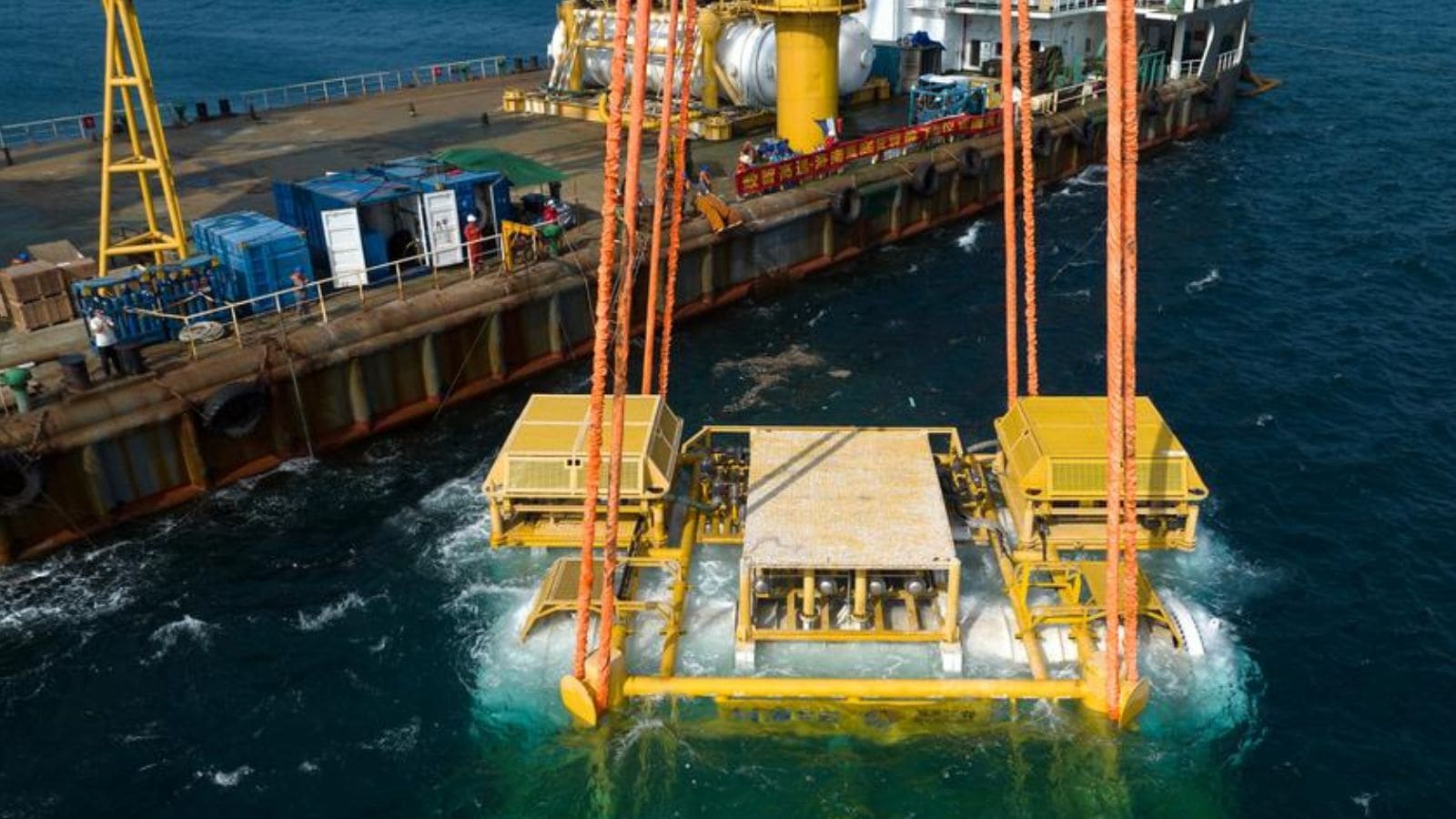
Shanghai Hailanyun Technology, also known as HiCloud, in collaboration with government agencies, launched the world’s first wind-powered underwater data centre, reported The Guardian.
Where is underwater data centre located?
It is situated around 10 metres (32 feet) underwater below the ocean surface, away from the coast of the Lin-gang Special Area in Shanghai. It is surrounded by a wind farm including more than 50 turbines.

What it matters
The Shanghai project represents the world’s first commercial deployment of subsea data-centre technology that Microsoft pioneered with Project Natick between 2015 and 2024 before discontinuing for economic reasons.
The Chinese facility achieves a Power Usage Effectiveness (PUE) below 1.15, significantly better than typical land-based data centres at 1.3-1.5, by using seawater as a passive cooling medium, eliminating the need for chillers, fresh water, and large land footprints.
China Telecom has installed GPU clusters in the facility to support the country’s surging AI computing demand.
For India, which is building a major data centre infrastructure base across Mumbai, Hyderabad, Chennai and Bengaluru, and is targeting 500 GW of renewable energy capacity by 2030, the Chinese model offers a template for combining offshore wind capacity with data-centre cooling needs along India’s eastern coastline.
How does it generate power and cool itself?
The combination of offshore wind power, supplying more than 95 per cent of the centre’s electricity, with a natural cooling seabed environment, cuts down on energy and also land use. Unlike traditional land-occupying data centres, this underwater facility is designed in order to reduce total consumption of power by an estimate of 22.8 per cent, prevent the use of fresh water, and reduce land use by more than 90%.
Story continues below this ad
What is its scale: 2,000 servers, 24 megawatts
The facility draws electricity from renewable energy sources. The project was developed in two phases. It began with a 2.3 MW demonstration facility, then scaled to the total capacity of 24 MW. China Telecom has installed GPU clusters within the facility as a computing client.
The entire facility costs about ¥1.6 billion (approx. US$226 million). Construction was completed in October 2025, with initial trials in February 2026 and full commercial operations launching in May 2026.
What are the engineering challenges?
Saltwater corrosion, subsea cable reliability, hardware accessibility and long-term pressure sealing remain vital engineering concerns for operations. Replacement of failed components inside the ocean is significantly more difficult than servicing traditional server racks. This forces operators to rely on sealed modular designs.
The development of the underwater data centre comes as governments and technology companies worldwide try new ways to tackle the rapidly rising energy demands, which are becoming increasingly critical to AI-driven services and digital economies. China’s facility represents a model that could shape the future of sustainable digital infrastructure on a global level.
Story continues below this ad
(This article was curated by Seekriti Saha, who is an intern with The Indian Express)
Stay updated with the latest – Click here to follow us on Instagram