











NEW DELHI: The rebellion within the Trinamool Congress (TMC) has deepened over the past week, with rebel MLAs backing expelled leader Ritabrata Banerjee for the post of leader of opposition and drawing comparisons with Maharashtra’s Shiv Sena split.But a closer look suggests the revolt may be less about challenging Mamata Banerjee‘s leadership and more about questioning the growing authority of her nephew and political heir, Abhishek Banerjee.At first glance, the developments appear to be a direct challenge to the TMC leadership. A group of rebel legislators has questioned the legitimacy of the party’s decision-making process, accused the leadership of fabricating a resolution on the appointment of the leader of opposition and openly defied the official line.Yet the rebels have been careful about one thing: they have avoided attacking Mamata Banerjee herself.Even after his expulsion, Ritabrata Banerjee has not projected himself as an opponent of the TMC supremo. Instead, his fight has centred on how decisions are being taken within the party and who is exercising authority in Mamata Banerjee’s name.The letter submitted by the rebel camp to assembly speaker Rathindra Bose reportedly continues to recognise Mamata Banerjee as its leader, even as it challenges the party’s official position on the opposition leadership.The immediate trigger for the crisis explains this clearly.The controversy erupted over the appointment of the leader of opposition after TMC national general secretary Abhishek Banerjee communicated the party’s decision to the speaker. Ritabrata Banerjee and Sandipan Saha challenged that process, alleging that no such resolution had been passed at the legislative party meeting and that several signatures had been fabricated.The dispute, therefore, is not over Mamata Banerjee’s leadership. It is over the authority exercised by Abhishek Banerjee and the functioning of the organisation under him.
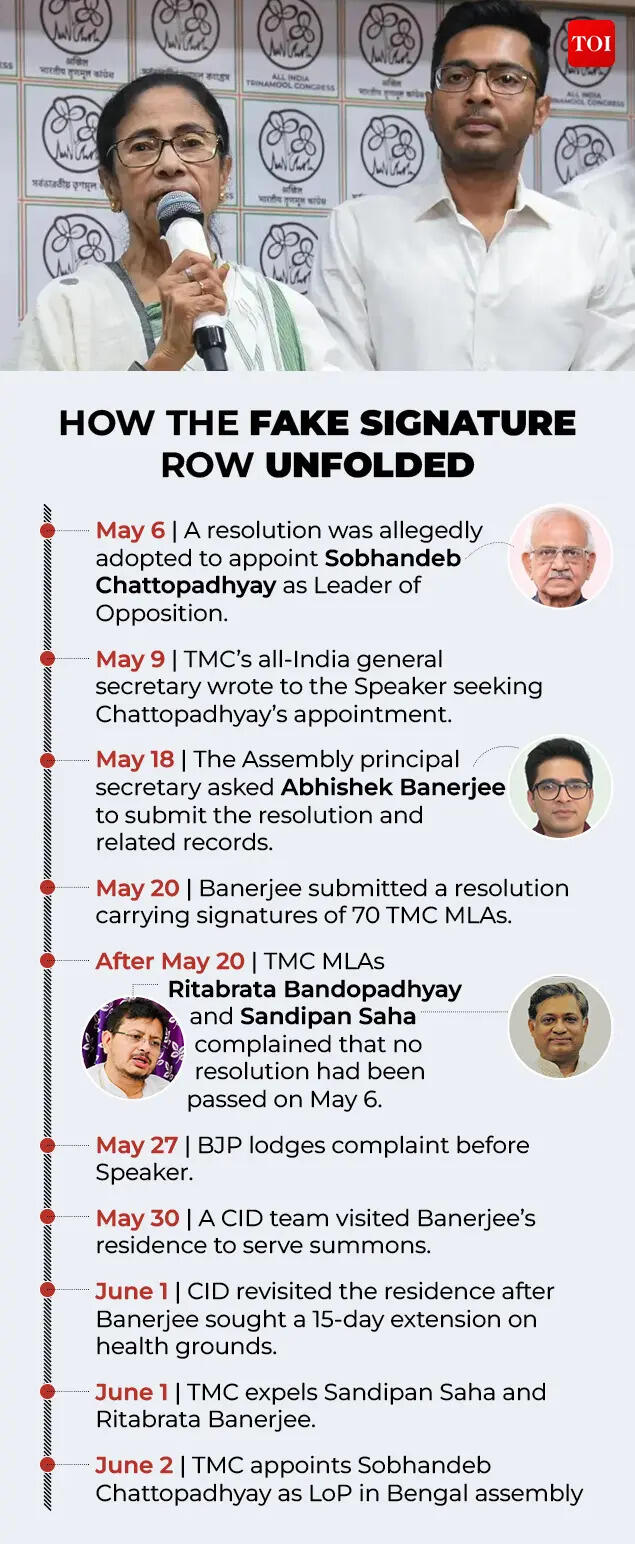
Notably, even the TMC’s defence of the LoP appointment has centred on Abhishek Banerjee’s communication to the speaker. Party leaders have repeatedly argued that his letter is the only valid document before the assembly, placing Abhishek at the centre of the confrontation.That is also why the latest developments may be viewed by many as a proxy battle over succession.For years, Abhishek Banerjee has been widely seen as Mamata Banerjee’s political heir. He has emerged as the party’s principal strategist, chief campaigner and organisational face after Mamata. As his influence grew, so did concerns among sections of the old guard who felt increasingly sidelined.The current rebellion appears to have brought those tensions into the open.After the party expelled Ritabrata Banerjee, he drew a sharp distinction between Mamata and Abhishek. “The party has expelled me, but I believe that I am still with the TMC … Abhishek Banerjee is nobody in the 18th West Bengal state legislative assembly,” he told reporters.When asked about Mamata Banerjee, however, his tone was markedly different.“Mamata Banerjee is a tall leader. I may be expelled from the party, but I have not lost respect for her. She is still my leader,” he said.Ritabrata also mocked Abhishek’s political troubles following the election setback and the subsequent signature controversy. Referring to protests directed at the TMC leader, he quipped before reporters: “At least people aren’t shouting ‘thief, thief’ at me.”His criticism of Abhishek, however, did not begin with the current crisis.Over recent months, Ritabrata emerged as one of Abhishek Banerjee’s most vocal internal critics. He questioned the growing role of consultants and strategists in party affairs and criticised what he viewed as excessive centralisation of decision-making.Following the party’s electoral setback, he publicly raised concerns about whether a handful of advisers had become more influential than grassroots leaders. While Abhishek was not always named directly, the criticism was widely interpreted as targeting the leadership structure associated with him.That helps explain why the rebels’ confrontation has focused on decisions communicated by Abhishek Banerjee rather than on Mamata Banerjee herself.The political calculations may also seems obvious.Mamata Banerjee remains the party’s biggest mass leader and its most recognisable face. Directly challenging her risks alienating a large section of TMC workers and supporters.For dissatisfied leaders, challenging Abhishek instead allows them to frame their rebellion not as a revolt against the party founder but as a fight against a leadership style, an organisational model and, ultimately, a succession process that has accelerated after the assembly poll debacle.That is what makes the current crisis significant.Regional parties across the country have often struggled during succession transitions. The eventual Shiv Sena split after Bal Thackeray and the NCP’s internal battle over succession after Sharad Pawar demonstrated how questions of inheritance can quickly become questions of power.The TMC now appears to be confronting its own version of that dilemma.The question facing the party is no longer whether Mamata Banerjee remains its undisputed leader. On that issue, there is little visible disagreement.The more important question is whether Abhishek Banerjee can command the same level of acceptance across the organisation.The answer will determine whether the current rebellion remains an isolated act of dissent or evolves into a broader challenge to the party’s organisational structure and succession plan.


