








Last Updated:
Beyond its own leaders, the Congress is also negotiating with allies to secure representation in states where it lacks the numbers to independently elect candidates




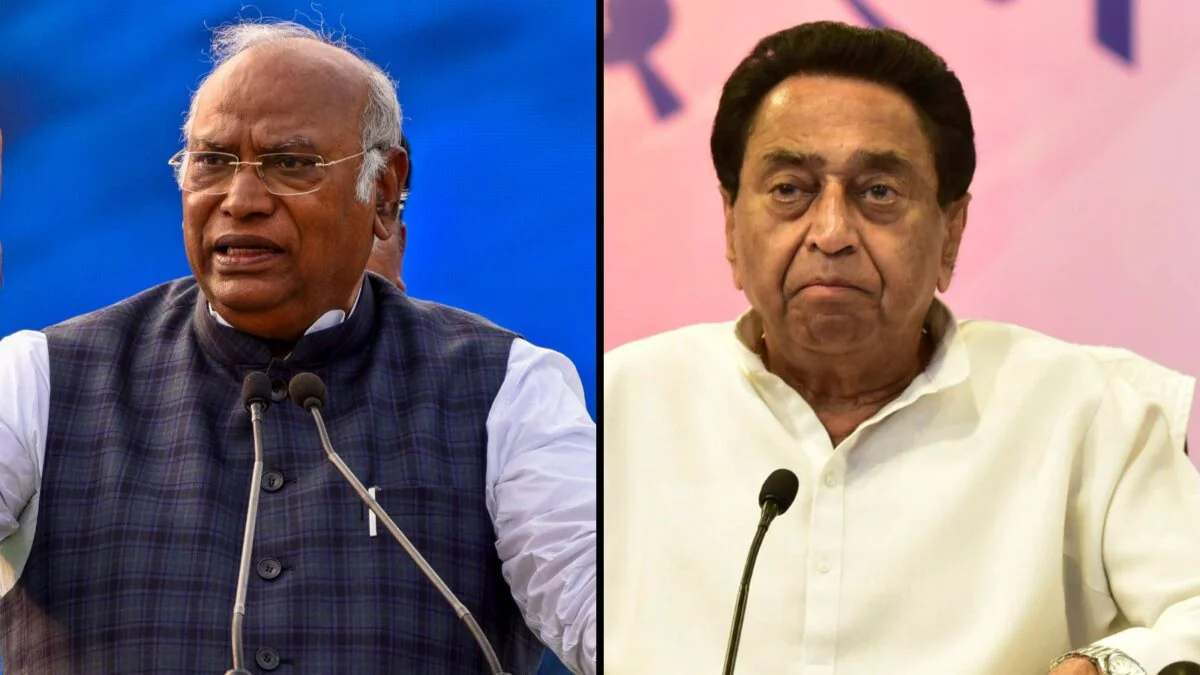
Mallikarjun Kharge (left) and Kamal Nath are the big names in th fray.
As the June 18 Rajya Sabha elections approach, the Congress leadership is grappling with a high-stakes balancing act—accommodating senior leaders, managing state-level factional equations, and ensuring it does not lose seats because of adverse arithmetic or cross-voting.
With terms of several prominent opposition leaders coming to an end, the upcoming elections are expected to trigger intense discussions within the party over who gets nominated to the Upper House and from where.
Among the biggest names in the mix is Congress president Mallikarjun Kharge, whose Rajya Sabha term is ending this year. Kharge is expected to return to the Upper House, making his re-nomination one of the least contentious decisions before the party. The bigger intrigue surrounds Madhya Pradesh, where Congress has only one realistic Rajya Sabha seat within reach and several political considerations to weigh.
Kamal Nath Back In Parliament?
Former Madhya Pradesh chief minister Kamal Nath has emerged as one of the most discussed names ahead of the polls. According to a Times of India report, the Congress leadership is weighing whether Nath should be nominated from Madhya Pradesh or whether another candidate should be accommodated instead.
The decision carries significance beyond a single Rajya Sabha berth. Nath remains one of Congress’s most influential leaders in the state despite stepping back from frontline politics in recent years. A Rajya Sabha nomination could signal a renewed national role for the veteran leader.
At the same time, the party must navigate competing claims from state leaders and balance factional interests in a state where it has struggled to recover since losing power in 2020.
Digvijaya Singh Steps Aside
The contest has become more open after senior Congress leader Digvijaya Singh declined another Rajya Sabha term. His decision has freed up space for a new entrant while also intensifying speculation about who the party ultimately considers most valuable for its parliamentary strategy.
Congress leaders are conscious that the candidate chosen from Madhya Pradesh must be capable of keeping the party’s legislators united, given that there are only three seats up for grabs. The BJP is likely to secure two seats in Madhya Pradesh, with George Kurian in the race.
Alliance Management Also Key
Beyond its own leaders, the Congress is also negotiating with allies to secure representation in states where it lacks the numbers to independently elect candidates.
In Jharkhand, the party is dependent on ally Jharkhand Mukti Morcha (JMM) for a Rajya Sabha berth. In Tamil Nadu, Congress has also been exploring possibilities through its alliance network, underlining how regional partnerships have become critical to maintaining its strength in the Upper House.
The negotiations reflect a broader reality confronting the party: while it remains the principal opposition force nationally, its ability to send members to the Rajya Sabha increasingly depends on coalition partners in several states.
The Shadow Of Cross-Voting
Candidate selection is also being influenced by concerns over party discipline.
Recent Rajya Sabha elections witnessed instances of cross-voting by opposition legislators in several states, creating anxiety within Congress ranks. Party leaders are therefore expected to favour candidates who can command broad acceptance within legislative parties and avoid triggering factional discontent.
This consideration becomes especially important in states where Congress’s numbers are only marginally above the threshold required to secure a seat.
More Than A Numbers Game
For the Congress, the Rajya Sabha elections are shaping up as more than a routine parliamentary exercise.
They will determine the future roles of several senior leaders, test the party’s ability to manage internal aspirations, and offer clues about its next generation of leadership. Whether it is Kharge’s expected return, speculation surrounding Kamal Nath, or the search for representation through allies, the party’s choices in the coming days will reveal much about its priorities ahead of a packed electoral calendar.
As nominations near, the central question facing Congress is no longer whether it can win its allotted seats but which of its heavyweights will ultimately occupy them.
Read More