







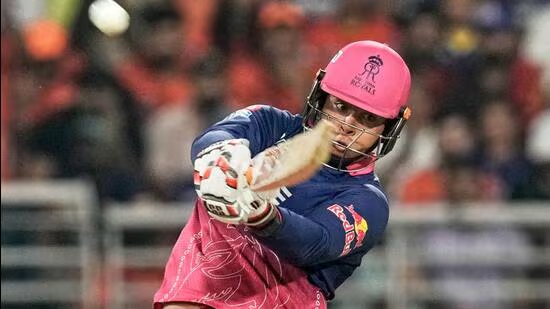
Chandigarh: When the Gujarat Titans step onto the field for Qualifier 2 against the Rajasthan Royals on Friday, they will know this is no longer an ordinary playoff battle. Standing between them and a place in the IPL 2026 final is a phenomenon the tournament is still trying to fully comprehend — 15-year-old Vaibhav Sooryavanshi.

In one breathtaking night at the PCA Stadium in New Chandigarh, the teenager transformed from an exciting young talent into the defining story of this IPL season. His astonishing 97 off just 29 balls against Sunrisers Hyderabad not only powered Rajasthan Royals into Qualifier 2 but also injected the side with a dangerous sense of belief and momentum.
For Gujarat Titans, the challenge is no longer only tactical. It is psychological as well.
GT arrive in Chandigarh wounded after suffering a crushing 92-run defeat to Royal Challengers Bengaluru in Qualifier 1. Rajat Patidar’s blistering 93 off 33 deliveries helped RCB pile up 254/3 — the highest total in IPL playoff history — and Gujarat never truly recovered from the assault.
What hurt them most was not merely the scale of the defeat but how quickly their plans unravelled under pressure. A missed chance turned into a boundary spree, one expensive over flowed into another, and Gujarat suddenly looked like a side struggling to regain control once momentum slipped away.
Against Rajasthan Royals, they cannot afford another such collapse. Because Sooryavanshi has already shown that once he seizes momentum, games disappear rapidly.
The teenager’s batting has defied conventional logic throughout the tournament. Pace has been whipped over fine leg, hard lengths have vanished into the stands, and even deliveries outside the off stump have been launched effortlessly over cover.
“The best thing about Vaibhav that I have noticed is that he doesn’t plan anything,” Rajasthan Royals wicketkeeper Dhruv Jurel said after the Eliminator. “Because he practices a lot and he always backs himself. That’s what he does every time he goes out and plays. He doesn’t even have a shadow of doubt that ‘I am not able to do it’.”
Sunrisers Hyderabad discovered that the hard way. Before they could settle into their lengths or adjust their field placements, Sooryavanshi had already raced to a 16-ball fifty and blown the contest wide open.
After the match, SRH assistant coach James Franklin admitted his side tried virtually every possible option to dismiss the teenager.
“I think you probably saw in the first couple of overs of the Powerplay that we were trying to bowl quite full, sort of inside leg stump, trying to get under his swing. But he started to work that out,” Franklin said. “I don’t think anyone’s ever seen a talent like this. It’s freakish what he’s doing at the moment. To think that he’s potentially got 25 years left in the career is quite scary.”
That makes Gujarat Titans’ new-ball discipline absolutely critical.
Mohammed Siraj and Kagiso Rabada will need to resist the temptation of hunting wickets too aggressively in the opening overs. Anything fractionally short or wide risks disappearing instantly on the true batting surface in New Chandigarh. Gujarat may instead look to cramp the teenager for room with hard lengths directed into the body, backed by protection at square leg and deep midwicket, forcing him to manufacture strokes rather than swing freely through the line.
But even the strongest plans may not matter without composure. GT’s biggest concern from Qualifier 1 was how visibly pressure affected their execution. Against Rajasthan, panic can become fatal because the Royals bat with relentless tempo. One loose over can often snowball into three.
That is where Rashid Khan becomes enormously important. The Afghan spinner remains Gujarat’s most dependable match-winner despite an inconsistent season by his own lofty standards. Rashid briefly managed to slow RCB in Dharamsala before the innings exploded around him again. Against Rajasthan, however, his duel with Sooryavanshi could shape the entire contest.
The teenager has attacked spin fearlessly throughout the season, but Rashid’s flatter trajectory, quicker pace through the air and ability to deny width may offer Gujarat their best opportunity to disrupt his rhythm. GT could even consider introducing Rashid unusually early if Sooryavanshi begins aggressively during the Powerplay itself.
Yet Gujarat’s challenge extends far beyond one wicket. Yashasvi Jaiswal’s composure at the top, Dhruv Jurel’s finishing brilliance and Riyan Parag’s aggressive intent ensure Rajasthan’s batting rarely loses momentum entirely.
Gujarat therefore need collective discipline across all phases — something glaringly absent against RCB.
Equally important will be their own batting response. Shubman Gill and Sai Sudharsan must prevent Gujarat from falling behind the asking rate early, unlike Sunrisers Hyderabad in the Eliminator. Rajasthan’s bowling attack becomes significantly more threatening once defending imposing totals, particularly with Jofra Archer’s hostility upfront and Ravindra Jadeja controlling the middle overs.
For Gujarat Titans, the equation is brutally simple. Stop Sooryavanshi early and the contest opens up. Allow him another free-flowing start, and Rajasthan Royals could once again ride the fearless energy of a teenage sensation all the way into the IPL final.