





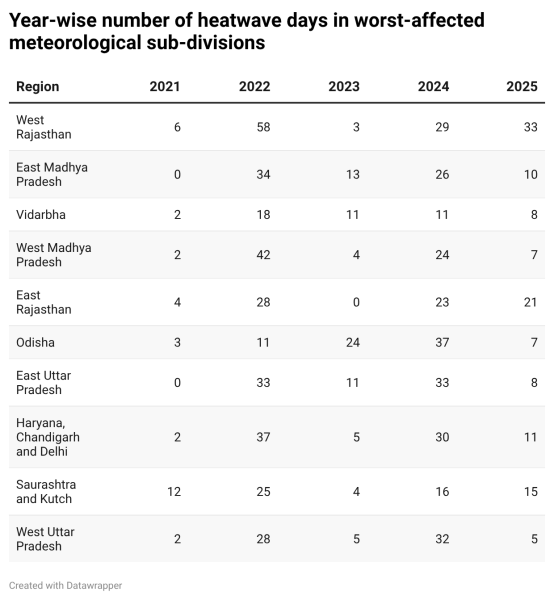
Light to moderate rainfall on Wednesday and Thursday brought an end to a week-long spell of heatwaves in most parts of north and central India, the first of the season. And another heatwave spell is unlikely for the next two weeks at least, according to the latest forecast by the India Meteorological Department (IMD).
But that might only be a temporary relief. There are indications that the temperatures might remain high this year, not just in the summer months but even extending into the monsoon season, and thereafter. That may mean several such spells of heatwaves could be possible in the coming months.

With rainfall expected to be a little subdued, particularly during the second half of the monsoon season, India could be facing prolonged periods of intense heat this year.
Heatwave zones
Summers have always been very warm in most parts of India, but heatwaves are very specific conditions defined by the India Meteorological Department (IMD). If the maximum temperature of a place gets at least 5℃ higher than normal, and this condition is reached at least two days in succession, the place is said to be experiencing a heatwave. If the temperature gets warmer than normal by 7℃, a severe heatwave is declared.
A few other things are factored in before declaring a heatwave, particularly whether the place is located in plains or mountains and whether its normal temperature is below 40℃ or higher. But the main idea is the same. Heatwave is a condition where the temperature of the place gets unusually, and uncomfortably, higher than the normal. The thresholds defined by IMD are specific to India and are not universal definitions of heatwave.
Heatwaves in India occur mainly during the March to June period, though sometimes they do extend further into the monsoon season as well. In 2023, some parts of the country experienced heatwave conditions even in February, a month in which there is not even a provision to declare a heatwave.
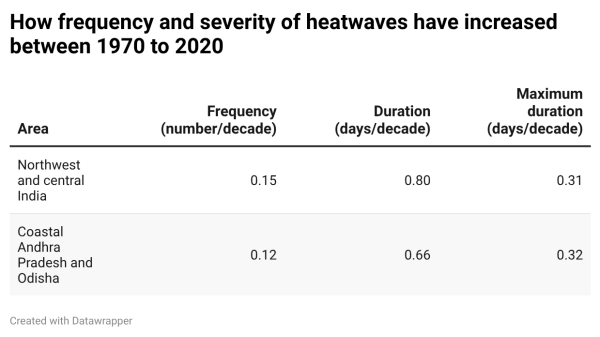
There are two areas where heatwaves are common in India: one, the northwestern and central part extending into Bihar and Jharkhand, which is known as the core heatwave zone; and two, the eastern coast comprising Andhra Pradesh and Odisha. The physical mechanisms causing heatwaves in these two areas are different, though related.
Story continues below this ad
 Source: IMD
In the core zone, heatwaves are caused mainly by persistent high-pressure conditions in the upper atmosphere that force the air to sink downward. This sinking leads to compression of the air, warming it significantly. Over Andhra Pradesh and Odisha, heatwaves are primarily a result of the prevention of the normal sea-breezes from coming over to the land by unusual westerly or northwesterly winds blowing from the hot landmass in north and central India.
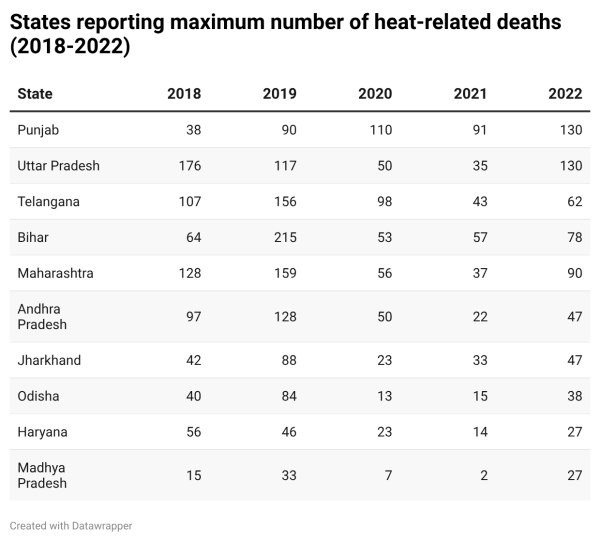
In general, the frequency and intensity of heatwaves is higher in the core zone, though historically, both Andhra Pradesh and Odisha have reported a disproportionately large number of heatwave-related deaths. On an average, a heatwave lasts between 4 and 8 days.
 Source: IMD
The southern peninsular India, as well as the northeastern part, have so far remained largely unaffected by heatwaves, though long-term climate projections suggest that this might not remain the case in the future. A 2023 report by IMD on heatwaves and cold waves cited studies that have suggested that southern India could be experiencing severe heatwaves by the end of this century. These studies also suggest heatwaves have been becoming more frequent and intense in the last half century, and their average duration is also on the rise.
 Source: IMD
El Nino linkage
Story continues below this ad
Several studies have shown that there was a strong linkage between the frequency and severity of heatwaves in India and the El Nino phenomenon in the eastern Pacific Ocean. In general, there is a greater chance of prolonged and severe heatwaves occurring in India during an El Nino phase. The opposite happens with the La Nina phase.
El Nino and La Nina are opposite phases of El Nino Southern Oscillation, a large ocean-atmospheric interaction that occurs over the equatorial Pacific Ocean, off the coast of South America, and influences weather events worldwide. During El Nino, the surface waters in this part of the Pacific Ocean get unusually warm.
In India, the El Nino phase is most commonly associated with a tendency to suppress rainfall, while the La Nina phase tends to induce more rains. But El Nino is also linked to stronger heatwaves in India. This is relevant for the current year because an El Nino event is under development, and is likely to mature between May and July. It is because of this that IMD has predicted a below-normal monsoon rainfall this year.
Most forecasts about this El Nino suggest that this event will gain in strength and persist through the rest of the year. This means that its influence in causing heatwaves could be felt next year too. Historically, the frequency and severity of heatwaves in India have been found to be more than average in the year immediately succeeding an El Nino event.
Story continues below this ad
“The time series of frequency, duration and maximum duration clearly indicate a correlation between El Nino events and heat waves over India. It is clear that most of the years with above average heat wave activity over India are the years following El Nino events,” the 2023 IMD report noted.
Heatwave as disaster
As many as 23 states in India are now affected by heatwaves. Each one of them, and hundreds of cities, now implement a heat action plan during summers. These plans are mainly about implementing solutions like making cool water available at public places, creating shelters and shaded places, revising the school, college and office timings, distribution of hydrating solutions, and halting non-essential outdoor activities, including construction, at least during peak hours. These plans have had varying degrees of success.
Still, hundreds of people die every year due to heat-stroke and other heat-related diseases, and thousands fall ill. These numbers are widely considered to be under-estimates, because not all such cases are reported.
Incidentally, a heatwave is not yet considered a notified disaster under the Disaster Management Act in India. The Sixteenth Finance Commission, which submitted its report last year, recommended that both heatwaves and lightning be included as notified disasters.
Story continues below this ad
In practical terms, this will enable the state governments to use the money in their State Disaster Response Funds to provide relief and assistance to people affected by heatwaves and lightning. This was a long-pending demand of the states, considering rising instances of heatwaves in India and increasing expenses in implementing the heat action plans.