

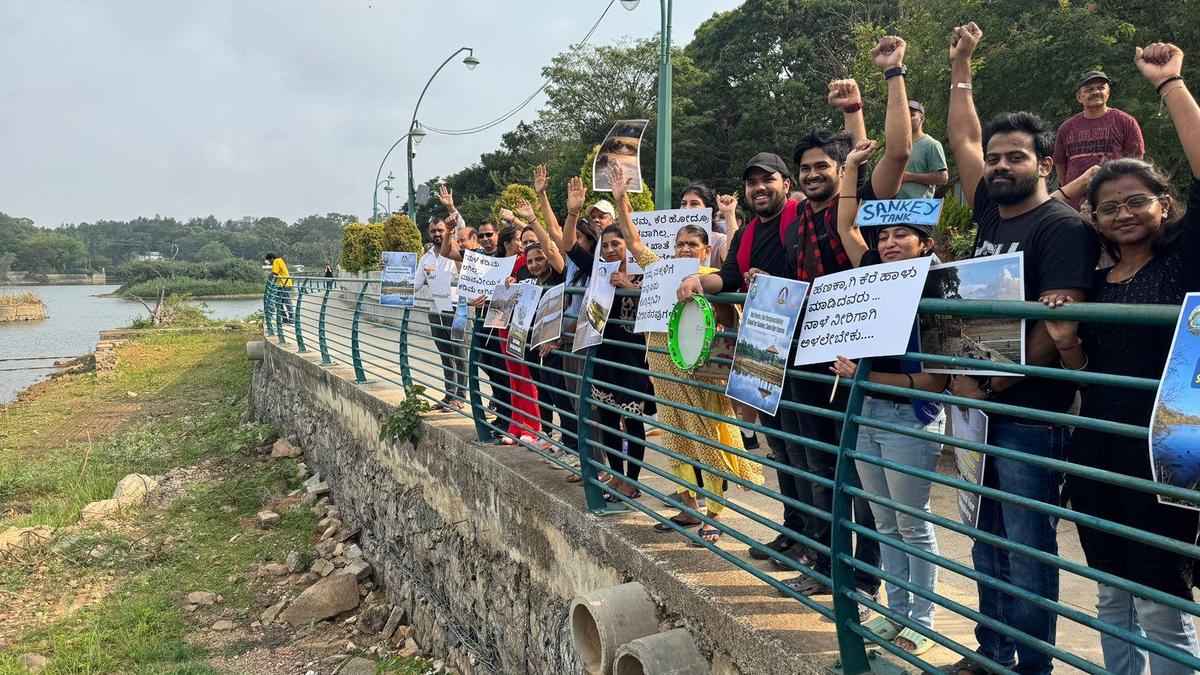
Residents of Sadashivanagar, environmental activists, and various organizations staged a protest and awareness campaign titled “Save Sankey Tank” to prevent the lake from being damaged by various causes at Sankey Tank, Bengaluru on May 24, 2026
| Photo Credit: Special Arrangement
Warning that Bengaluru could lose another major lake to “unscientific development”, residents and civic groups on Sunday (May 24, 2026) held a campaign to save Sankey Tank, highlighting years of concretisation, sewage inflow, shrinking water spread and ecologically damaging works that have pushed the water body into visible decline.
Under the banner of the “Save Sankey Tank”, citizen groups accused authorities of altering lake’s natural hydrology through poorly planned interventions that they said now threaten not only the lake’s survival but also groundwater recharge in surrounding areas, including Sadadhivanagar, Malleshwaram and Rajmahal Vilas.

The core concern, Shilpa Jetti, from Voice of Sadashivanagar said is the depleting water level. “Sankey Tank was once a dependable recharge source for large parts of north Bengaluru and is now slowly losing its capacity to retain and percolate water because of increasing concretisation inside the lake premises and disruption of feeder channels,” she said, arguing that that surfaces that allowed rainwater to seep into the ground are now being covered with hard structures, weakening one of the lake’s most critical ecological functions.
Environmental groups alleged that the situation has been worsened by a decision to raise the height of the lake bund by nearly two feet. According to them, the plan to raise height has disrupted the natural inflow system, leaving the feeder channel below the lake’s water level. Instead of fresh water flowing into the lake, polluted lake water is now said to be flowing backwards into the channel, disturbing the hydrological design of the water body.
“Sewage-contaminated water continues to enter the lake through inlets and feeder channels”, Suman Bagrecha, a resident said, calling it a failure rather than a seasonal issue during heavy rainfall. The contamination, she said, is accelerating the degradation of aquatic life while also rendering the water unsuitable for ecological or recreational purposes.

During the campaign, environment groups and citizens demanded an immediate independent water quality audit and urgent intervention to stop sewage entry. They also demanded an immediate halt to all construction and concreting activity inside the lake premises pending an independent ecological review.
Citizen groups also accused authorities of severely damaging the lake’s biodiversity through the felling of decades-old trees around the premises. The green buffer surrounding Sankey Tank, they said, played a vital role in stabilising soil, regulating the microclimate and supporting bird and aquatic life. Environmentalists alleged that no credible environmental impact study had preceded the tree cutting, nor had compensatory plantation been carried out at a comparable scale.
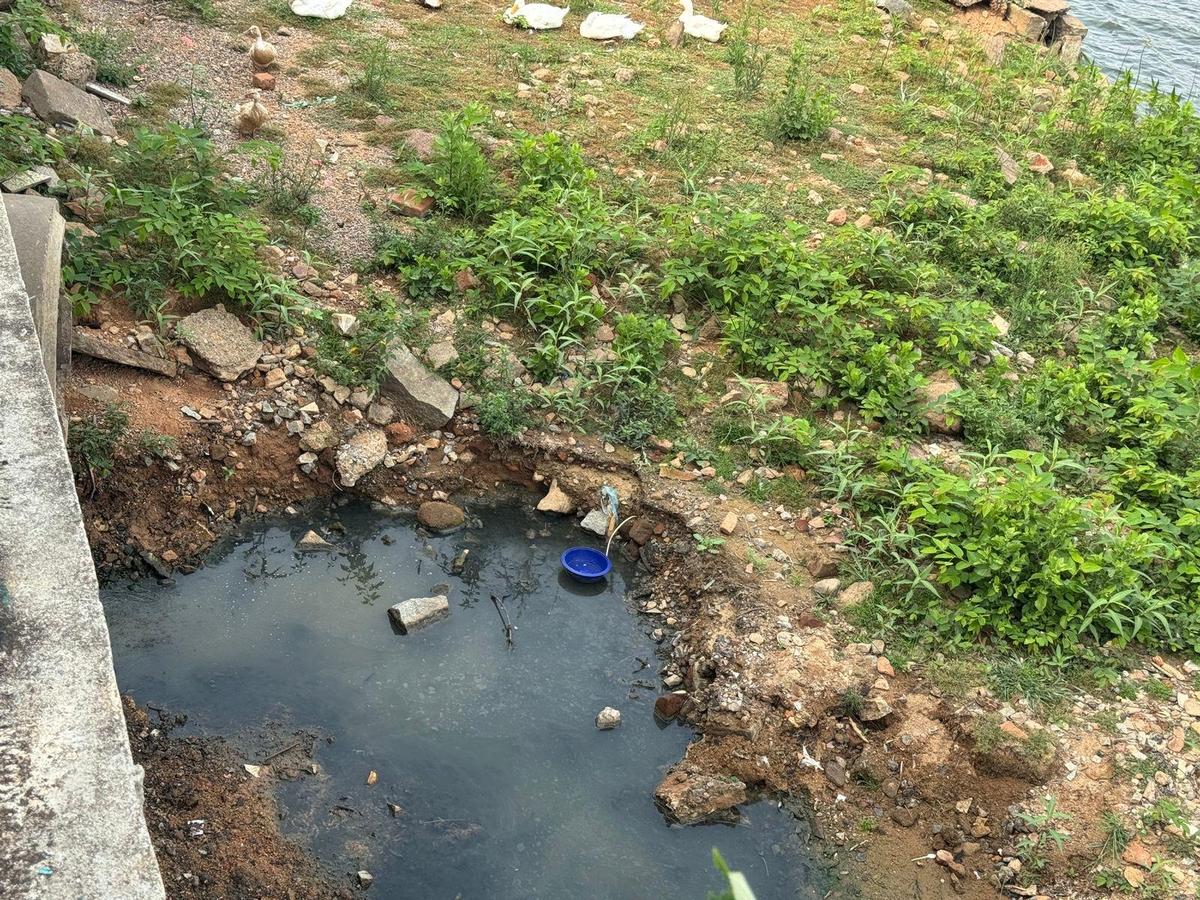
Polluted state of Sankey Tank, Bengaluru on May 24, 2026.
| Photo Credit:
Special Arrangements
Another major allegation raised during the campaign was the dumping of construction debris and waste material within and around the lake that has contributed to increased siltation and a steady reduction in the lake’s water-holding capacity. The environmentalists pointed to records and satellite imagery which show a visible shrinkage in the lake’s original water spread area over the years because of encroachment, debris accumulation and repeated civil interventions.
The campaign criticised the construction of a new toilet block despite an existing structure already being available, arguing that renovation would have been more practical and economical. They also raised questions over restricted park timings at Sankey Tank, with access limited from 10 a.m. to 4.30 p.m., keeping out morning walkers and evening visitors.
Published – May 24, 2026 03:13 pm IST