






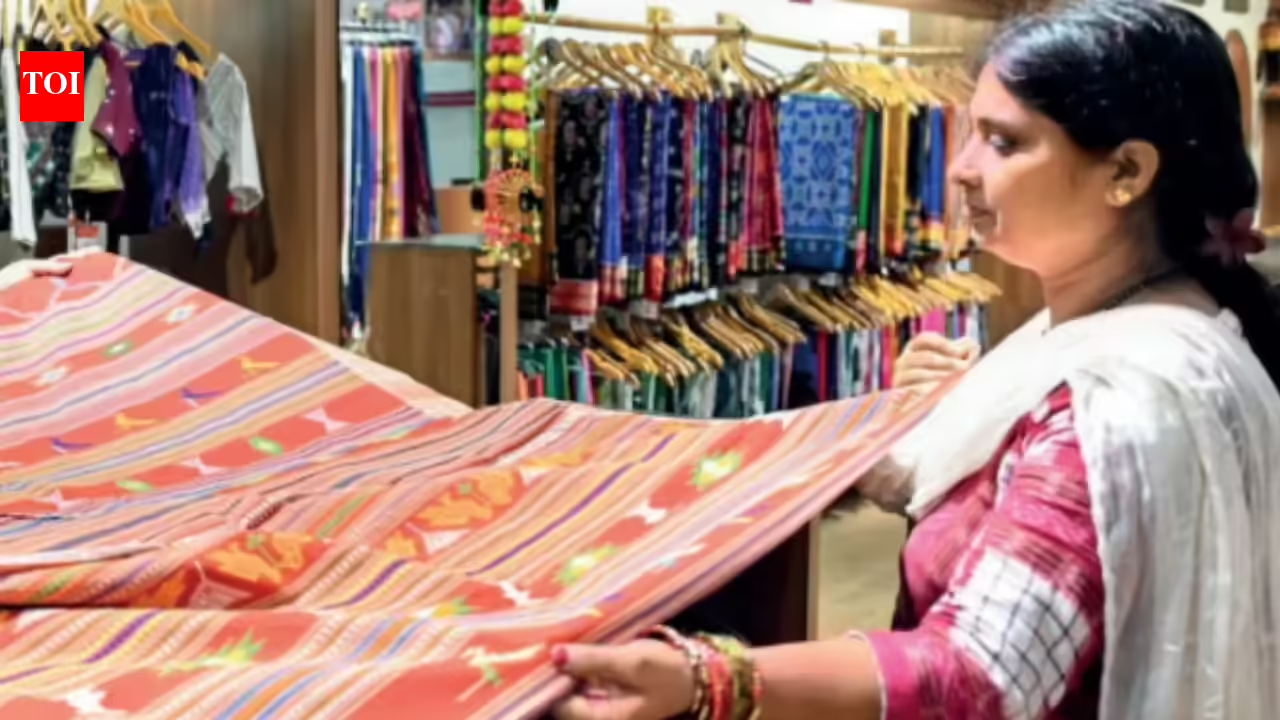
The original Bomkai saree, one of Odisha’s most celebrated textile traditions & a GI-tagged craft, is nearing extinction in Ganjam, its birthplace, where only two weaving families continue to practise the weaving tradition. TOI examines the causes behind it & the steps being taken by the govt to revive the tradition. In the quiet village of Bomkai in Ganjam district, the rhythmic clatter of looms has nearly faded into silence. Once home to a thriving weaving tradition that travelled to other parts of the state and national fashion ramps, the village today has only two weavers Keshab Nayak and Sushanta Kumar Nayak still preserving the original Bomkai saree, a heritage now hanging by a thread.Ironically, the Bomkai saree, celebrated across Odisha and beyond, is today more widely recognised as ‘Sonepuri Bomkai’ because it is predominantly woven in Sonepur (or Subarnapur) district of western Odisha by Bhulia community weavers using modified designs in both cotton and silk. The original Ganjam Bomkai, however, remains distinct for its coarse cotton texture, vivid colours, geometrical motifs and intricate extra-weft work on the anchal or pallu. Its signature phoda kumbha (temple spire) borders are characteristic of traditional Ganjam weaves.Bomkai is among the nine textiles from Odisha to have received the Geographical Indication (GI) tag. Yet, in the village where the weave originated, the tradition is on the verge of disappearing.“What makes the original Bomkai unique is that there is no fixed layout for the anchal panels created through extra wefts in various colours. No two sarees look the same,” said Keshab, who is in his late-70s. The motifs, inspired by nature, are Kanthiphula, Atasi flower, bitter gourd flower, flies, birds, peacock, fish, lotus and Damru (Maclura cochinchinensis), among others, are all rendered in geometrical forms.“The coarse cotton and the geometrical motifs are also the reason why Ganjam Bomkai is often confused with Koraput’s Kotpad,” he said. For Keshab, weaving is no longer just a livelihood but a way of holding on to memory and legacy. Despite failing eyesight and the personal loss of his son last year, he continues to sit at the loom every day, assisted by his wife and daughter-in-law.Recalling a bygone era, second-generation weaver Sushanta said there were 50 to 60 weavers in the village five decades ago, including his father Chaitanya Nayak. What, then, pushed the tradition to the brink? The reasons are many, he said, with the primary ones being a lack of interest among the younger generation and the immense labour and time the craft demands.Woven in pit looms, original Bomkai is a labour-intensive weave. A minimum of three people is required to weave the saree from scratch, from preparing the cotton yarn to weaving designs onto it. “Every stage of the weave, be it starching the yarn, preparing the loom, setting the design or weaving, requires a lot of patience, labour and time. The younger generation did not want to continue with such demanding work, especially when the earnings were low,” added Sushanta. Over the years, children from weaving families chose other professions and never learnt the technique. “That is how the number of weavers in Bomkai village gradually declined until only two families remained,” said Sushanta, who is in his mid-40s.The collapse of the village cooperative society around two decades ago dealt another major blow to the weaving community. The society once supplied raw materials and handled marketing and sales of the sarees, but it eventually shut down amid allegations of corruption and was never revived.Located close to the Andhra Pradesh border in Chikiti tehsil, Bomkai village now depends largely on Andhra Pradesh for cotton, dyes and even dyed yarn. “Earlier, colours were extracted naturally, but that practice has disappeared over time,” said Sushanta who is helped by his wife Soudamini and daughter Tapaswini Nayak. Lack of govt patronage and rising prices of cotton and dyes have added to their struggles.Today, depending on the complexity of the design, the weavers’ families make anywhere between Rs 12,000 to Rs 15,000 per saree.“There is demand for the original Bomkai saree because of its beauty and uniqueness, but where are the weavers to meet that demand?” asked Sapna, Keshab’s daughter-in-law, who learnt the weaving technique from her husband Prashant Nayak. “Despite global admiration for the craft, the original weaving tradition in its birthplace has nearly vanished because the income is not encouraging enough to sustain the painstaking process,” she said.Researcher Anita Sabat said the weave now faces yet another threat of cheap imitations. The market, she said, is flooded with machine-made printed sarees replicating Bomkai designs, a trend that requires urgent govt intervention.