

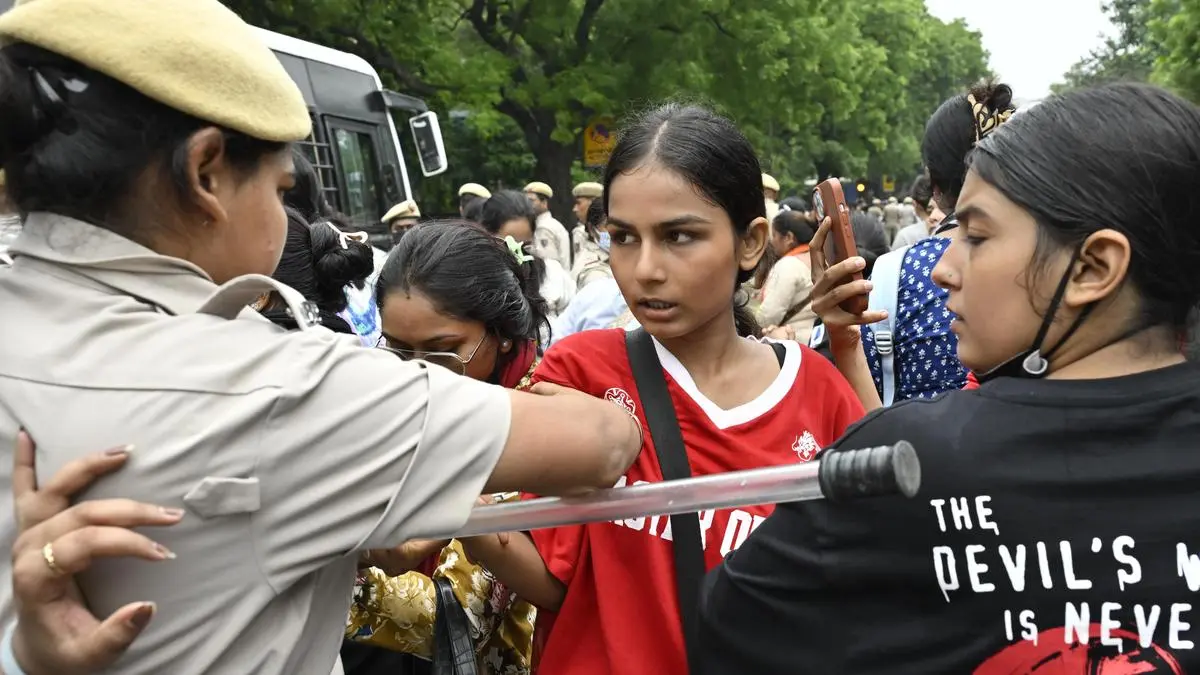
Social media has recently been swarmed with posts in solidarity with Ruchika Singh, a Noida resident accused of using “abusive language” against Prime Minister Narendra Modi at Gen Z’s Jantar Mantar protest. A Zero FIR was registered against her under Bharatiya Nyaya Sanhita (BNS) Sections 352 (intentional insult with intent to provoke breach of peace), 353(1) (statements conducing to public mischief) and 356(1) (defamation). The FIR lists her age as 25. However, she later identified as a 15-year-old minor and made an apology video. Even setting aside the disputed question of her age, what followed after her being named in public was disproportionate by any measure.
The incident exposes three interconnected dynamics. One, state overreach to repress and criminalise dissent. Second, the immunity granted to the IT cell to doxx and threaten young women, demonstrating the gendered and protected nature of violence unleashed by auxiliaries of the state. Posting on X, Cockroach Janta Party (CJP) founder Abhijeet Dipke questioned whether India operates under “two laws”, pointing out that the BJP’s IT Cell accounts that proudly advertise being “followed by PM Modi” have long directed abuse at women with no consequence. Third, the incident points to our collective amnesia. How easily we have forgotten that long before this outrage, dozens of Muslim women were targeted by a relentless, systemic campaign of digital dehumanisation through apps called Sulli Deals and Bulli Bai.
It is also pertinent to point out that Prime Minister Narendra Modi—who has otherwise been silent on the falling rupee, the rising petrol and LPG prices in the aftermath of the West Asia crisis, and the 20+ students who died by suicide after the NEET paper leak—made a late-night Instagram reel and called it “a cultural shock” that “our daughters were using such abusive language”. He added that punishing them or dragging them through court would “not solve the problem”, and that the youth should instead be shown “the right path”. Despite this statement, the hate campaign against Singh did not stop. As per the latest reports, she has been forced to vacate her Noida home and move to a safe place with her family.
A lot has been written about how the project of Hindutva perceives the bodies of women as battlegrounds which need to be protected from invasion by people of other castes and from the figure of the Mohammedan; of the need to protect purity and chastity of their bloodline while ensuring that women continue to be confined to the household and perform child-rearing functions. Even Modi’s phrase “our daughters” rather than young protesters reflects this same gendered anxiety. A young woman stepping outside her home and having a political opinion is undoubtedly a “cultural shock” for the Hindutva brigade.
The IT Cell hounding a young woman is shocking, shameful, and the outrage around it from what seemed to be an otherwise morally dead society was reassuring. However, the witch hunt of women by the IT Cell is not new. Unfortunately, most of our outrage is ahistorical. That needs to change.
Targeting Muslim women
Five years ago, in July 2021, an app named Sulli Deals was created and operationalised with the assistance of GitHub, the world’s largest open-source software repository system. Photographs of more than 80 Muslim women—including students, activists, and journalists—were uploaded to the app without their knowledge or consent. The platform’s founders offered visitors a chance to claim one a sulli, a derogatory term used by right-wing Hindu trolls for Muslim women, and labelled them as “deals of the day”.
Following this, another app called Bulli Bai was created to auction Muslim women, which allowed users to bid for them on the internet. Journalists, activists, and writers were again made explicit targets on this app. With their numbers and images doxxed, many of these women were subjected to vitriol, trolling, harassment, as well as rape and death threats.

The accused identifed as Neeraj Bishnoi, one of the main conspirators in the ‘Bulli Bai’ case, arrives at an airport after being arrested by Delhi Police from Assam, in New Delhi, January 6, 2022.
| Photo Credit:
Arun Sharma/PTI
After it raised widespread outrage, the Delhi Police (Intelligence Fusion and Strategic Operations unit) and Mumbai Police Cyber Cell filed extensive chargesheets and the accused were booked under various sections of the BNS (then Indian Penal Code) and the Information Technology (IT) Act, including sexual harassment and stalking. However, in March 2022, the Patiala House Court in Delhi granted bail to the main creators Aumkareshwar Thakur and Neeraj Bishnoi. The Chief Metropolitan Magistrate Pankaj Sharma observed that they were “first-time offenders”, young in age, and since chargesheets were already submitted, prolonged incarceration before trial would be “detrimental to their wellbeing”. Subsequently, the Mumbai City Civil and Sessions Court granted bail to Aumkareshwar Thakur, Neeraj Bishnoi, Neeraj Singh, Shweta Singh, Mayank Rawat, and Vishal Kumar Jha in the parallel cases registered by Mumbai Police. As of today, all the accused are out on bail while the women they targeted continue to face the harassment and trauma they unleashed.
The targeting of Singh by the IT Cell is therefore not a new phenomenon. For years, this ecosystem has targeted Muslim, Dalit, and Adivasi women critical of the state. Why does society forget certain incidents while remembering others?
Selective memory and outrage
In his seminal work on memory, the French sociologist Maurice Halbwachs argues that human memory functions only within a collective context, and collective memory therefore is always selective. Different groups have different collective memories, which produce different modes of behaviour. As a consequence, one form of memory is often pedestalised over another.
Michael Pollak, another French scholar, develops the idea further. He invokes Pierre Bourdieu’s concept of symbolic violence to reframe collective memory as something that can be imposed. Power structures, according to him, enforce an “official memory” that sanitises or forgets state-backed violence while marginalised groups make for “subterranean memories” that society chooses to ignore until the next outrage takes place. Therefore, official/dominant memory is not just “what most people happen to remember together”, it is rather actively produced and enforced by those who have the power to define what counts as legitimate memory, while other accounts of outrage are pushed into silence or forgetting. Thus, it is power structures (both invisible and visible) that determine whose harassment will be narrated and whose grief will be remembered.
This article should not be read as a form of whataboutery. Whataboutery is used as a tool to dismiss the other side. In this instance, both incidents where women were targeted are categorically wrong. Both deserve public condemnation, but one incident has drawn more widespread flak than the other, and that tells us a lot about how society responds to crimes based on the identity of the victims.
This selective outrage must be flagged. The mobilisation of outrage only when the victim fits a specific acceptable profile while maintaining silence over the systemic digital violence faced by marginalised women in the present or past is what makes the IT Cell and its ideologues stronger.
Equally important is the state’s selective memory about violence directed against women. While the Prime Minister has gone on air to express his grief over being abused at Jantar Mantar and to lament young women using cuss words, he has never once acknowledged, condemned, or expressed remorse over the sustained abuse and harassment of women by members of his party’s IT Cell, which continues unabated. The state responded to the Jantar Mantar protest by issuing takedown orders to social media companies, by threatening action against the display of satirical posters, by hunting down mocking posts that take the government down a peg. But when it comes to the very real physical and mental danger faced by women who are doxxed by state-sanctioned actors, the state is silent. The perpetrators of the Sulli Deal and Bulli Bai crimes are still at large, as is the handle that doxxed Singh.
Harsh Mamnani is an independent researcher and reporter based in Delhi.
Also Read | Hate speech gets a new safe zone
Also Read | The alarming reality of government censorship on online platforms in India